A team of scientists led by Christopher Chitambar and Kathleen Schminda in preclinical trials
Scientists say that numerous studiesstudies of the relationship between iron and cancer show that high levels of iron in the body lead to increased risk and severe disease. Researchers believe this is due to cancer cells using Fe(III) iron to multiply and spread.
Gallium maltolate - oral formmetallic gallium. This substance is similar to Fe (III) iron. Cancer cells, "entangled" by the similarity of substances, absorb gallium instead of the usual iron, which leads to the cessation of reproduction and death of such cells.
“Evidence in preclinical studiesThe efficacy of gallium maltolate against glioblastoma is extremely interesting. It opens up the possibility of using this substance in the treatment of glioblastoma in patients,” says Christopher Chitambar.
The scientists emphasize that gallium maltolate may also be effective in treating other solid tumors. Researchers are currently recruiting participants for clinical trials of the drug.
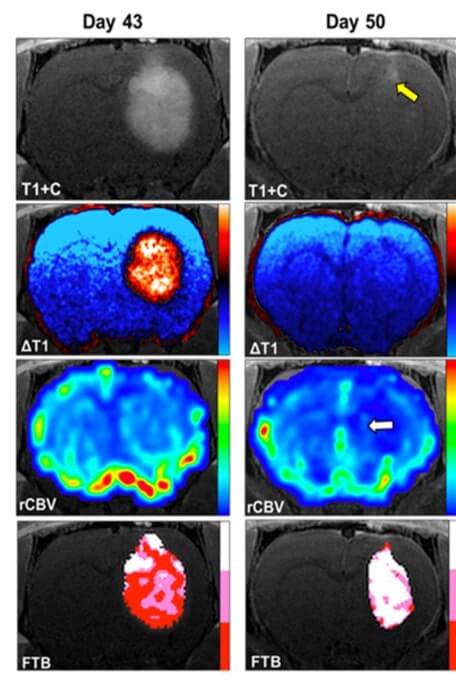 MRI with contrast shows a 93% tumor reduction in the rat. Source: The Medical College of Wisconsin, Imaging Biometrics
Glioblastoma is a rare and aggressive form of cancerbrain This is the most common type of primary brain tumor in adults. As the scientists note, despite decades of research, little progress has been made in prolonging or improving the quality of life of patients with glioblastoma. Treatment options are limited and usually involve a combination of surgery, radiation therapy and chemotherapy.
Read more:
There is another “planet” inside the Earth: how it saved nascent life
New study refutes light energy transfer theory
Everything you knew about the tyrannosaurus is not true: how science is changing its Hollywood image