A quasar that is powered by a giant black hole can even be seen with a regular telescope - scientists
What happened?
An Australian team of astronomers has found a black hole:it is 500 times larger than the one at the center of the Milky Way. Based on this find, scientists will find out how galaxies, in particular ours, developed and formed.
Now, an international team of researchers has said that this supermassive black hole is devouring a volume of matter equal to one Earth every second.
It is the brightest and fastest growing supermassive black hole that scientists have ever found.
People have been looking for such objects since the 1960s, saidlead author Christopher Onken, an astronomer at the Australian National University. And somehow this black hole could not be found for a long time.
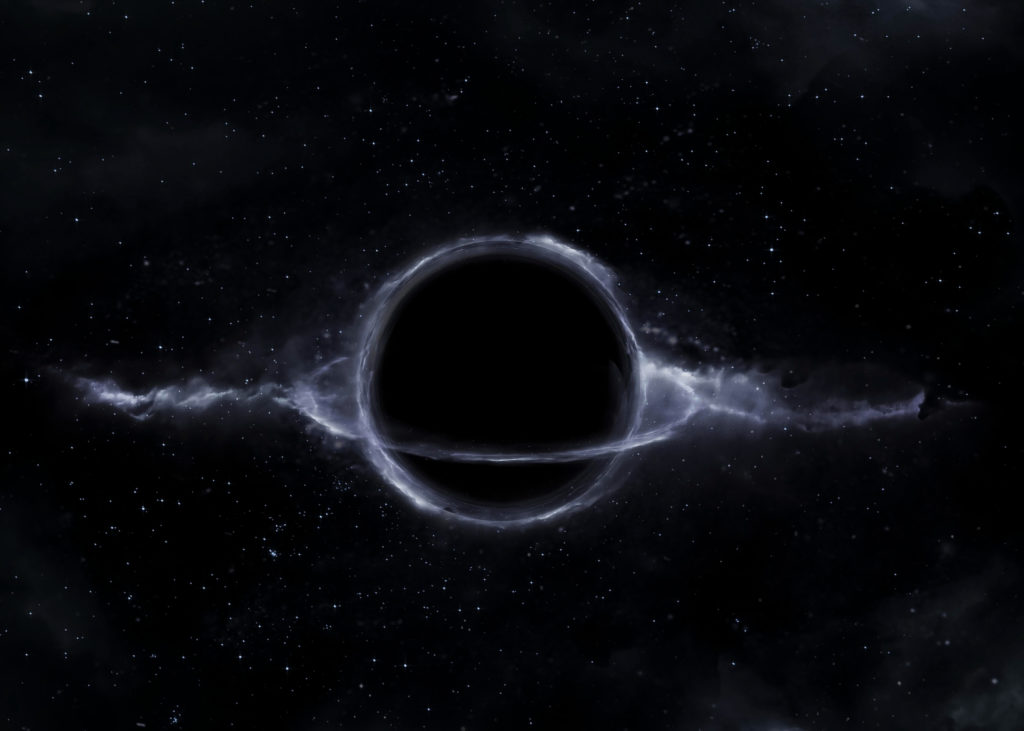
How was a black hole found?
A team of researchers found a black hole whenshe was looking for pairs of double stars—objects that orbit the same center of mass. They used the SkyMapper telescope, which is located in New South Wales.
Adrian Lucy, a graduate student at Columbia University in New York, found about 200 putative double stars, but there was something strange among them, according to Onken.
“One of the objects turned out to be something very different from binary stars,” Onken said.
To get a closer look at the strange object, the team used a 1.9-meter telescope at the South African Astronomical Observatory in Cape Town.
So they were able to see the different wavelengths of light that come from the object. It was named SMSS J114447.77-430859.3, or J1144 for short.
These waves or bright lines of light indicate that there is a rapid movement of gas going on there. This means that the object is powered by a supermassive black hole.
What do we know about this huge black hole?
Supermassive black holes, which have a mass of millions or billions of suns, are the "motors" that power some of the brightest objects in the sky - quasars.
From Earth, these luminous objects look a little likestars. But their light actually comes from a ring of gas, dust and stars orbiting the black hole—collectively called the accretion disk.
When a black hole sucks dust and gas into itself due to gravity, this material becomes very hot and begins to glow.
“You can say that the gas flows down into thepancake shape, and this material is then heated by friction,” said Dr. Onken. Material moves faster and faster as it approaches the event horizon, a black hole is a point from which not even light can escape. In the end, all the matter falls into the black hole beyond the event horizon - due to this, its mass grows.
It is this luminous, fast-moving gasthe vortex helped Onken and his team to measure the mass of a supermassive black hole - it amounted to about 3 billion suns. For example, the black hole at the center of our galaxy has a mass of about 4 million suns.
Even though J1144 was weaker than the othersquasars discovered over the past 60 years, it was much further away and brighter than other objects of a similar age. The team also compared the luminosity of J1144 over the past 45 years to see what it was like in earlier observations.
It turned out that the giant quasar remained consistently bright for a long time. This means that its black hole was constantly absorbing gas and everything else that came across it in its path.
Michael Cowley, an astrophysicist at the Queensland University of Technology, said that if a supermassive black hole is so large, then it must be connected to a huge galaxy.
You can even look at a quasar with a conventional telescope. We tell you how
The light from this quasar is 7,000 times brighter, light,coming from the Milky Way. This means that the quasar can be seen using a suitable telescope. According to Onken, this requires a telescope with a diameter of 30-40 cm and a camera that takes pictures with a long exposure.
J1144 is in the sky northwest of the Southern Cross, glowing in the constellation Centaurus.
Why study a new supermassive black hole?
According to Dr. Cowley, this is a rare find,which can provide information about the formation and evolution of galaxies. This is because the properties of a supermassive black hole and its host galaxy are interrelated. By studying black holes, we can understand the structure of the galaxy and vice versa.
J1144 is located outside the Milky Way, but not far from it, so this object can be used to study how gas moves in and out of our galaxy.
Now Onken and his team want to understand howsuch a huge supermassive black hole was formed. It is not yet known whether it grew gradually or whether a major galaxy collision occurred, which generated a lot of gas and sharply increased its volume.
Read more:
All tumors are gone: a new cancer drug works without chemotherapy and surgery
AI chip upgrades phones and laptops: no need to buy new devices anymore
The origin of the Black Death is revealed. DNA research led to Central Asia