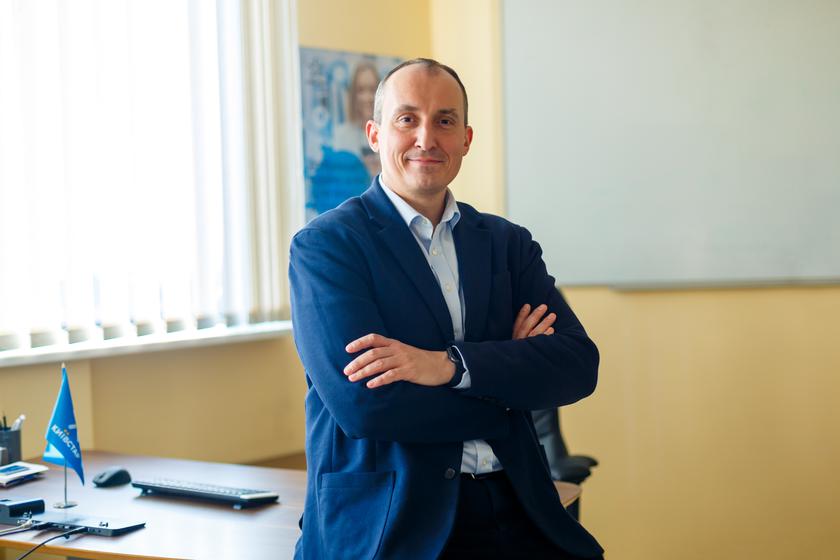
Interview with Ilya Polshakov, Kyivstar Business Development Director
Ukrainian
Already not just an operator
gg:What areas do you consider promising for development?
Ukrainian telecom begins to follow the pathlarge global operators. The world is undergoing a transition from a purely telecom service provider model to a service provider for b2b clients, where communication is only one aspect. To be successful in this, you need to understand well what large corporate clients and representatives of small and medium-sized businesses (hereinafter referred to as SMEs - editor's note) need, and see where we, as an operator, can help, and where we need to attract partners and develop the area together.
At Kyivstar I am responsible for three major areas.The first is Big Data and analytical services, including analytical services for internal business tasks of Kyivstar. The second is mobile financial services (hereinafter referred to as MFS - editor's note). The third is the ICT direction (information and communication technologies, that is, essentially, IT and communications - editor's note). This includes cloud computing and the Internet of Things.
Thanks to Big Data analytics, we were able to tell120,000 users about the ability to pay for Kyiv Smart Card from a mobile account. People learned that they can skip the queue and also get 20% cashback
These blocks have already been built and are actively developing, andthanks to convergence with mobile communications technologies, they provide innovative services to customers. For example, with the help of financial services and Big Data, our b2b-clients can carry out targeted communication of our b2b-clients with their final audience.
gg:Can you give an example?
We are currently developing an SMS-payment service for travel infive cities of Ukraine. In Kyiv, we focus on those clients who actively use public transport and do not yet know that the Kyiv Smart Card can be topped up from their mobile phone balance. Big Data helps a lot here. We see the client's profile and understand his behavior. Thanks to targeted communication, we were able to reach more than 120,000 users in a month. People learned that they can avoid standing in line at the ticket office or at a terminal that may not yet work, but pay for a ticket from a mobile account and receive a 20% cashback. For a person who drives every day, this is a great value. Convenient and profitable. Financial benefits encourage users to try a new service. But convenience is much more important here, thanks to which subscribers continue to use the service.
Now I see other promising areasfor telecom operator. They will soon appear in our portfolio. These are cybersecurity or manage security services that complement a complete business solution.
gg:So now, as a company, are you more focused on new services for b2b users?
These services can give a big boost andcorporate clients and SMEs. We create value for them so that they provide their services to users, that is, create value for the market. All new directions contribute to the development of our clients.
Any large b2b client always operatesconcepts of benefits for the business, what it will give - revenue growth or greater operational efficiency. They look to us as a partner to help them become more competitive. Cloud computing allows you to optimize your infrastructure, become more flexible, gain expertise in data storage, etc. But just the cloud is half the battle. The client will become more efficient, but will not earn more. If he reaches out to customers in a targeted way and gets more sales using Big Data, then this is truly valuable.
</ img>
Big Data in Ukrainian: who is willing to pay for analytics
gg:Tell us about Big Data direction: how long have you been doing this, how many clients are you developing?
We began to actively develop Big Data for b2b clients about a year ago.
Our product is our own developmentopen technologies. There are many big players in the clouds - Amazon, Google, Microsoft, they have many of their own analytics tools. And here it is important for a business to understand whether it only needs a cloud or something else? Can he implement everything himself or do he need help? We offer the client different services. This includes consulting if the client does not know how to build a DMP platform (Data Management Platform - editor's note) or how to communicate with the client base. Retailers and banks are mainly interested in this product. The same credit scoring allows banks to reduce risks, increase their portfolio with an audience that has not previously used banking services, and earn more through fewer reserves and losses.
Over 470 were sold over the past yearprojects. This direction is growing in money by 320% from year to year. The number of repeat orders is growing. We created Business Data Solution, a subscription solution for those who use analytics. The consumption profile is growing. More requests for newer products come. We will develop and launch them in the next few months.
gg:How does scoring of a mobile operator work? What are you looking at?
Our model takes into account many nuances, but inthese are mainly behavioral factors. There are things that are related to scoring, but there is an antifraud service that shows the bank that the client’s behavior has changed a lot and looks like fraud, that is, fraud. For example, a subscriber often changes SIM cards or makes specific switching groups or newsletters, which are more like fraudulent ones. That is, the trigger is any atypical behavior. Thus, the Bank understands that the subscriber is in a more risky zone.
Consumption profile is, for example, how oftendoes the user travel abroad, does he spend a lot on mobile communications, etc. This information is not directly transmitted to the bank; it only sees the overall scoring score. This is more of a look-alike model, meaning this client looks like a client who spends a lot and travels frequently.
We also see what phone is usedthe client changes how often, and this opens up opportunities for new services. If, say, he buys a new iPhone every year, then we, as an analytics provider, can give a trigger to a partner from whom the person previously took an installment plan for the phone. By the time the new model is released, he will be able to make a profitable offer to the client. Trigger analysis is deep, it allows you to understand that this is your historical behavior.
gg:Now many are afraid that services and providersservices are somehow wrong with their personal data. Or, let's say that the operator spies on each specific Vasya Pupkin. What user information do you pass on to customers?
If you change the card every 10 minutes, thistrigger. I can tell the partner bank that the behavior profile has changed, but he does not know what you did and how. If we are talking about targeted mailing, banks and retail do not receive a customer base, they get the opportunity to do a newsletter on the base to which Kyivstar prepaid subscribers subscribed. Only prepaid.
Why Kyivstar financial services
gg:Why do you need payments as an operator? Do you believe that in Ukraine there is an audience for this service?
Mobile financial services allow for greaterdegree to answer questions about what purchases might be of interest to you. The phone does not allow you to pay for as many services as a regular card, but it does allow you to make micropayments. By understanding what the transaction is about, you can make more personalized offers. We are waiting for the implementation of the PSD2 directive (the second EU payment directive, which will expand opportunities for the development of fintech services – editor's note), which means the adoption of the principles of open banking. This will allow us not only to expand services for payment from a mobile balance, but also to turn into a financial company (almost a bank), which will make it possible to pay from a personal payment account, including using a payment card, as well as transfer funds or take out a loan. This way we will become closer to the client and provide an expanded range of services.
gg:In Ukraine, do banks consider themselves fintech themselves and are probably not happy about the new competitor?
We are not competitors to banks.They have their own customer segments, their own services. MFS is a market segment that banks are not interested in. These are microtransactions – mass payments with a small check, up to several hundred hryvnia.
Mobile financial services help growcustomer loyalty because we give them simplicity and convenience. In addition to payments in transport, there are many other services on which we can earn money as partners
gg:You also do not earn on payments in transport?
The question is not in earnings, but in the transformation of telecomthe industry with which we started a conversation. IFS helps build customer loyalty, as we give them simplicity and convenience. In addition to payments in transport, there are many other services on which we can earn as partners. Microcredit, for example. Or projects like Tap to Phone, where, using our technology and NFC, entrepreneurs will be able to accept payments directly to their smartphones. We can launch such a service when the NBU adopts the PSD2 directive in Ukraine. Here on such operations we will be able to receive income. But still, for us, mobile payments are primarily about customer loyalty and involvement.
gg:It seems that a couple of years ago you already had a pilot project for accepting payments for SMEs using QR codes. What is his fate?
This was not a pilot, but a testing of technologyQR payments. Tap to Phone is different. The technology makes it possible to implement universal means of accepting non-cash payments. QR is one type and can reduce the cost of payment for the merchant. But, firstly, it is not widespread. Secondly, contactless payment is simply more convenient in terms of customer experience. But we will also develop QR technology. You need to have a range of services so that the client can choose what he needs and is convenient. Nowadays NFC prevails in our market.
gg:As far as I know, payment acceptance technology can work on a limited number of flagship devices, which is expensive for a small business.
A POS terminal is also very expensive.The terminal itself costs about $300, in addition to this you also need to regularly pay a commission and a subscription fee. Yes, this expands the audience of buyers, but the merchant eats up his income. Therefore, for micropayments somewhere in coffee shops and other small establishments with a small average receipt, a POS terminal is not profitable. Tap to Phone will make non-cash payments available where previously it was impossible for economic reasons.
As for smartphones, there really is a problemwe are working on it. If we want to bring Soft POS technology to the masses, it must be affordable. The question now is which low-cost devices it can run on so that transaction security can be guaranteed.
Who should pay for a smart city and why in Ukraine this is still not
gg:Back to the topic Kyiv Smart Card. How interesting are you in principle for the direction of a smart city?
A smart city is not a specific application.This is the development of infrastructure of services that lead to an increase in the quality of life. Applications are an aggregation of specific services that are already available. We are still far from this.
</ img>
Let's take housing and communal services, for example.Smart meters are great. They solve the problem of operational monitoring and control of coolant flow. And who needs it: OSBB, the owner or the end user? Who should pay for this? First, we need a clear position of the state, city, housing management and the end consumer who pays the tariff, what will happen to the tariff if a smart component is introduced - will the tariff increase because investments need to be recaptured, or will it decrease because losses will be reduced?
The value of smart housing and communal services infrastructure is that itallows you to effectively manage energy costs and receive services that will optimize costs. It is also support, a guarantee that you will not be left alone with the problem. We have just begun to move in this direction, while Europe and other developed countries have made good progress in it. Digitalization and management using Big Data takes place there. On our agenda are worn-out utility systems. Modern systems reduce losses, which allows you to save money and reinvest in new technologies. But each stage of implementation must be analyzed from a commercial point of view; any investment is justified by commercial success.
Kyivstar, by the way, has pilot projects in the NB-IoT network. But the question is not about pilots and prototypes, but how much time will be spent on market formation and implementation.
gg:And who, in your opinion, should pay for such projects? The consumer will definitely not want to.
More like a provider, their job is to create a service forconsumer. But there are two nuances. The first is the ability to disconnect defaulters. In Europe it is, but here we are not. Technically it's easy. But there is no legislative mechanism and understanding that you cannot exist at the expense of others. People realize that they can be left without the Internet if they don’t pay, but they are not ready to treat housing and communal services the same way. Each house may have many defaulters; existing tariffs include the coverage of these debts. But not a single integrator, operator, or service provider can do anything about it.
Pilot projects in several cities showthe efficiency of installing smart meters, but there are two nuances - in Ukraine it is still impossible to turn off non-payers and users have no financial motivation to be energy-efficient and punctual in payment
The second point is the tariff.In theory, those who use energy-efficient technologies have invested money in it and can count on some benefits. If someone doesn't use it much or pays regularly, they should have some kind of bonus. For example, the opportunity to pay a year in advance and get a discount. But we don’t have this opportunity either.
Pilot projects in several cities showefficiency. But for our partners, the question is how to bring this into a business case. The market should emerge through the position of the state, city administrations who wish to increase transparency as part of the initiative of smart cities, when we want to measure, control, and manage the final result.
gg:But will it all pay off in the end?
We see from the example of b2b clients that IoTallows you to significantly increase efficiency. Large companies that are managed by the owners look at IoT solutions, clouds, data analytics, smart devices that allow you to manage vehicles, carry out smarter video surveillance, etc. The world is definitely moving towards automation. Many if they have not implemented this, then think about it.
A new big one is emerging in the world and in Ukraine.area - peripheral computing, edge computing. This is when a smart video camera itself does preprocessing and calculations on the spot. It does not need to upload a large amount of data to the cloud or to a data center; the system produces the result. This could be searching for people, monitoring the situation, for example, no one should appear in a room without special clothing or be in a certain area. The camera itself can analyze whether it needs to sound an alarm or not. This allows you to increase the level of safety at sites, reduce the number of incidents that lead to production shutdowns and large losses for the company.
Ukrainian business still has no IoT budget
gg:Who are your competitors in the IoT market?
Here we are talking about a comprehensive solution forspecific task. That is, this is not about telecom operators in their pure form, but about everyone who can provide such solutions. We have our own data analytics, we work with companies that know how to develop smart cameras, technologies integrate with each other.
gg:Do you have your own IoT platform, like your competitor in the telecom market?
Every large company has its ownIT infrastructure. It can be built on the clouds, or maybe in its own local data centers. Our task – offer a turnkey solution. If the company is already using some technologies, we can provide a professional service and offer a ready-made solution or approach to developing models, this could be a subscription service every month for the service. The client may say that he does not need a subscription service; he can buy a comprehensive solution. It all depends on how the client’s infrastructure is structured.
A new big one is emerging in the world and in Ukraine.area - peripheral computing, edge computing. This is when a smart video camera itself does preprocessing and calculations on the spot. She does not need to upload a large amount of data to the cloud or to a data center
Here edge computing is precisely connected with the fact thatthe camera requires a lot of bandwidth. It is illogical to connect it with the cloud; it is not effective. Therefore, there are calculations in the camera itself, there is the Azure Stack platform, which is close to the customer’s object, and there is an Azure cloud. The camera communicates with Azure Stack, all calculations are done in Ukraine. This means low latency, etc.
gg:Do you offer a cloud in your data centers or sell someone else’s product?
In this case, we are a strategic partner.Microsoft Microsoft has hybrid technologies that can solve the problems of large companies, banks, etc., and transfer some of the calculations to the territory of the country. You can get a part of Azure technologies in your data center, in Kyivstar data center.
The cloud has many PaaS and SaaS (“platform asservice" and "software as a service", that is, the user does not need to have it all on his computer, it is in the cloud, like Office 365, for example - approx. editors). The same Office 365. Any cloud is elasticity. For retail, for example, this is a fairy tale. Black Friday means sales increase 10 times; the rest of the time you don’t need as many resources.
Building and maintaining a data center is a challenge.not telecom. Our business is to solve the client's problem, provide Paas and SaaS. But in Ukraine we are building data centers that will help the development of those convergent solutions that I spoke about. These are IoT, edge computing, elements of cloud computing.
gg:In what areas is IoT used most in Ukraine?
IDC has analytics on the ICT market in Ukraine in2018. No one is measuring the Internet of Things separately yet. ICT and communication services are also included, but this is a few percent. So, in 2018, the market volume in money amounted to 1.1 billion, of which half was spent by the state. This is the purchase of servers, licenses, services. Potentially spend a lot on ICT:
- power engineering
- heavy industry
- infrastructure (data transfer)
- banks and financial organizations.
Other industries are no less interesting, but suchthey have no capital investments. It is clear that agro, pharmaceuticals, etc. are interested in this, but the question is how they will develop in the future, and whether they will have a sufficient percentage of margin for capital investments in new technologies.
gg:The most active industries in the implementation of IoT and Big Data coincide? Or does someone need one, someone else?
Big Data is of interest primarily to banks, retail,financial institutions – this is more than half of the orders. Energy companies use big data to alert about accidents, leaks, etc. But this is not as frequent as promotions from retailers, etc. The latter have a higher frequency.
Working with the state is one of the areas of Big Data that is developing in the world and which we would like to see in Ukraine.
Now there is a lot of unrealized potential in the tourism sector. Operators have a wealth of information about where subscribers go
gg:If we talk about the state, then what kind of services does it have a request for?
It's difficult to comment.If the tender – then the request is through a tender. This is all quite transparent. But it seems to me that now there is a lot of unrealized potential in the tourism sector. Operators have information about where subscribers travel. We have Big Data services for tourism development. This includes the development of cities, roads, tourist spots, etc. The population should know where to go on vacation. But first – there must be a road along which you can get to this place. The development of local tourism is a promising story for the country.
gg:And something has changed on the part of the state in recent years, has there been an interest in technology?
For example, there was a census recently. We helped in data modeling and behavior.
</ img>
gg:Now on the Internet a lot is ridiculed that many have several SIM-cards per family, so the census is incorrect. Tell us, how was it?
There is such a concept – heatmap – WhenThe map shows how many subscribers and devices are concentrated in one place and how they move. If three statements overlap this information, all duplicates are eliminated. With high-quality data analytics, the error is exactly what was stated – statistical. I think these numbers can be trusted.
gg:Participation in the census did not pay you? What did it cost the company?
The working hours of my staff. It was a non-profit project.
gg:Here's how. In general, in your opinion,Gready to pay for analytics?
We are not a charitable organization. We hope that the state will be interested in commercial projects.