The Tibetan Plateau, known as the "water tower" of Asia, supplies nearly 2 billion
“The prognosis is unfavorable,” noted MichaelMann, professor of atmospheric sciences at the University of Pennsylvania, in a press release accompanying the study. “In a “business as usual” scenario, in which fossil fuel burning does not decline in the coming decades, we project a 100 percent loss of water availability for regions downstream of the Tibetan Plateau. Problems are expected even under a moderate climate policy scenario.”
Despite its importance, the impact of climate change on terrestrial water supplies on the Tibetan Plateau is not well understood, scientists say.
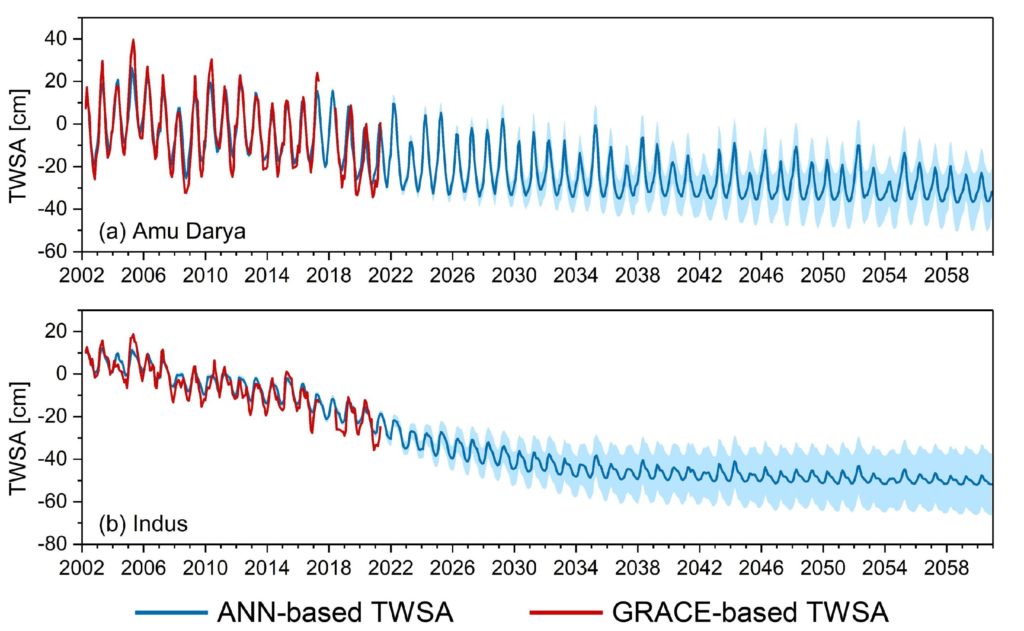 A graph that shows the reduction in water supplies. Source: Penn State, Tsinghua University
To fill knowledge gaps, expertsused measurements of the mass of water in glaciers, lakes and underground springs. They applied machine learning based on neural networks to the data. They were eventually able to link observed changes in total water storage to key climate variables, including air temperature, precipitation, humidity, cloud cover and incoming sunlight. After training the model, climate scientists predicted changes in freshwater supplies over the next four decades, from 2021 to 2060.
“The Tibetan Plateau provides significantpart of the water needs of nearly 2 billion people, emphasizes Di Long, associate professor of hydrological engineering at Tsinghua University. — Surface water supplies in this region are critical for the population. At the same time, they are greatly affected by climate change.”
Read more:
"James Webb" sent a photo of the collision of two huge galaxies
"Useless" bacteria on Earth will provide life to the colonists of Mars
On the pyramid in China found a portrait of the "king of ancestors". He ruled over 4,000 years ago