Using the Very Large Telescope (VLT), Chinese astronomers examined the nearby blue
Blue compact dwarfs are dwarfgalaxies with low luminosity and low abundance of metals, in which violent outbursts of star formation occur. They are characterized by a compact optical appearance and spectra similar to the H II region due to highly concentrated star formation activity.
The galaxy is at a distance of about 13.4 millionlight years from Earth. NGC 2915 (also known as PGC 26761) is one of the closest objects of this type. The content of neutral atomic hydrogen (HI) in it is very high and extremely common. Moreover, almost all young stellar populations and regions of ionized atomic hydrogen (H II) are located near the center of this galaxy. This is her uniqueness.
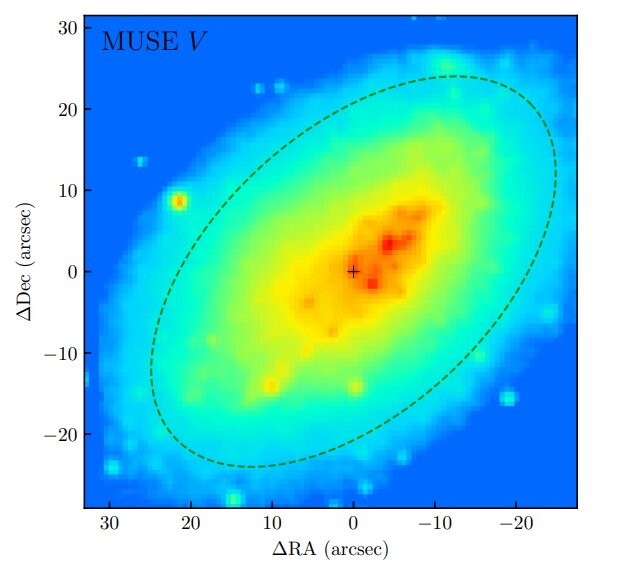 V-band image of NGC 2915. Image Credit & Copyright: Tan et al., 2022
Despite the fact that NGC 2915 is rich in gas,star formation activity in its extended outer disk is difficult to detect and explain. In addition, the mechanism for triggering highly concentrated star formation in this galaxy remains unclear.
Therefore, for further study of the activitystar formation in NGC 2915, a team of astronomers conducted a comprehensive analysis of spectroscopic observations of the deep integral field and the central region of the galaxy. They used the Multi Unit Spectroscopic Explorer (MUSE) on the VLT.
“In order to solve the mystery of NGC 2915, in which star formation does take place, we are conducting a comprehensive analysis of spectroscopic observations,” the researchers write in the article.
It turned out that global star formation ingalaxy peaked about a couple of billion years ago. At the same time, the last episode of the burst of star birth occurred about 50 million years ago. It lasted about 50-100 million years and due to it about 3% of the total stellar mass of the object appeared.
According to the study, episodes of explosivestar formations, like the last one, may have occurred up to four times in different places in the galaxy over the last billion years. But, basically, they are limited to the central region of the galaxy (with a radius of about 1300 light years).
In addition, scientists have found that recent episodes of bursts of star formation were supported by the outer gas of the galaxy.
Read more:
A monster black hole was found in the "backyard" of the Earth: it is very close to our planet
NASA revealed the origin of Haumea - the most mysterious planet in the solar system
Webb photographed the Pillars of Creation. Compare how Hubble shot them before
On the cover: Robert Nemiroff (MTU) & Jerry Bonnell (USRA), NASA Web Site Statements, Warnings, and Disclaimers