The rapid change in ocean currents in the Southern Ocean likely broke one of the largest icebergs in half.
The giant ice mass, named A68a,known as the "table iceberg" due to its rectangular shape. Previously, its size was compared to the state of Delaware. Its area was 6 000 km². In 2017, it famously broke off from another iceberg, A68, dumping 1 trillion tons of meltwater into the ocean over three years. However, scientists didn't know what caused the A68a ice mass to form.
Researchers at Princeton UniversityNew Jersey used satellite imagery and datasets to figure out what happened in December 2020 when the iceberg collapsed twice. They already knew that as the A68a passed South Georgia Island, it began to break apart. At the same time, a large piece broke off as a result of dragging the keel of the iceberg along the seabed. However, the second event baffled experts as it swam in the deep open ocean.
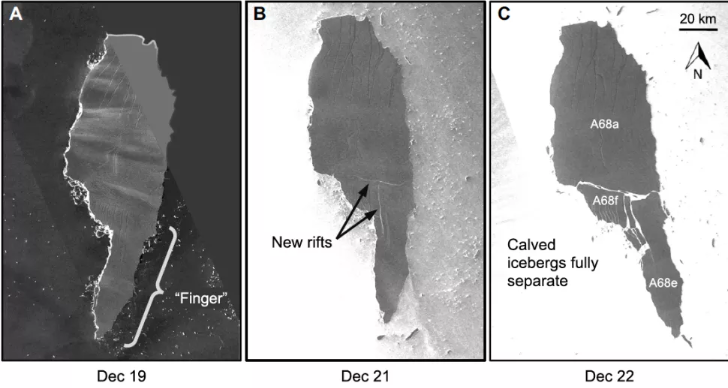 Satellite images show the evolution of iceberg A68a and its two disintegrations in 2020.
Image Credit: Science Advances
Usually icebergs break becausecollide with the seabed, causing parts of it to break off. But this was not the case. It turned out that the second destruction event was caused by shifting ocean currents. This led to the cutting off of part of the iceberg. This had not been reported before.
To test the theory, they calculated howExternal forces, such as ocean currents and wind, can affect the iceberg. By creating a simulation using the Kinematic Iceberg Dynamics (iKID) model, the scientists found that when an iceberg is caught in a very strong current versus another very weak one, the bonds between the ice particles are broken. In fact, glaciologists have modeled the actual fracture of the ice mass.
</ p>