In a new study, researchers examined the effects of walking in nature on the amygdala. It's small
Previous studies have shown thatThe amygdala is less activated during times of stress in rural residents compared to city residents. However, this does not mean that living in rural areas itself causes this effect. Perhaps it's the other way around, and people who naturally have this trait are more likely to live in the countryside.
To study this issue, the Institute's staffhuman development named after. Max Planck conducted a study using functional magnetic resonance imaging (fMRI). Let us recall that fMRI allows us to determine the activation of a certain area of the brain during its normal functioning under the influence of various physical factors (for example, body movement) and under various pathological conditions.
Using 63 healthy adult volunteers,The researchers asked subjects to fill out questionnaires, complete a working memory task, and undergo fMRI scans while answering questions designed to induce social stress. Participants were told that the experiment involved an MRI and a walk, but they did not know the purpose of the study.
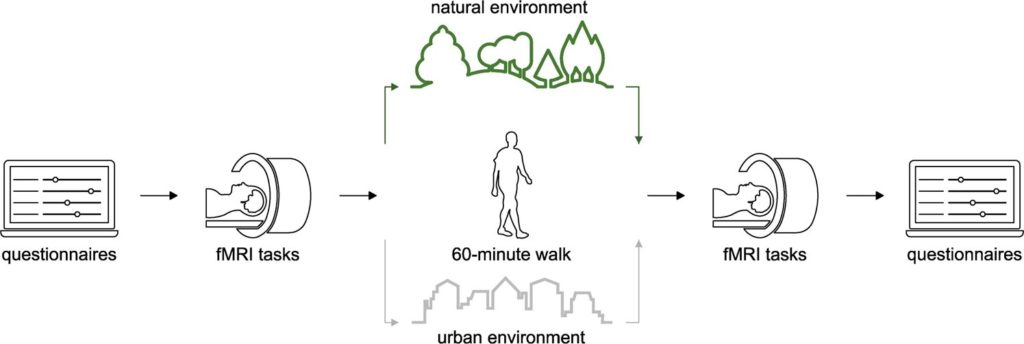 Block diagram of the research procedure. Illustration: Nature
Subjects were then randomly assignedtake an hour-long walk in either an urban setting (Berlin's bustling shopping district) or a natural setting (Berlin's 3,000-hectare Grunewald Forest).
The researchers asked the subjects to takealong a specific route in any place, without going off course and without using mobile phones along the way. After the walk, each participant underwent another fMRI scan and an additional stress-inducing task and completed another questionnaire.
fMRI scan showed decreased activityamygdala after a walk in the forest. This supports the theory that nature produces positive effects in areas of the brain associated with stress. And, apparently, this can happen in just 60 minutes.
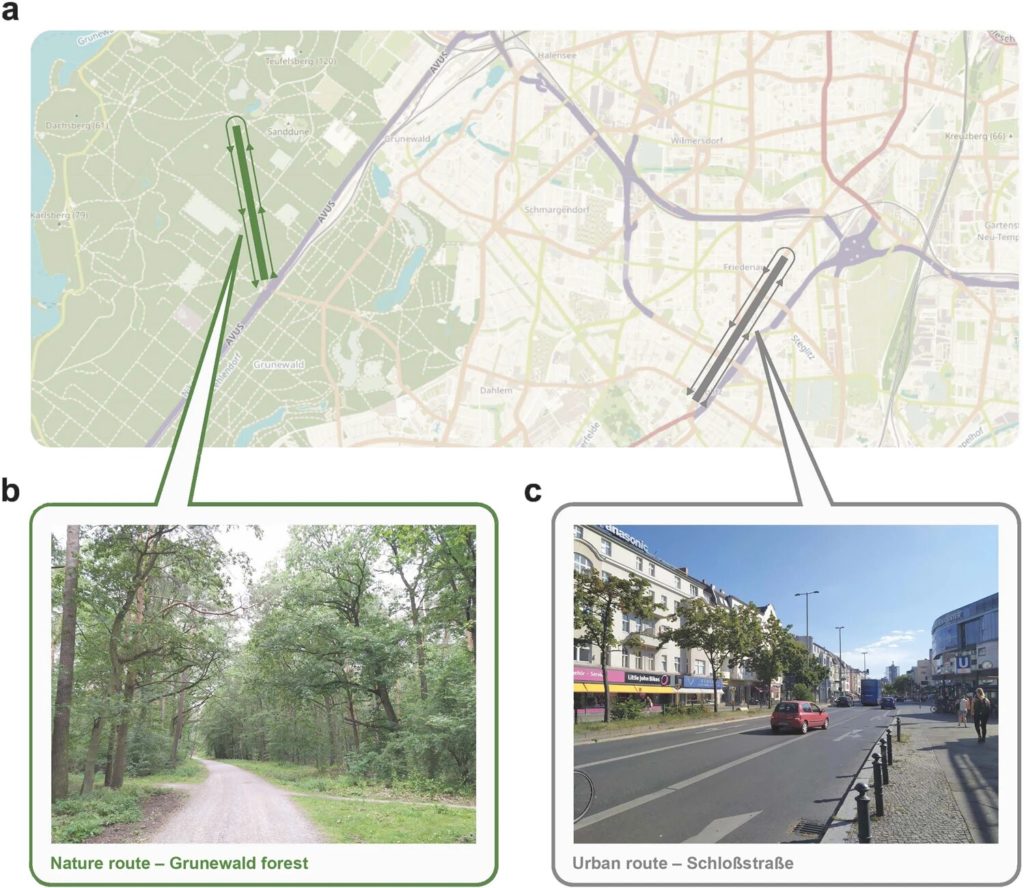 A. GPS data of two participants during a walk in a natural environment (Berlin, Grünwald) and in an urban environment (Berlin, Schlossstrasse), displayed on an OpenStreetMap.
b. Photo of a walk in nature.
With. Photograph of a walk in an urban environment.
Photo and illustration: Nature
Participants who walked through the forest alsoreported regaining attention and pleasure from the walk itself, in contrast to those who took walks around the city. This is consistent with the fMRI scan results, as well as with previous studies.
Read more:
It became known which tea destroys protein in the brain
7,000-year-old structure found that is older than the Egyptian pyramids and Stonehenge
Look at the first photos of Mars that Webb took: they are literally dazzling
Cover photo: rawpixel.com