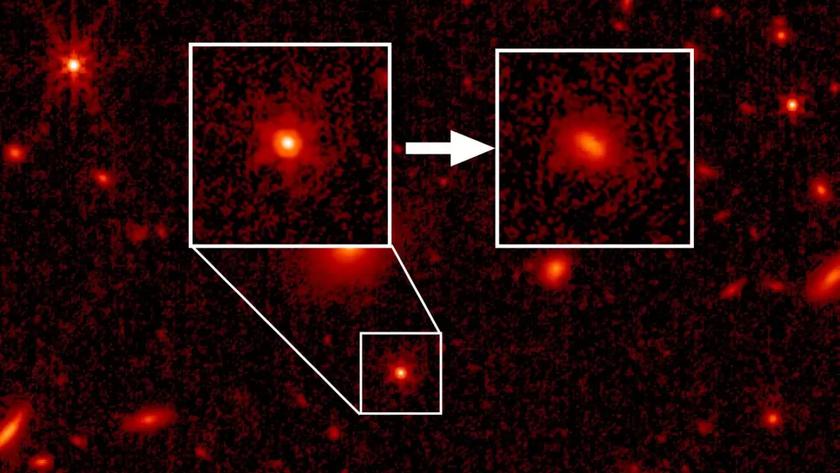
James Webb helped scientists obtain a unique image. Space telescope looks almost 13 billion years into the past
What is known
Previously, astronomers could see stars and galaxies10 billion light years away using the Hubble Space Telescope. The James Webb space observatory made it possible to look at stars in the light of quasars (active black holes) at a distance of 12.8 billion and 12.9 billion light years, when our Universe was 880 and 870 million years old.
The data obtained will allow scientists to continueto study the evolution of galaxies and quasars in the early stages of the development of the Universe. It is very important that James Webb was able to see the light of individual stars against the light of quasars. Thanks to this, scientists will be able to determine the masses of distant galaxies.
In our case, the James Webb lens hitquasars J2236+0032 and J2255+0251. At that point in time, galaxies were 130 billion and 30 billion times more massive than the Sun, and black holes were 1.4 billion and 0.2 billion times more massive than our star.
Now scientists know about the dependence of the mass of a quasarfrom the mass of galaxies, but cannot answer the question of what this is connected with. It is possible that the radiation from black holes influences the activity of star formation. Another version is that holes can grow in proportion to the growth of galaxies during mergers.