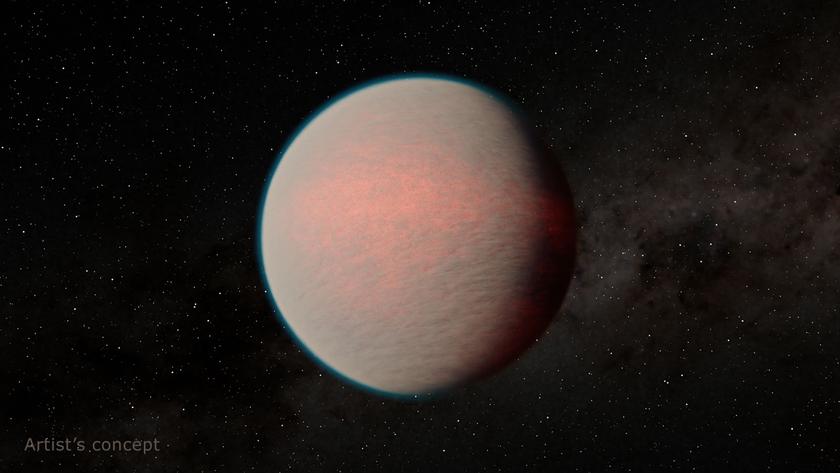
The James Webb Space Telescope continues to help scientists study the Universe. A new study says,
What is known
James Webb sent his tools to studya distant alien world called GJ 1214 b. It is a mini-Neptune, i.e. a gas dwarf, more massive than our planet, but smaller than the "real" Neptune.
The planet under study is located in the star system GJ 1214. It is located at a distance of 40 light years from us and has already been studied by scientists before. At the center of the system is a red dwarf.
Although scientists have already studiedplanet, they knew little about the composition of the atmosphere on it. The James Webb space telescope helped solve this problem. The observatory's instruments were able to track the temperature of GJ 1214 b throughout its entire orbital period, which is less than 40 hours.
As it became known, at night the temperature drops to165 degrees Celsius, and rises to 279 degrees Celsius per day. This difference is caused by a large concentration of heavy molecules in the atmosphere. For example, methane or water.
Probably, these elements formed at a distance from GJ 1214 b, and then began to approach the planet. This assumption is due to the fact that the red dwarf is poor in methane and water.
Scientists believe that GJ 1214 b may be an ocean planet. The study should help in the study of such exoplanets, which are very common in the universe.