Researchers from the Advanced Deep Extragalactic Survey (JADES) project
This galaxy is called JADES-GS-z13-0 and is nowlocated 33 billion light years away, while the observed light from it was emitted approximately 330 million years after the Big Bang and moved to the Earth for 13.4 billion years. This difference is explained by the effect of the expansion of the Universe, as a result of which objects move away from each other over time.
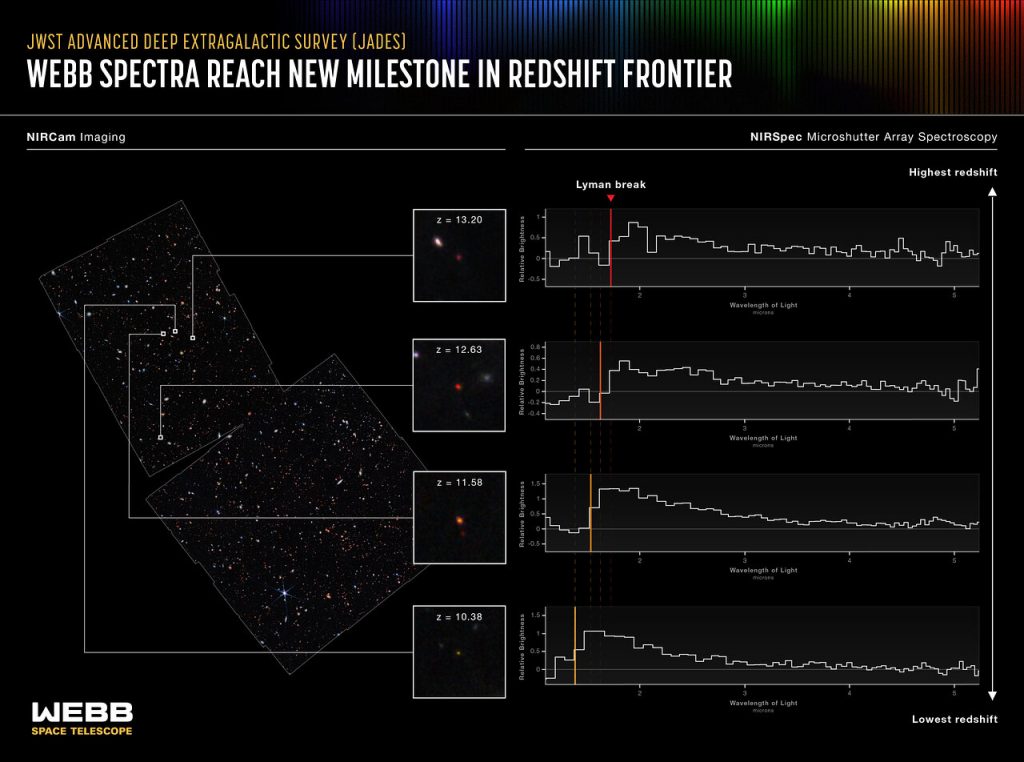 Estimation of the spectroscopic redshift forfour galaxies based on the Lyman limit. Image: NASA, ESA, CSA, M. Zamani (ESA/Webb), Leah Hustak (STScI), Brant Robertson (UC Santa Cruz), S. Tacchella (Cambridge), E. Curtis-Lake (UOH), S. Carniani (Scuola Normale Superiore), JADES Collaboration
The JADES project used the observations of the newpowerful telescope "James Webb" to check the observations made by "Hubble". Using the Webb's Near Infrared Camera (NIRCam), scientists examined the same area of the sky in nine different infrared wavelengths, and using NIRSpec, they estimated the redshift of different galaxies.
In the images, scientists looked for faint galaxies,visible in the infrared, but whose spectra stop abruptly at a critical wavelength (Lyman limit). The oldest stars are composed predominantly of hydrogen, so their spectrum does not contain lines shorter than this limit. Measuring this indicator allows you to estimate the distance to distant objects, and the presence of a limit indicates that the radiation was emitted by an ancient star.
Scientists used two testing methodsphotometric and spectroscopic redshift to establish the distance to galaxies. They found that four of the galaxies they studied formed at the dawn of the Universe, less than 400 million years after the Big Bang.
The data collected by the telescope show noonly the distance, but also the properties of distant systems: they are at least 100 million years old, and the mass of each of them is about 100 million solar. At the same time, galaxies formed very quickly and actively ionized the gaseous hydrogen around them. Further research will help to better understand the history of the early universe, scientists say.
Read more:
Does science exist in extreme conditions? We answer in numbers
"The Walking Dead" existed millions of years ago: scientists told how they appeared
A hyperactive sunspot will lead to a geomagnetic storm on Earth