A research team led by UCSF used the instruments
In his work, accepted for publication in the journalNature, the scientists used a near-infrared spectrograph (NIRSpec) mounted on the telescope. This instrument generates a high-resolution "transmission spectrum" that shows the light that has passed through a planet's atmosphere.
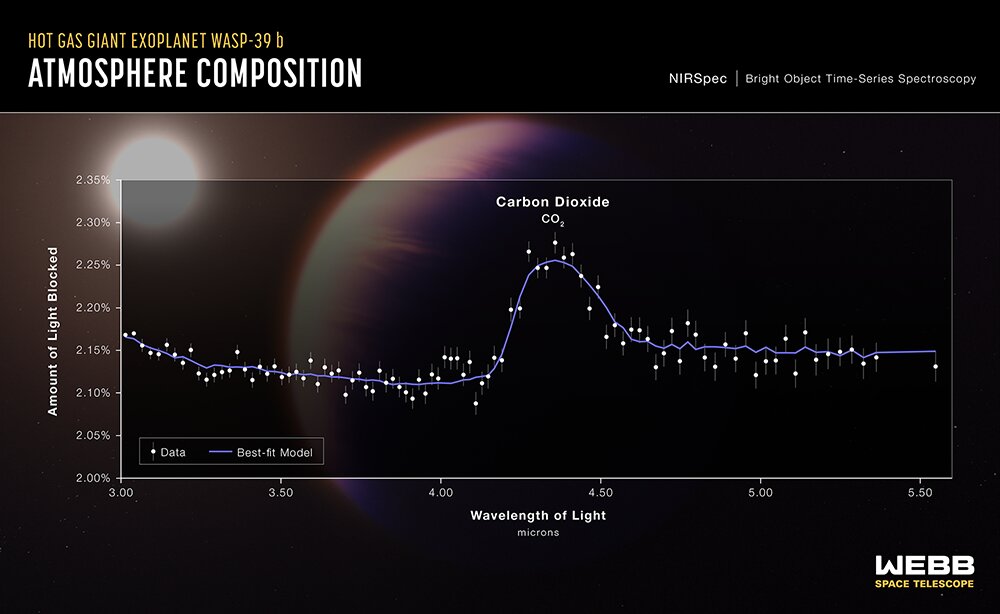 The fraction of a star's light at different wavelengths that is blocked as a planet passes in front of the star. Image: NASA, ESA, CSA, Leah Hustak (STScI), Joseph Olmsted (STScI)
Atoms and molecules in the atmosphere leave unique"fingerprints" in the spectrum of light that passes through it. These prints look like lines with different wavelengths, the scientists explain. The higher the resolution of the device, the more accurately it is possible to restore the composition and physical properties of the object.
Previous studies with telescopesSpitzer and Hubble have shown that WASP-39b could have an atmosphere rich in carbon dioxide. A new Webb study confirms this hypothesis. In addition to carbon dioxide, the planet's atmosphere contains another substance that planetary scientists have not yet been able to determine. They hope that this mystery will be solved in future research.
 The fraction of light of different colors blocked when a planet passes in front of a star. Image: NASA, ESA, CSA, and L. Hustak (STScI)
Scientists note that WASP-39b is the firstexoplanet whose atmosphere has been found to contain carbon dioxide, which is an important component of the atmospheres of planets in our solar system. It has been found both on rocky planets (Mars and Venus) and in the atmosphere of gas giants (Jupiter and Saturn). This gas makes it possible to estimate the total content of heavy elements in the planet's atmosphere.
Researchers say WASP-39b issimilar to Saturn. The metallicity of Saturn is 10 times that of the Sun, and WASP-39b also appears to be enriched in heavy elements by about 10 times that of the Sun.
On the cover: an artistic depiction of the planet WASP-39b. Source: NASA, ESA, and G. Bacon (STScI)
Read more:
The largest migration in the history of the Earth will affect all living organisms on the planet
Astrophotographers have collected a detailed photo of the Moon from 200 thousand images
Nearly half of cancer cases linked to preventable risk factors