An international team of researchers led by astrophysicists from the University of Technology
Using the James Webb Telescope, researchersidentified six galaxies estimated to be over 12 billion years old. This means that they formed only 500-700 million years after the Big Bang. At the same time, these galaxies reach gigantic proportions: they are hundreds of billions of times greater than the mass of the Sun.
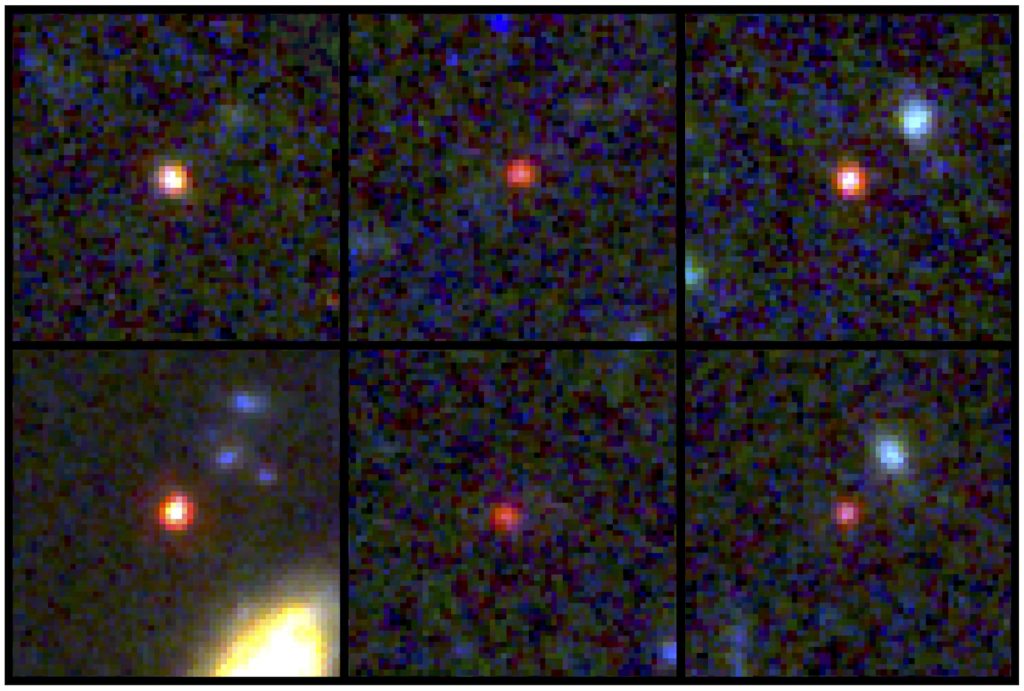 Massive galaxies in the early universe. Image: Swinburne University of Technology
The researchers note that so far scientists have notit was possible to find galaxies of such a size that would have existed immediately after the Big Bang. Researchers will continue to monitor these objects to rule out alternative explanations for the anomalous mass. One hypothesis, for example, is that some of the objects belong to an unknown class of supermassive black holes.
If the initial conclusions about the anomalous mass of galaxies are confirmed, this may turn scientists' ideas about the structure and evolution of the Universe and require the creation of a new cosmological theory.
Read more:
Giraffe mating is even stranger than previously thought
Biologists understand why naked mole rats give birth 'infinitely'
It's not about the Earth: scientists explained why the solar system is the rarest