An international team of astrophysicists has examined the first spectral data on protoplanetary disks.
Researchers analyzed conditions in internalareas of such disks where rocky exoplanets are expected to form. The first results, presented in two papers, demonstrate the diversity of rocky planet formation regions. The discs range from environments rich in carbonaceous compounds to agglomerates containing carbon dioxide and traces of water.
Like fingerprints, various chemicalsubstances create unique, identifiable markers in infrared spectra collected by the James Webb Space Telescope. The scientists use this data to determine the chemical composition of the regions under study, in this case protoplanetary disks.
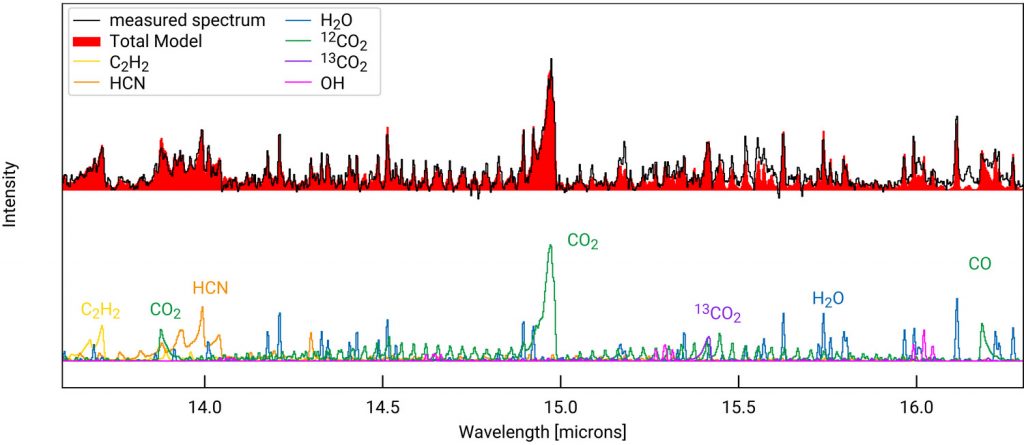 Analysis of the spectrum of the protoplanetary disk of the star GW Lup. Image: S. Grant et al., MPIA
One of the areas of study iswarm inner disk of a young low-mass star GW Lup. The analysis showed that this is a "dry" area, in which there are almost no water molecules. In doing so, the researchers found molecules containing carbon and oxygen, as well as, for the first time in a protoplanetary disk, a rare version of the carbon dioxide molecule containing a heavy isotope of carbon. The lack of water could explain the void around the central star, a region devoid of gas, the scientists note.
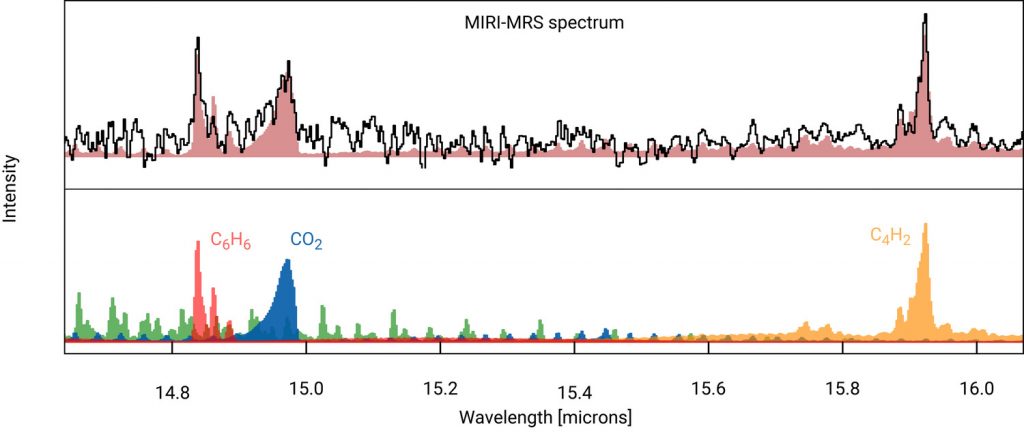 Analysis of the spectrum of the protoplanetary disk of the star J160532. Image: S. Grant et al., MPIA
In the spectrum of another protoplanetary disk,surrounding the low-mass star J160532, scientists have discovered warm hydrogen gas and hydrogen-carbon compounds with a temperature of about 230 ° C. The strongest spectral signal comes from hot acetylene molecules, each consisting of two carbon atoms and two hydrogen atoms.
Other no less warm organic gasesThe molecules are diacetylene and benzene, first discovered in a protoplanetary disk, and probably also methane. Analysis shows that this disk contains more carbon than oxygen. Such a mixture of chemical composition could also influence the planetary atmospheres formed there.
Researchers note that even the firstthe results of the analysis say that "James Webb" "opens a golden age in astronomy." Future research will help to learn more about the conditions for the formation of planets and find those on which life can exist.
Read more:
"Sea" of quarks inside one proton: what does an elementary particle consist of
Look at the highest resolution map of Mars: 110,000 frames and 5.7 trillion pixels
Scientists have studied an ultra-bright object that violates the law of physics
On the cover: an artistic illustration of the diversity of molecules in a protoplanetary disk. Image: ALMA (ESO/NAOJ/NRAO) / MPIA