The James Webb Space Telescope has studied the atmospheres of some of the seven Earth-sized planets for the first time.
Preliminary results obtained by scientistsdo not yet give an exact answer about the composition of the atmospheres of the planets, but show that the telescope can potentially do this. At a scientific symposium, scientists presented observations of the TRAPPIST-1g and TRAPPIST-1b planets. The first of them is in the habitable zone, and the second next to it is close to the star.
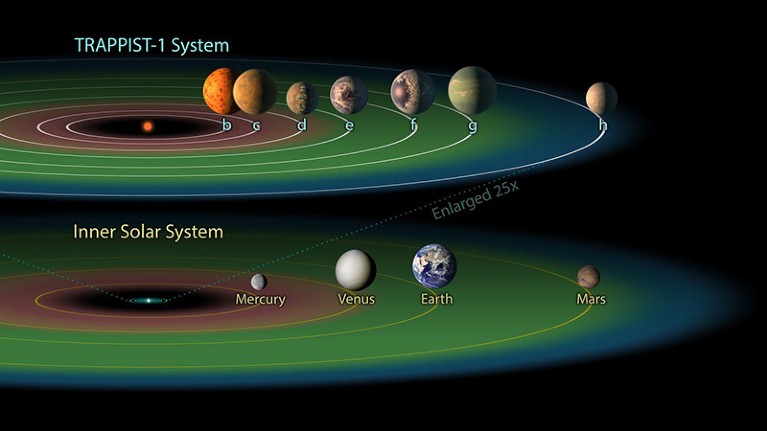 Planets of the TRAPPIST-1 system (above) and the Solarsystems (bottom). The diameter of the orbits of all the planets of the first system is less than that of Mercury. The potentially habitable zone is highlighted in green. Image: NASA/JPL-Caltech
In a series of observations, scientists were able to establish thatNone of the planets have a hydrogen-rich atmosphere. This type of structure is physically very large and therefore the easiest to detect. This means that planets may have denser atmospheres or no atmosphere at all.
Further analysis will be directed towards finding traces of a methane atmosphere or an atmosphere rich in carbon dioxide. If they exist, the telescope will be able to find them in the coming months, scientists say.
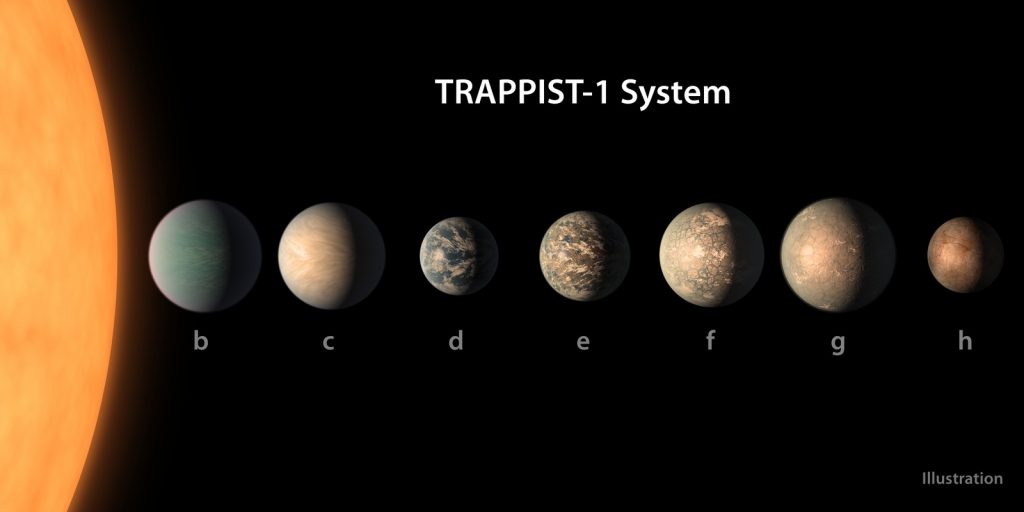 An illustration of seven terrestrial planets around the star TRAPPIST-1. Image: NASA/JPL-Caltech/R. Hurt, T. Pyle (IPAC)
The TRAPPIST-1 system, located 39 lightyears from our planet, is seven planets the size of the Earth, orbiting one relatively cold star. The orbits of all the planets are closer to the star than the orbit of Mercury is to the Sun, but due to the properties of the star, a potentially habitable zone (a region in which liquid water can remain) is formed at such a distance. Three of the seven planets fall within the boundaries of the habitable zone.
The researchers note that this first analysistelescope data is needed primarily to refine the parameters of observations. They expect new discoveries from future observations. In addition, next year they promise to present a "family portrait" of the TRAPPIST-1 system - a picture that will show the star and all seven of its planets.
Read more:
Does science exist in extreme conditions? We answer in numbers
Scientists have found out who benefited from the death of dinosaurs
Look at the photo of the Earth from space: it was made by the first private module
On the cover: artistic illustration of the TRAPPIST-1 system. Image: NASA/JPL-Caltech