Astrophysicists have found in one of the images taken by the James Webb telescope differences fromPrevious
Scientists have discovered a bright object in the photographsgalaxies SDSS.J141930.11+5251593. It is located at a distance of 3 to 4 billion light years from Earth, so we are observing the death of a star that occurred 3-4 billion years ago.
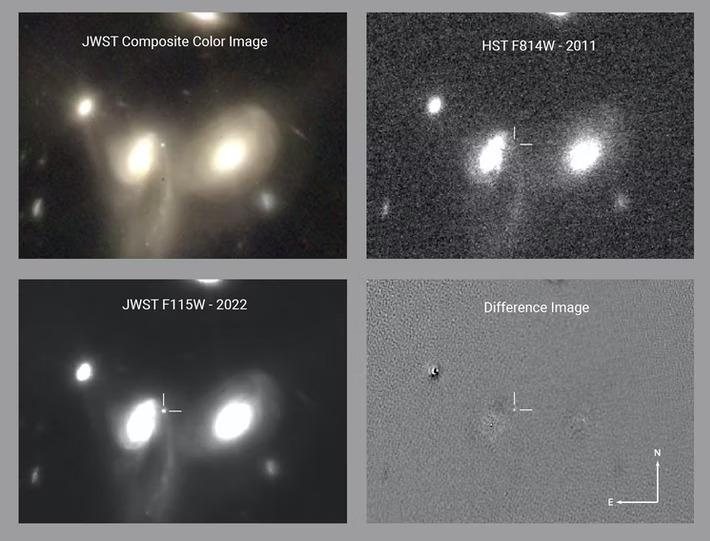 Pictures of the same area of the sky taken at different times. In the lower right corner - a comparison in the brightness of objects. A supernova candidate is indicated by a mark. Source: STSCI
A star dies in a split second, they sayastrophysicists, but the resulting fireball grows and becomes brighter over the course of several days, then gradually fades away over the next few months. This is an instant in astronomical terms, so Webb was able to detect this supernova shortly after its brightness reached its peak.
Search for short-lived cosmic events such aslike supernovae, is not the goal of "James Webb". But as it turns out, he can do just that. And because this space telescope can see farther than any other scientific instrument, it opens up possibilities for exploring the death throes of the first generations of massive stars in the universe.
Thanks to the high depth of "James Webb"covers a very small area of the sky, astrophysicists dismiss. For example, the first image, which represents the deepest view of the Universe, is the area of the sky that will be covered by a grain of sand in an outstretched hand.
Therefore, the actual probability that youyou will find the transient in the field you are looking at is quite small - at least we thought it would be small. But, as you've probably heard, every telescope field is a deep field right now, so there are galaxies everywhere, and now we're thinking, oh, we might have a really good chance of finding supernovas all the time.
Mike Engesser, astrophysicist at the Space Telescope Institute and member of the James Webb Project, in an interview with Inverse
Read more:
The supersonic plane will fly at a speed of 2,000 km/h and cross the ocean in 3.5 hours
Scientists filmed a strange creature with tentacles, which they mistook for a flower
Created a quantum computer that "went beyond the binary system"