
The James Webb Space Telescope continues to produce interesting photographs. National Directorate for
What is known
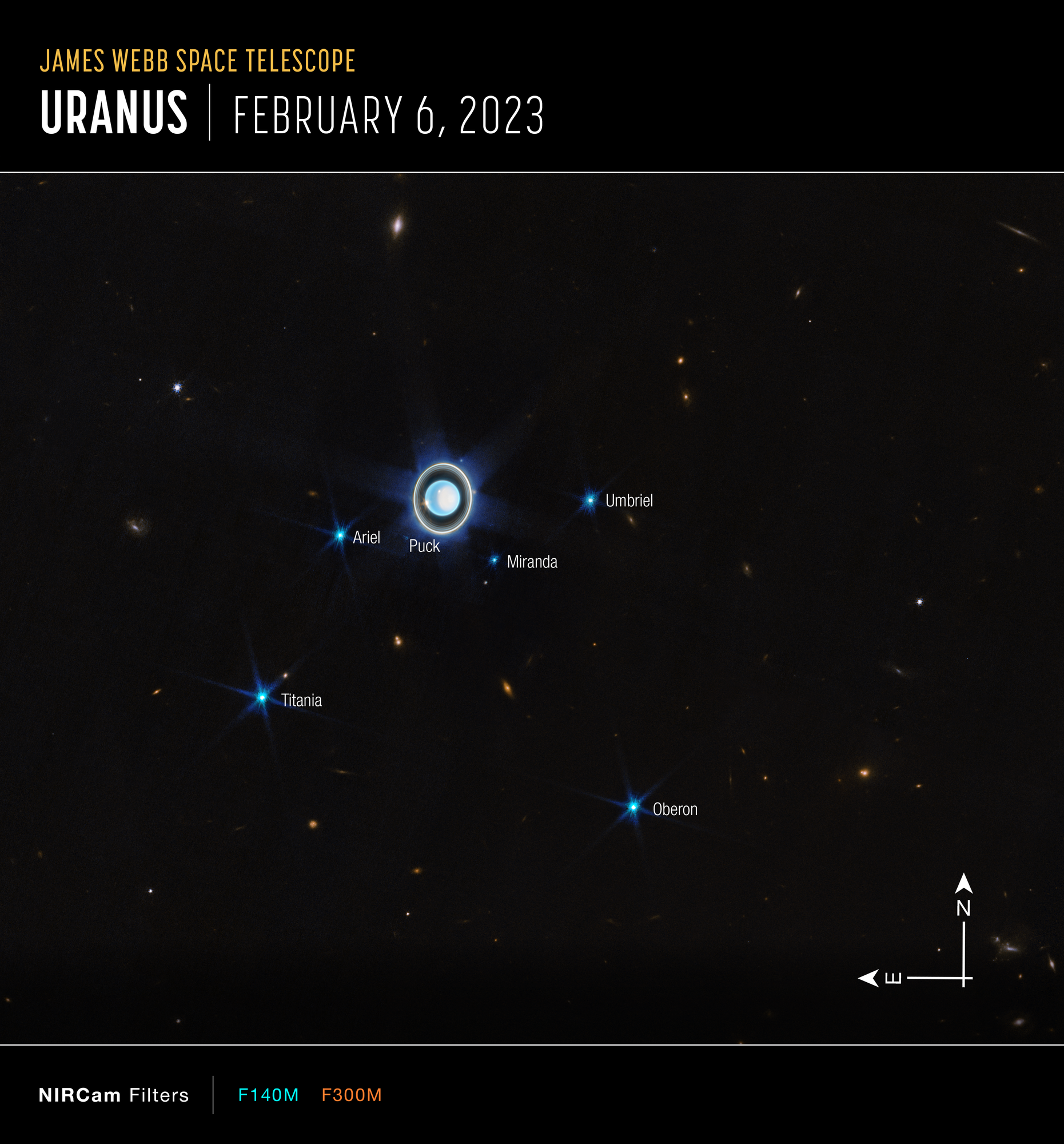
The photo shows the rings and some satellites of the seventh planet from the Sun. The equator of Uranus is rotated 90 degrees to the plane of the orbit. In simple words, the planet rotates, lying on its side.
Due to the unusual location, day and night onthe poles of Uranus last for years. The ice giant makes a complete revolution around the Sun in 84 Earth years. Now spring is ending on the planet, and summer will begin in 2028.
Uranus has 13 rings.The image taken by the James Webb Space Telescope perfectly demonstrates 11 of them. Some rings are very bright, so it may seem as if they merge with each other into one large and wide ring.
</ img>
The telescope also captured some of the satellites of Uranus. In total, the planet has 27 of them. The six brightest satellites are labeled in the image above.
James Webb is equipped with a NIRCam camera.It was with her help that the photograph of Uranus was obtained. The bright region on the right side of the planet is called the polar cap. It is only visible when exposed to direct sunlight.
Check out the polar cap (bright white area) onthe right side! Webb reveals, for the first time, a subtle enhanced brightening at its center. This polar cap appears in the direct sunlight of summer and vanishes in the fall. Webb's data will help us to understand this mystery. pic.twitter.com/OJuBUpcsiD
— NASA Webb Telescope (@NASAWebb) April 6, 2023
Astronomers hope the findings will helplearn more about the polar cap. When autumn begins on the planet, it will disappear again. Clouds, which can also be seen in the photo, are likely formed due to thunderstorm activity.