On March 1, 2023, NASA's Juno spacecraft flew at a distance of 51.6 thousand km from the surface of Io -
Most of the dark spots on Io's surface areconsequences of volcanic eruptions. One of them, East Girru, appears to have erupted since the last New Horizons sighting. Experts note a lava flow that appeared on the eastern side of this volcano. It is possible that this region of about 3,200 km² was formed during an eruption in late 2021, recorded by the JIRAM instrument of a spacecraft designed to study the auroras on Jupiter.
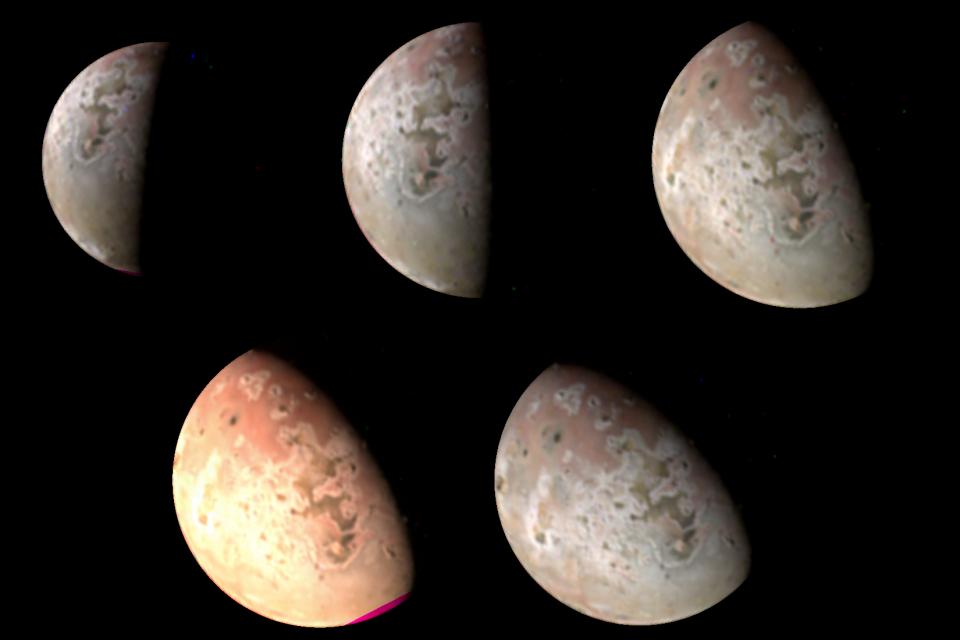 A series of images of Io taken during the 49th flyby of Jupiter by the Juno spacecraft. Image: NASA / SwRI / MSSS / Jason Perry
Another difference:"Redness" of Patera Khorsa, an irregularly shaped crater located on top of one of the volcanoes. This color change indicates the presence of short-chain sulfur formed as a result of active high-temperature volcanism.
The Juno spacecraft studies Jupiter and itssatellites since 2006. It was initially assumed that the mission would end in 2020 and the station would burn up in the atmosphere of the gas giant. But the excellent condition of the ship made it possible to continue research. The extended mission involves exploring Jupiter's largest moons: Ganymede, Europa and Io.
Current observation:49 flyby of Jupiter and the third in a series of close encounters with Io. As close as possible to the surface of the volcanic satellite, Juno will approach during the 57th and 58th flybys in December 2023 and February 2024, respectively.
Read more:
Named a vitamin that protects the brain from dementia
See how the Earth has changed over 100 million years on the most detailed map
It turned out which men are the most fertile: their sperm is 50% better than the rest
Cover photo: NASA / JPL / SwRI / MSSS / Gerald Eichstädt / Thomas Thomopoulos