Icy worlds of Jupiter
The European Space Agency plans to launch the Jupiter mission in April 2023
The main objective of the mission is to explore three distant worlds - oceans covered with an icy crust, which scientists believe consist of liquid water. These are Jupiter's moons Ganymede, Europa and Callisto.
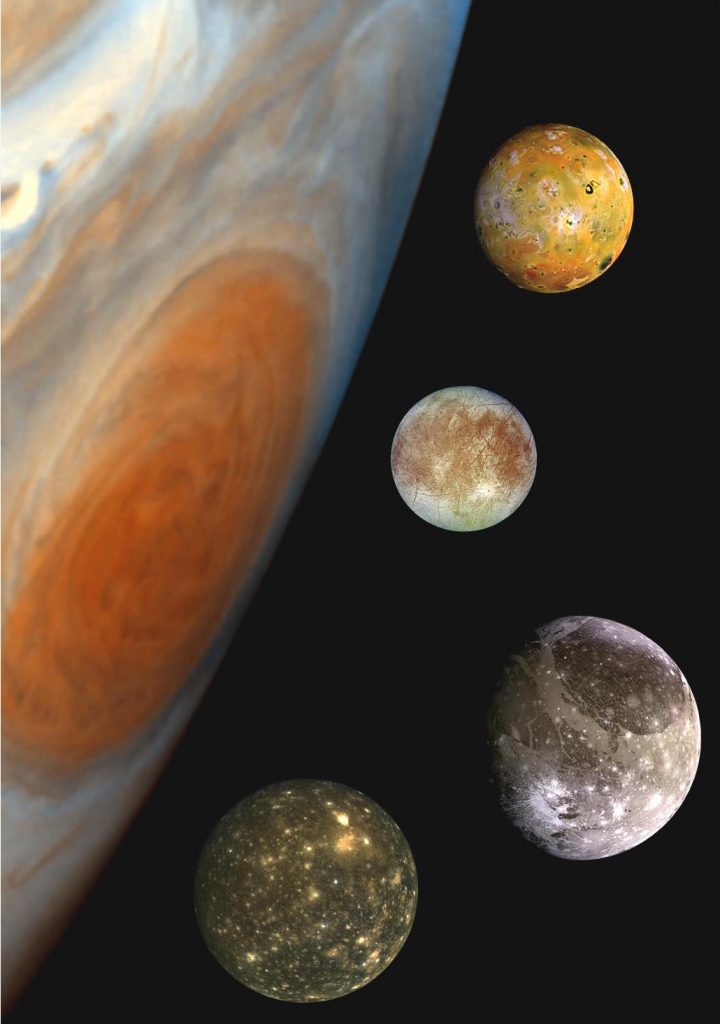
The spacecraft will spend several months onOrbit Jupiter, fly around Europa, Ganymede and Callisto, and finally enter a stationary orbit around Ganymede. The main mission will begin in 2031, six months before approaching the largest planet in the solar system, and will last four years. The space probe will look for answers to questions about what the icy worlds surrounding Jupiter are, whether life could have existed there in the past and whether life exists now, and how gas giants and their satellites are formed.
Image: NASA/JPL/DLR
The JUICE ship will map the oceans of satellites withusing radar instruments and will look for biosignatures (molecules associated with living organisms) on the Europa ice surface. The surface of this satellite is covered with cracks caused by internal activity, which is why molecules from the ocean can penetrate into outer space.
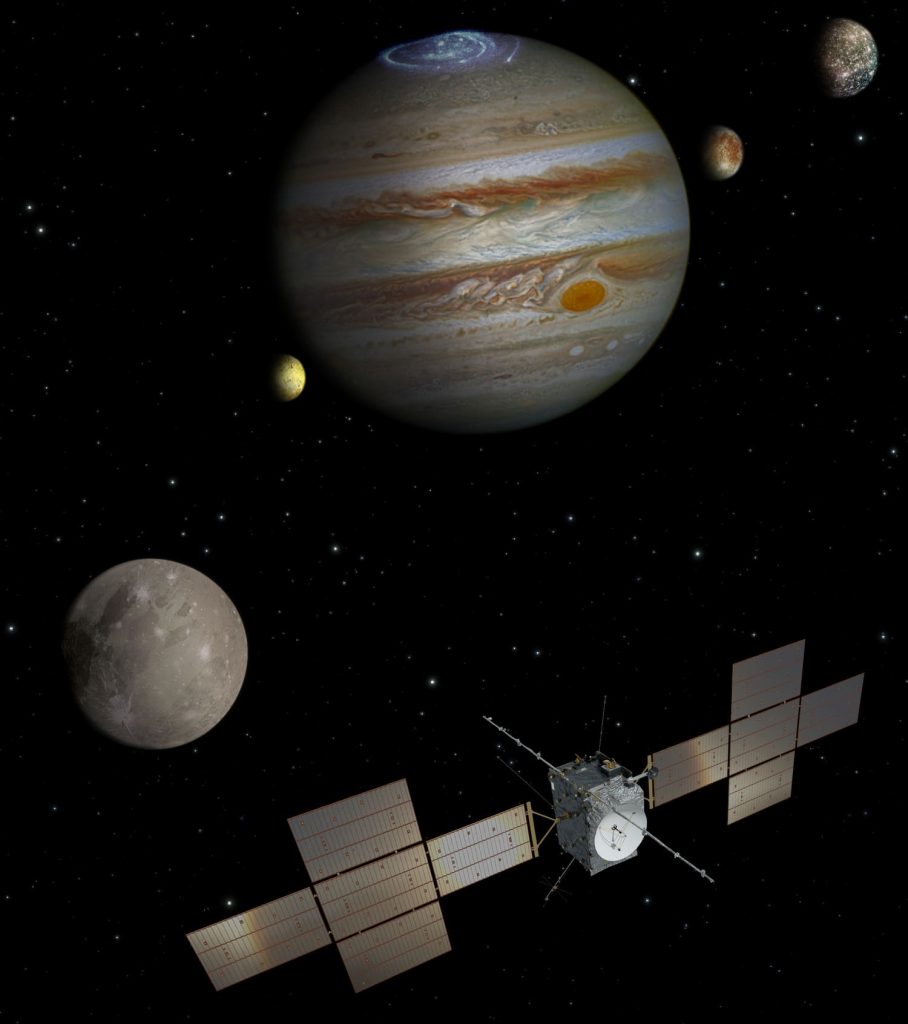 Artistic illustration of the JUICE mission.Image: ESA/ATG medialab (ship); NASA/ESA/J. Nichols (Jupiter); NASA/JPL (Ganymede); NASA/JPL/University of Arizona (Io); NASA/JPL/DLR (Callisto and Europe)
Solar Observatory "Aditya L1"
Plans to start the year with an ambitious startIndian Space Research Organization (ISRO). It is expected that already in the first quarter of 2023, the Aditya L1 mission (Aditya L1), the first solar space observatory developed in this Asian country, will be launched into space. In addition, it is only the second Indian astronomical satellite. Prior to that, Astrosat was launched in 2015, studying outer space in ultraviolet and X-ray radiation.
Translated from Sanskrit, "Aditya" means“Sun”, and L1 in the name refers to the corresponding Lagrange point. It is located on the line connecting the centers of mass of the Earth and the Sun, in the place where equal forces of attraction between the two bodies allow the satellites to maintain a stable position. The spacecraft will take 109 days from launch to reach the L1 Lagrange point, located about 1.5 million km from Earth.
The Aditya L1 satellite will simultaneously observebehind different layers of the sun. Among other things, it will be able to record changes in the photosphere, chromosphere, and solar corona, as well as observe solar wind streams, flares, and coronal mass ejections. The researchers believe that simultaneous images of different layers of the Sun's atmosphere will reveal the ways in which energy is channeled and transferred within a star.
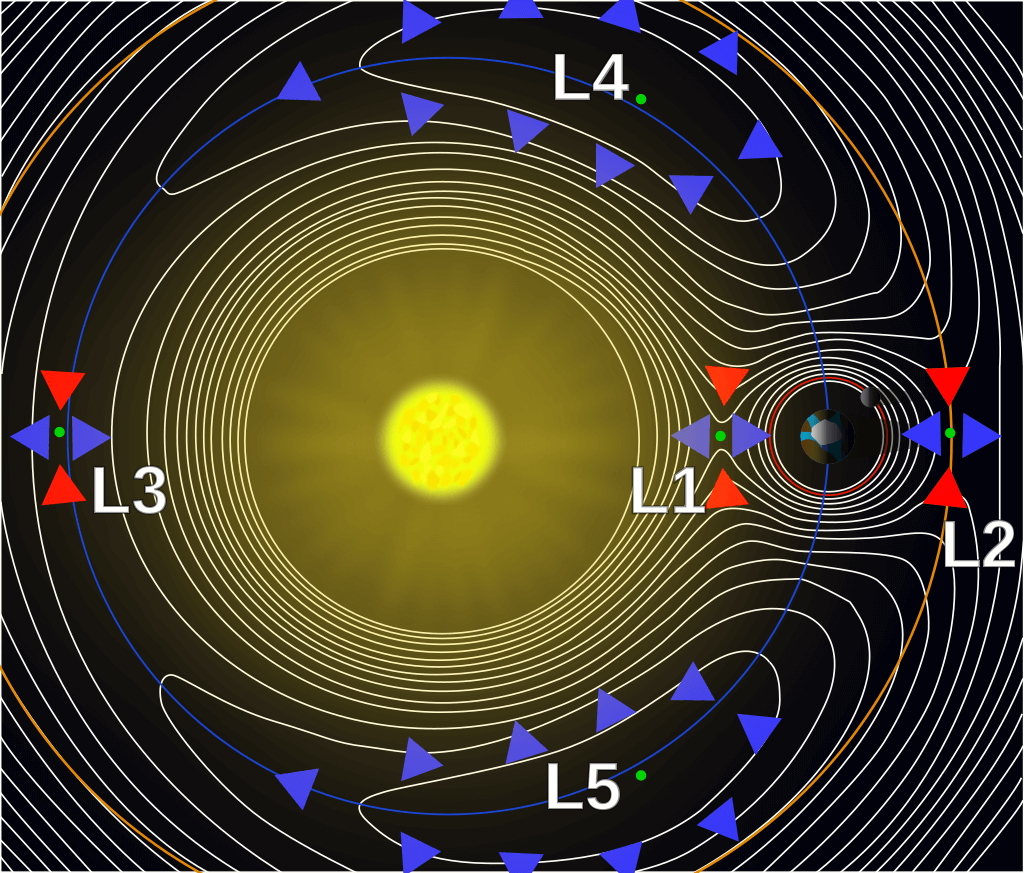 Lagrange points in the system of the Sun and the Earth. Image: Lagrange_points.jpg: created by NASAderivative work: Xander89, CC BY 3.0, via Wikimedia Commons
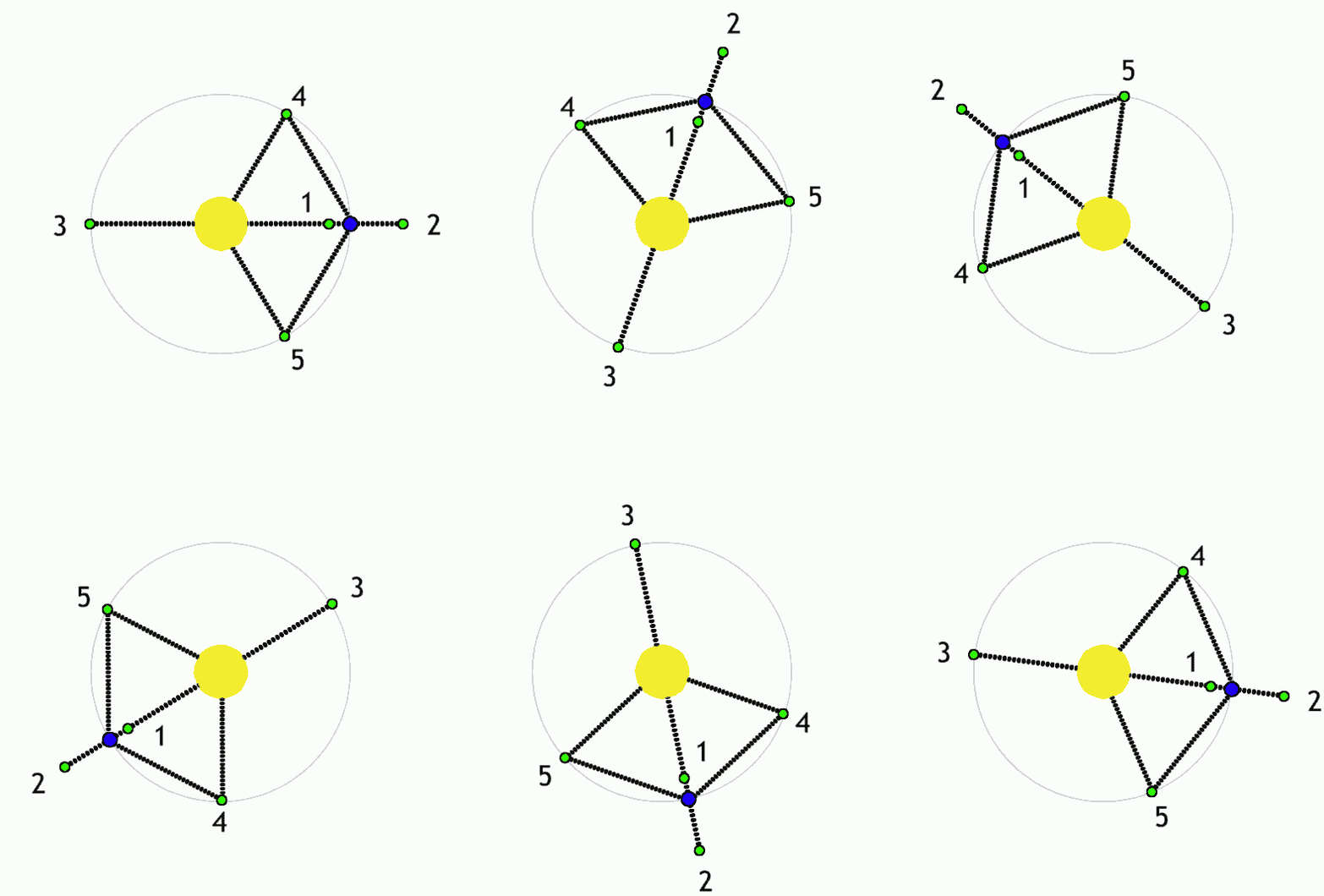 Lagrange points in the system of the Sun and the Earth. Image: Anynobody, CC BY-SA 3.0, via Wikimedia Commons
Telescope at the Heavenly Palace
At the end of 2023, China will launch a lowits modified analogue of Hubble into near-Earth orbit. Xuntian ("Heavenly Sentinel" in Chinese) or CSST is an autonomous research satellite with an optical telescope.
"Xuntian" will rotate in the same orbit, according towhich moves the Chinese space station "Tiangun" ("Heavenly Palace"). This is no coincidence, the module will be equipped with its own engines, with which it will rendezvous with the space station for repairs, upgrades and maintenance.
"Xuntian" is a building the size ofwith a bus, the length of which is equal to the length of a three-story building. The aperture of the flagship Chinese telescope is two meters, which is slightly less than that of the Hubble, which is similar in function and capabilities. But the advantage of CSST is in its wide field of view (regions of the sky in one image): its area is 350 times larger than that of the ESA and NASA space telescope.
According to the developers, from their orbitXuntian will take pictures of 40% of the sky. It will observe more than a billion galaxies and measure their position, shape and brightness to study how they evolve. In addition, the telescope will help determine the upper limit of neutrino mass and will search for and investigate dark matter and dark energy.
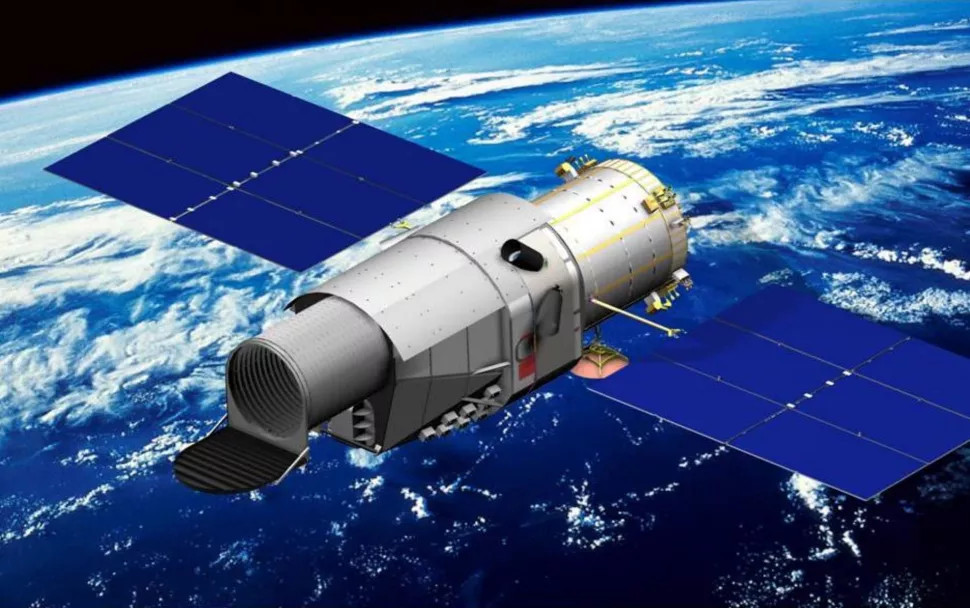 Artistic illustration of the Xuntian Telescope in orbit. Image: Jaimito130805, CC BY-SA 4.0, via Wikimedia Commons
Bringing Bennu Samples to Earth
In September 2023, the spacecraft missionOSIRIS-REx will drop samples collected on the asteroid Bennu to Earth. The "package" sent to Earth will complete its seven-year primary mission, and the space probe will continue its journey to a new target - the near-Earth asteroid Apophis.
Still have to deliver samples from asteroidsOnly the Japan Aerospace Exploration Agency (JAXA) succeeded. In 2010, the Hayabusa probe dropped a capsule with samples of the Itokawa asteroid to Earth, and in 2020, Hayabusa-2 delivered samples to Ryugu. The research has already helped clarify theories of the origin of life, asteroids and the past of the solar system.
The complexity of the sample return mission isthe need to very accurately select and calculate the trajectory, NASA explains. If the capsule passes too high, it will fly out of the atmosphere, and if it is at too great an angle to the surface, it will burn up before reaching the Earth.
A series of maneuvers to begin in July 2023year, will bring the space probe to a distance of about 250 km from the Earth's surface. That's close enough to release a precision landing sample capsule - parachuted into a test site in the Great Salt Lake Desert in Utah.
Delivery of samples to Earth during the OSIRIS-REx mission. Video: NASA
Analysis of the "terrestrial" core
NASA plans to launch another asteroid exploration mission in October 2023. Unlike all the previous ones, it will not be aimed at a stone or ice object, but at a metal ball.
Deep within the terrestrial planets, includingEarth, scientists suggest the presence of metal cores. It is impossible to study them directly - all knowledge is obtained through indirect observations, for example, analysis of the propagation of acoustic waves through rocks, and modeling. Asteroid Psyche is a unique opportunity to explore the basis of the planets "by touch".
Psyche revolves around the sun between orbitsMars and Jupiter. It is the largest known asteroid of the poorly understood class M (metal asteroids). It represents the exposed iron-nickel core of an early planet, one of the building blocks of our solar system, NASA notes.
The spacecraft will have a longjourney: it is expected to reach its goal only in 2029. The probe will have to explore the asteroid to find answers to the questions: if Psyche was a planet in the past, how it formed and collapsed, and, if the formation of the planet was not completed, then what prevented this.
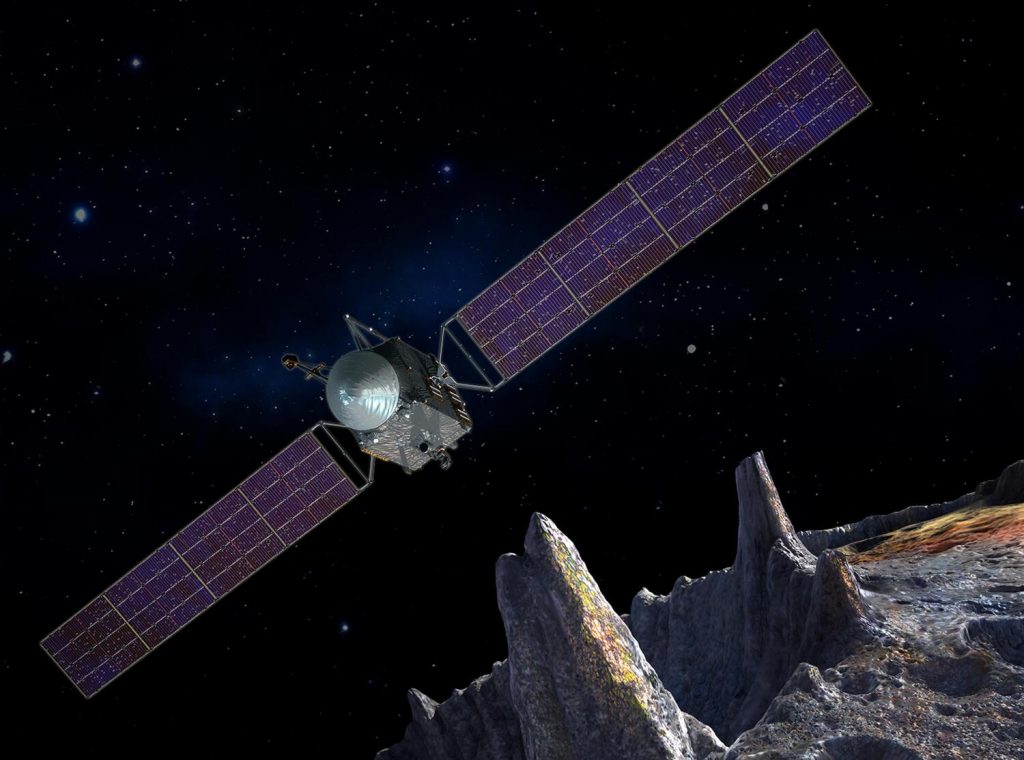 Artistic illustration of the Psyche mission. Image: NASA/JPL-Caltech
The search for dark energy
Why is the Universe accelerating and what is its nature?the source responsible for this acceleration, which physicists call dark energy - ESA's new Euclid space telescope will try to answer this question.
Space telescope visible and nearinfrared will be launched in the third quarter of 2023. Its task: to study how the Universe has evolved over the past 10 billion years in order to confirm and clarify the main provisions of the modern cosmological model.
The telescope will look for traces of dark energy andgravity using two complementary cosmological probes to register signs of the rate of expansion of the Universe and the growth of cosmic structures. The new satellite will estimate baryon acoustic oscillations and the redshift of space with high accuracy.
The satellite will go to the Lagrange point L2,located at a distance of about 1.5 million km behind our planet on the line connecting the Earth and the Sun. It is expected that Euclid will observe about 10 billion light sources, of which more than 1 billion will be used for weak gravitational lensing, and several tens of millions for redshift calculations.
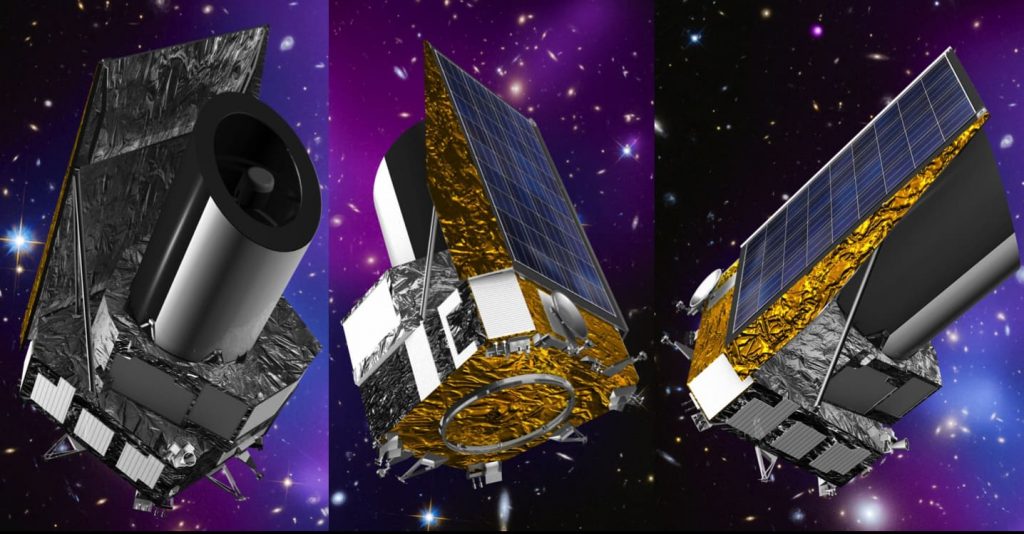 Artistic illustration of the Euclid telescope. Image: ESA
Read more:
The tomb of the “midwife of Jesus” was unearthed: scientists told what they found there
Einstein is wrong again and his main theory was rewritten: how it changes the world
The loss of one oxygen atom leads to the birth of girls with an XY chromosome