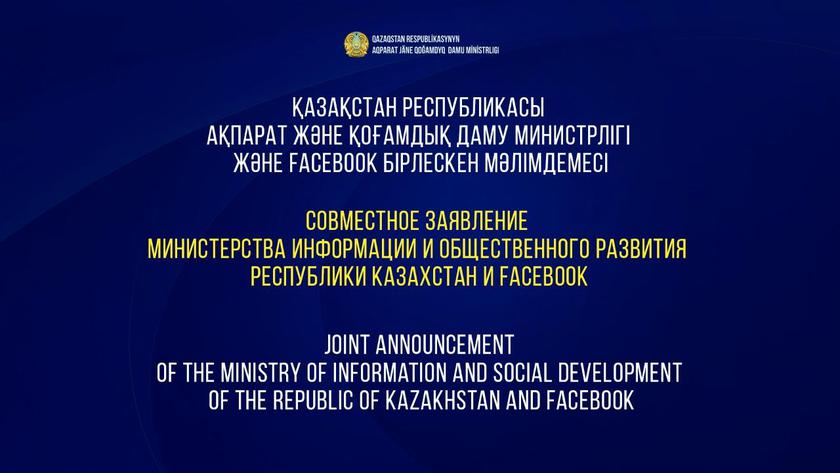
On November 1, 2021, the government of Kazakhstan posted a “Joint Statement” on the official portal of the country, in
The statement explained that this “will allowThe Ministry must promptly report content containing violations of both Facebook’s global content policy and the national legislation of the Republic of Kazakhstan. In other words, the Kazakh authorities received a tool for direct censorship of content posted by citizens of the country.
The statement even quoted Facebook's Regional Director of Communications, Mr. George Chen, as saying:
“Facebook is pleased with the jointwork with the Government of Kazakhstan, especially in the direction of ensuring the safety of children on the Internet. As a first step towards our long-term cooperation, we are pleased to provide the Government of Kazakhstan with access to the Content Notification System, which we hope will help authorized bodies of the Government of Kazakhstan to more effectively and efficiently fight harmful content. The Facebook team will also continue to train Kazakhstani specialists to ensure cyberspace security.
October 28 this yearthe Facebook team conducted a training for the Ministry's specialists on working with the "Content Notification System", as well as on Facebook's content policy and Community Standards. From the beginning of November, the Ministry will already start working in the System ”.
However, the very next day, Meta Platforms director of political communications in the Asia-Pacific region Ben McConaghy said:
“Firstly, we did not make a joint statement withthe government of Kazakhstan - instead, the government of Kazakhstan has issued its own statement based on our discussions about the process for handling requests from governments to restrict content that violates local laws.
We follow a consistent global processassessments of individual requests – independent of any government – in accordance with Facebook policies, local laws and international human rights standards. This process in Kazakhstan is the same as in other countries of the world.”
From this we can conclude that negotiations andconsultations actually took place, Facebook speaks about this quite directly. At the same time, a streamlined phrase about “compliance with Facebook policies and local laws” makes you tense, since the devil usually lies in the details of local legislation. Of course, it is impossible to prove or disprove the holding of special training for ministry employees, but the fact that in Facebook’s refutations they are not mentioned a word, and only the awkward wording of a “joint statement” is emphasized, says a lot.
Source:gov.kz, Reuters
Illustrations: gov.kz
</ p>