An international team of researchers presented the results of a new analysis of the chemical composition of the samples,
The researchers analyzed samples of mountainrocks collected at two Hayabusa-2 landing sites on the asteroid Ryugu in 2018. The analysis showed insignificant differences in the concentration of uracil in different sampling sites. The researchers believe that this may be due to different exposure to ultraviolet radiation and cosmic rays in different parts of the asteroid's surface.
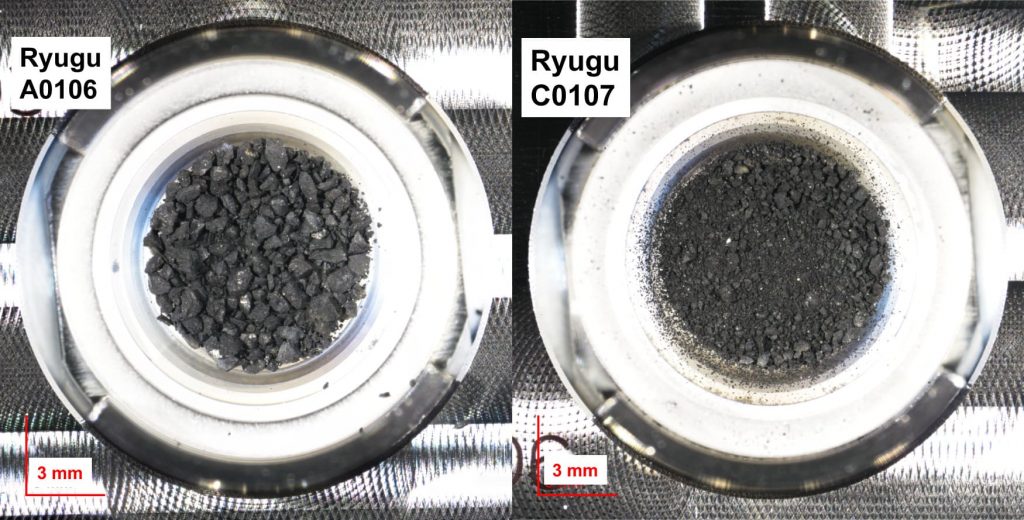 Samples collected at two landing sites on Ryugu. Image: Yasuhiro Oba et al., Nature Communications
Japan Aerospace Exploration Agencydeveloped the Hayabusa-2 mission to explore a carbonaceous asteroid. In 2018, a space probe reached the asteroid, conducted several surveys in its orbit, and then landed on the surface of the object and collected samples. The materials were placed in an insulated container and delivered to Earth in December 2020.
This is not the first study of samples obtainedmission "Hayabusa-2". Previously, researchers have reported finding many different amino acids and other prebiotic organic molecules. Together, these studies show that various components necessary for the origin of life could have formed off our planet and come to Earth along with asteroids.
Read more:
Physicists have found a way to overcome the limitation on the size of semiconductors
Treasure found that was hidden during the war almost 1,000 years ago
The secret of longevity is revealed: scientists have figured out how to start the necessary mechanism in the human body
Cover: Artistic illustration of an asteroid exploration mission. Image: Akihiro Ikeshita, JAXA