Research team led by Professor Christoph Becker-Pauly from the Institute of Biochemistry
“For the first time, we have shown that the enzyme complexmeprin α and meprin β located on intestinal cells influence the composition of the microbiome by processing the substrate galectin-3,” explained first author Cynthia Bülk, PhD and student at the Institute of Biochemistry at Kiel University. At the same time, the microbiome itself influences this process.
Researchers have studied the interaction of regulationenzyme complex in mouse models with various bacterial colonizations. They focused on the protein-degrading enzymes meprin α and meprin β, which are highly expressed in the healthy gut and are decreased in chronic inflammatory bowel disease (IBD). Chronic inflammatory bowel diseases are a group of intestinal diseases that include ulcerative colitis (UC) and Crohn's disease (CD, intestinal granulomatosis). Both of these pathologies, with a progressive course, often lead to disability and even death.
“On the one hand, we wanted to figure out the functionmeprins in the small and large intestines, and on the other hand, to understand how the intestinal microbiome is regulated,” explain the study authors. Meprin proteases are found throughout the intestine and are present as the meprin α/β complex in the colon, but are not typical digestive enzymes. To clarify their functions, the researchers used a method based on mass spectrometry. The goal is to find substrates that are processed by the enzyme complex. As a result, scientists identified galectin-3.
It is constantly produced in the villiintestines and is located both inside and outside the cells, in the mucous layer. Galectin-3 interacts with bacteria, for example, by agglutination. The study showed that proteolytic cleavage of galectin-3 by meprin α/β resulted in altered microbial binding properties. At the same time, depending on the bacterial composition, the enzymatic processing of galectin-3 changes.
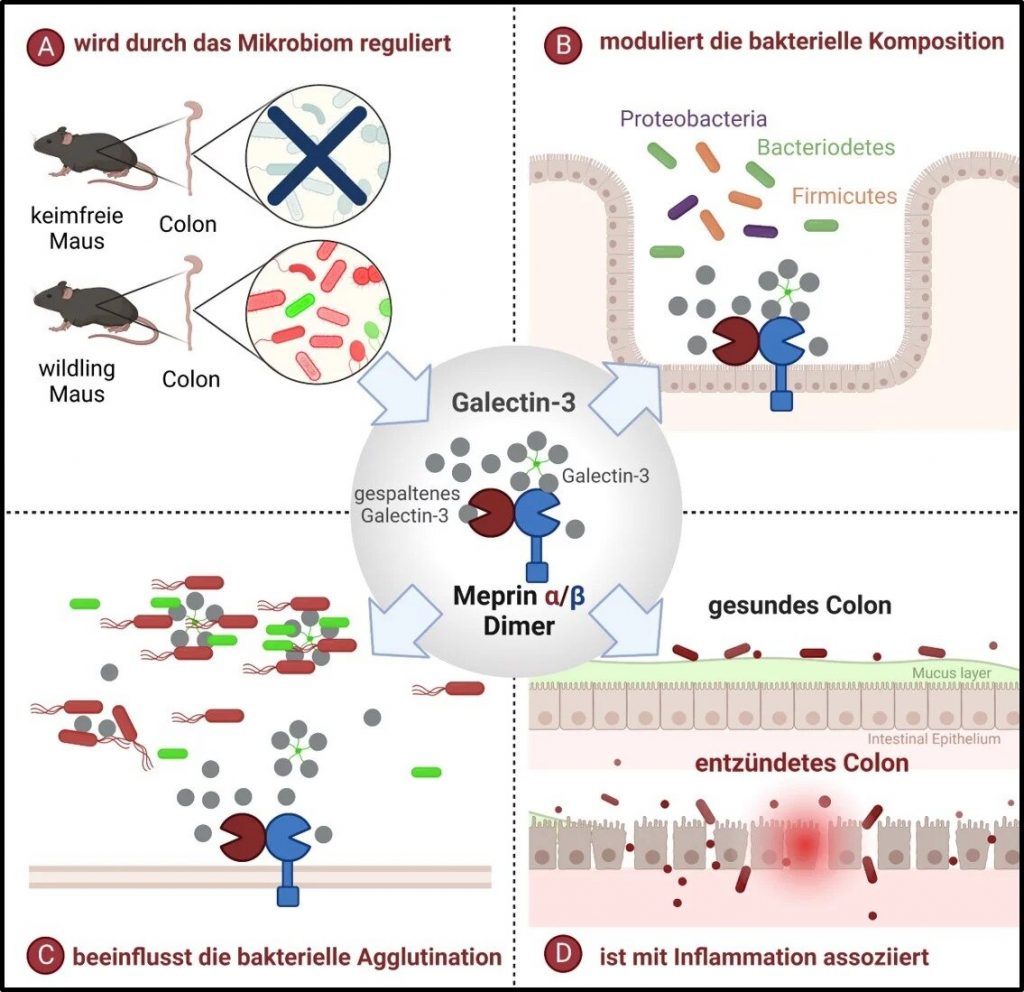 Proteolytic processing of galectin-3 by meprinα/β in the gut is regulated by the microbiome (A) but also modulates microbiome composition (B). It plays an important role in bacterial agglutination (C) and is associated with inflammatory processes (D).
Therefore, the cleavage of galectin-3 by the enzymemeprin α/β complex is critical for the homeostasis of the host microbiome.Credit: K. Bülk, Institute of Biochemistry, University of Kiel (image created using BioRender)
Scientists also found that enzymaticcleavage of galectin-3 leads to strong agglutination (clumping) and elimination of the pathogen Pseudomonas aeruginosa (also known as Pseudomonas aeruginosa). This type of gram-negative, aerobic, motile, rod-shaped bacteria lives in water and soil and is the causative agent of nosocomial infections in humans. Treatment is difficult due to high resistance to antibiotics.
The researchers concluded that cleavage of galectin-3 by the meprin α/β enzyme complex is critical to host microbiome homeostasis.
Read more:
It turned out that photosynthesis does not work the way scientists thought. Now they want to hack it
Distant radio galaxy turned out to be a black hole, which is directed directly at Earth
Found a way to reduce weight and blood sugar. Scientists promise the effect of surgery
On the cover: Enzyme Polyneuridine-Aldehyde Esterase
Contributed by: Yang L, Hill M, Wang M, Panjikar S, Stöckigt J (2009). doi: 10.1002/anie.200900150, PMID 19496101