Experts from the European Earth remote sensing program Copernicus presented the results
Researchers note that the most noticeablethe temperature anomaly manifested itself in the north of Europe, the northwest and north of Russia, and in the area of the Kara Sea. In addition, temperatures were above average in the eastern United States, Pakistan and India. Moreover, the latter recorded the warmest February since 1901. Relatively cold last month of winter was in the Iberian Peninsula, Turkey and parts of the Caucasus.
Temperature anomalies in February 2023. Video: Copernicus Climate Change Service/ECMWF
The researchers also note that the average monthlyArctic sea ice reached 14.4 million km² in February 2023. This is the second minimum value: the anti-record was set in February 2018. At the same time, a decrease in Antarctic sea ice was observed. Its area reached 2.2 million km², which is a third less than the average value and an absolute anti-record in February. And the daily extent of Antarctic sea ice has reached its lowest value on record.
Our latest data show that the areaAntarctic sea ice has reached its lowest level in 45 years of satellite observations. These low sea ice conditions could have important implications for the stability of Antarctic ice shelves and, ultimately, for global sea level rise.
Samantha Burgess, Associate Director of the Copernicus Program
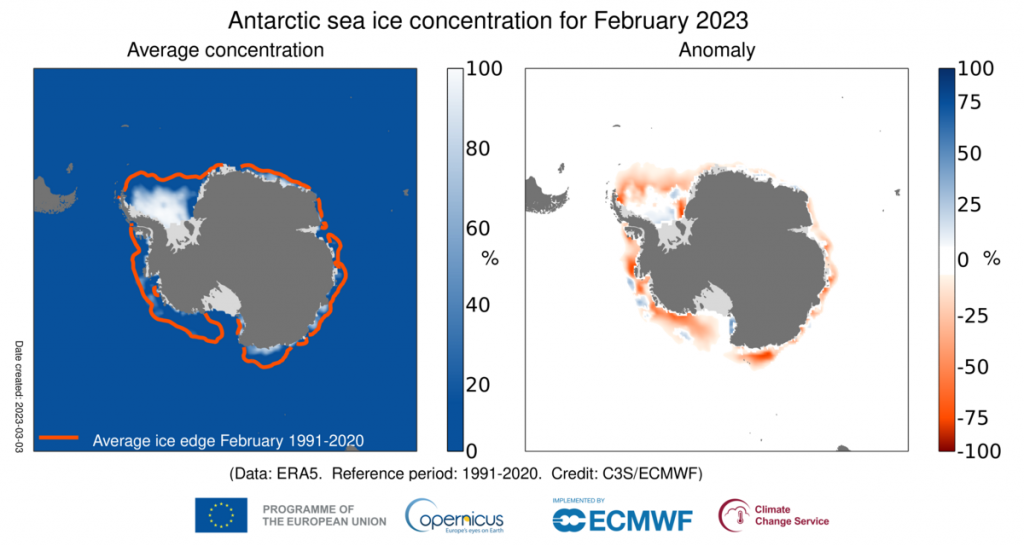 Ice area change in Antarctica in February 2023 from 1991–2020 averages. Image: Copernicus Climate Change Service/ECMWF
This is not the first anomalous month for Antarctica. A similar anti-record was set in January of this year.
Read more:
Named a vitamin that protects the brain from dementia
Named a type of insomnia that reduces the risk of dementia. But why is unknown.
A treasure with 1,000 coins was accidentally found on a farm: what could they buy
On the cover: Temperature anomalies in February 2023. Image: Copernicus Climate Change Service/ECMWF