Researchers have developed a camera that uses a thin array of microlenses and new algorithms
“We consider our camera to be lensless becauseit replaces the volumetric lenses that are used in conventional cameras. Our device has a thin and light array of microlenses made from a flexible polymer,” Weijian Yang, research team leader at the University of California, Davis, said in a press release.
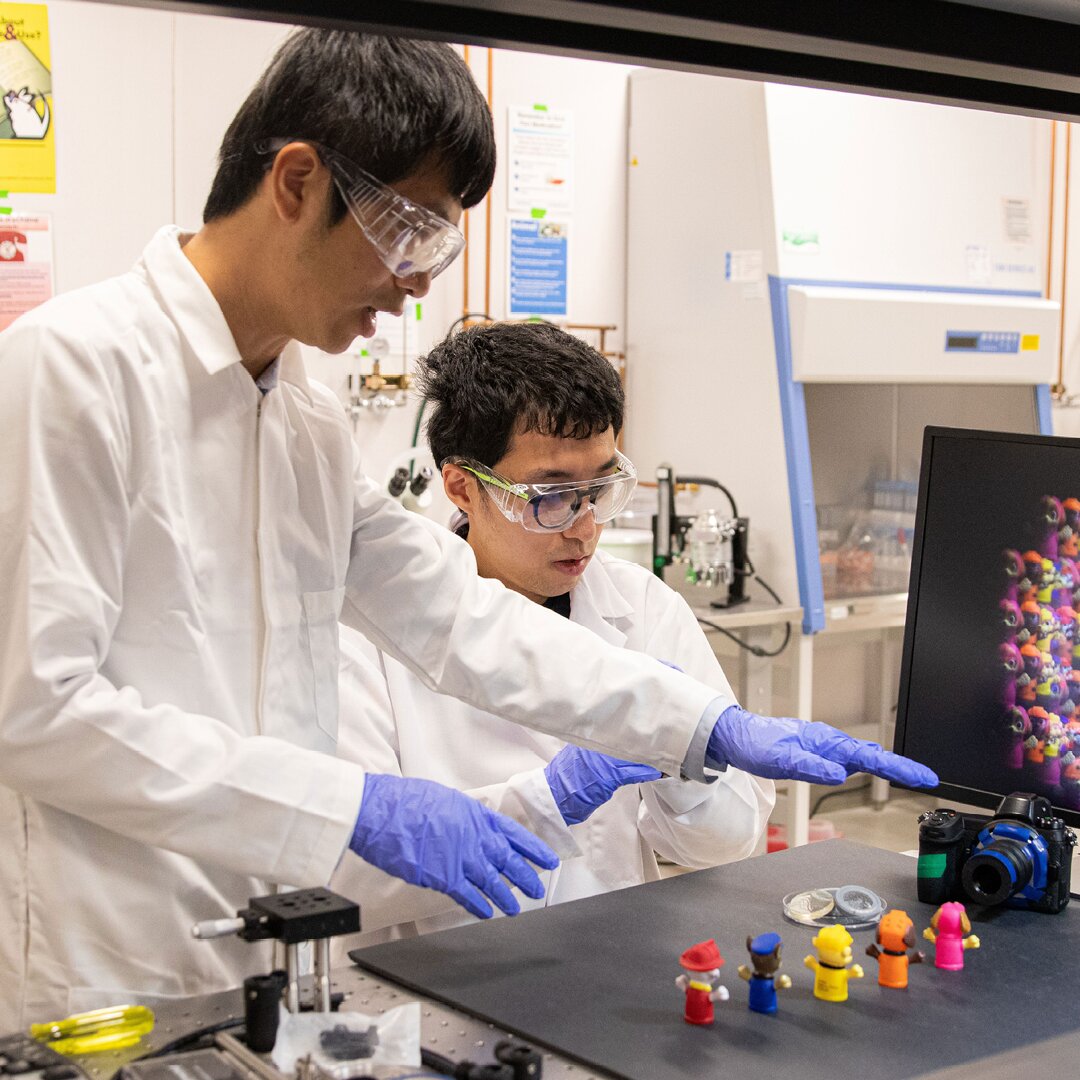 Engineers have developed a chamber in whichuses a thin array of microlenses and new image processing algorithms to capture 3D information about multiple objects in a single exposure. Raw sub-images from the microarray are displayed on the monitor. Image Credit & Copyright: Savanna Lui, UC Davis
As each microlens observesobjects from different viewing angles, it performs complex visualization tasks. For example, getting 3D information from objects that are partially hidden by other objects closer to the camera.”
Camera learns from existing data andcan create 3D images in real time. Separate lenses in it allow you to see objects from different angles or perspectives. Although other research groups have developed cameras based on single-layer microlens arrays, they have been difficult to make practical. All because of extensive calibration processes and low reconstruction speed.
The array contains 37 small lenses distributedin a round polymer layer with a diameter of only 12 mm. The reconstruction algorithm developed by engineers is based on a highly efficient artificial neural network. She learns how to convert information from an image back into scene objects.
Read more:
The ancient Vikings suffered from a dangerous disease. It is caused by a parasite from Africa
Plant on Mars produces oxygen at the rate of an average tree
Physicists have cooled atoms to record temperatures. They are a billion times colder than outer space.
Cover photo: 2happy, Creative Commons — CC0