Researchers from the California Institute of Technology found in Leonardo da Vinci's notebook
In his notes, da Vinci describes the experiment,in which a jar of water or granular material (such as sand) was moved in a straight path parallel to the ground. In the process of movement, the contents of the jug spilled out or poured out. The scientist noted that water or sand will not fall at a constant speed, but will accelerate. He also showed that after falling from the vessel, the material stops moving horizontally, since it is no longer affected by the jar, but accelerates downwards under the influence of gravity.
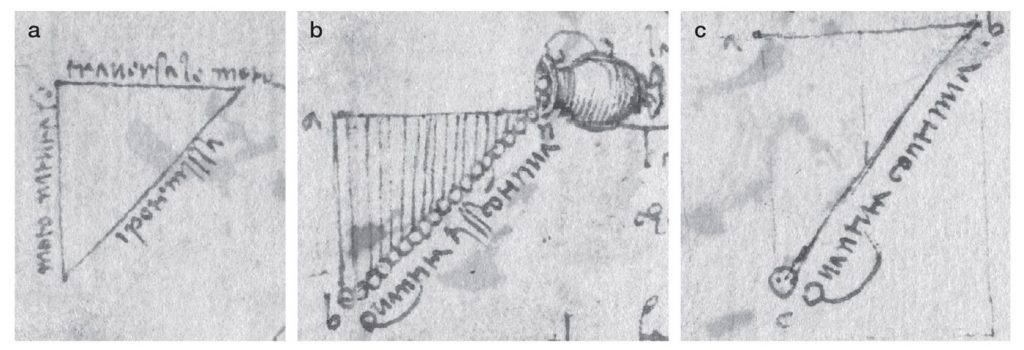 An illustration of an experiment devised by da Vinci to measure gravity. Image: Caltech
Da Vinci points out that if the jug movesuniformly with a given speed, then the falling material forms a vertical line and does not form a triangle, if it moves with a fixed acceleration, an inclined line is formed. At the same time, when the jug moves with the same acceleration that gravity gives the objects, the falling material forms an isosceles triangle.
Leonardo tried to form a mathematicalan equation that would describe this acceleration, but in this, as the authors of the study believe, has reached a dead end. He calculated that the distance to the falling object was proportional to 2 to the power of t (t is time), and not to the square of time. However, computer simulations showed that if the scientist carried out the described experiments, he could calculate the value of the gravitational acceleration with an accuracy of 97%.
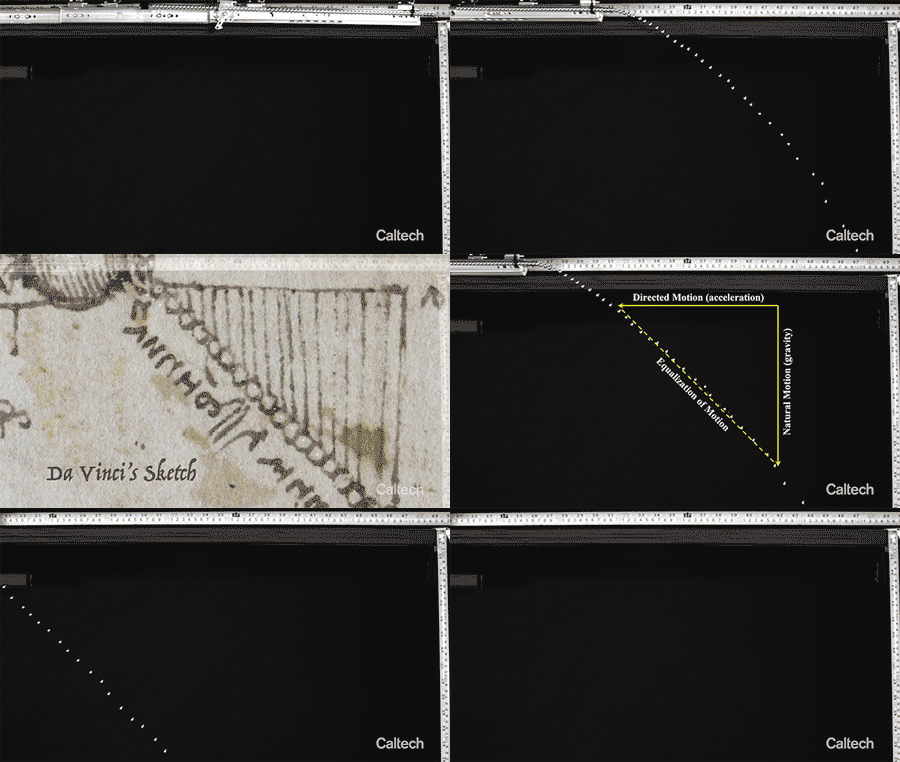 A da Vinci experiment modeled at the California Institute of Technology. Video: Caltech
Leonardo da Vinci lived from 1452 to 1519 and howthe authors of the study believe, was ahead of his time: he lacked the tools to formulate the final law. Nevertheless, using the methods available to him - geometry, he came as close as possible to the discovery of the laws of gravity. After him, only in 1604, Galileo Galilei put forward the hypothesis that the distance traveled by a falling object is proportional to the square of time, and in the middle of the 17th century, Isaac Newton expanded this theory to develop the law of universal gravitation.
Read more:
Remains of 'delicacy' meal found in Neanderthal cave
Substance from the "grandfather's beard" improves memory and neuronal growth
It turned out that the drug for arthritis "reverses aging" and rejuvenates the body