To eat, hide from predators, cool down and check the route - scientists believe that these are the reasons
How to live kilometers under water?
To live at such depths, creatures have evolveddifferent anatomical and physiological features. For example, they are covered in thick, insulating fat, their blood vessels act as heat exchange systems, and they have oxygen-storing lungs and hypersensitive eyes.
Why would these creatures dive so deep?
For most biologists, the answer is obvious: food.However, this was very difficult to prove. After decades of research, there is enough indirect evidence that many large predators dive so deep to the bottom in search of prey.
But food may not be the only factor. The behavior of deep sea animals and the way they dive is different. Some dive several times an hour, others much less frequently.
Fish, turtles, sharks and, in general, most sea creatures descend to depths of 200 to 1,000 m. This region is called mesopelagic, another name for it is the twilight zone.
Biologists studied these swims and noted that theyhappen differently. For example, in one case the animals sank quickly and also quickly emerged, while in the other, on the contrary, they swam slowly and for a long time. Scientists conclude that if creatures dive in different ways, then their goals are different.
There are many suggestions why you need to diveslowly. One theory is that deep, dark water makes it easier to hide from predators or cool off. Biologists put forward various hypotheses, but none of them is dominant.
How to hide from a predator at depth?
Yellowfin tuna - Thunnus albacares - conductsspends most of its time in the upper 200 m of the ocean. In 2020, biologist Tim Lam of the University of Massachusetts Boston reported that six of 17 tuna he tagged with devices appeared to have encountered a predator.
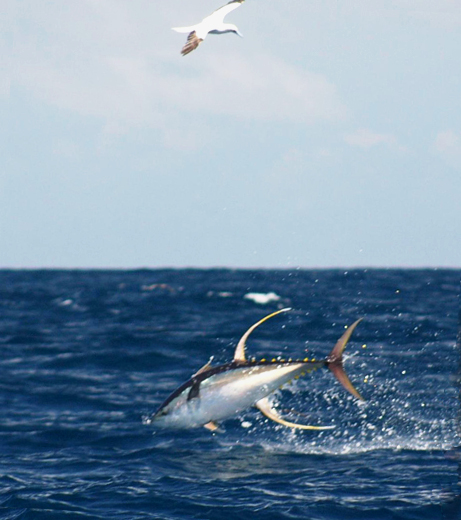 yellowfin tuna
Four tuna dived sharply to the bottom - three of them about 1,000 meters deep - and then they lost their tags. Another one suddenly descended from a depth of 134 m to 1,592 m.
Elephant seals apparently also divegreat depth to avoid meeting with enemies. During the study, biologist Selen Fregosi of Oregon State University attached tags to young elephant seals that unexpectedly produced different sounds, such as echolocation clicks and whistles from elephant seal enemies, killer whales and sperm whales. From these sounds, elephant seals began to dive sharply into the depths.
Last year, researchers reported thatelephant seals do not just hide in the dark, but also rest there. Most likely, these creatures will die if they live in the brightly lit upper layers of the ocean, where sharks and killer whales are often found. The researchers found that they prefer to rest at a depth of several hundred meters. And the more mature and powerful an individual becomes, the deeper it sinks.
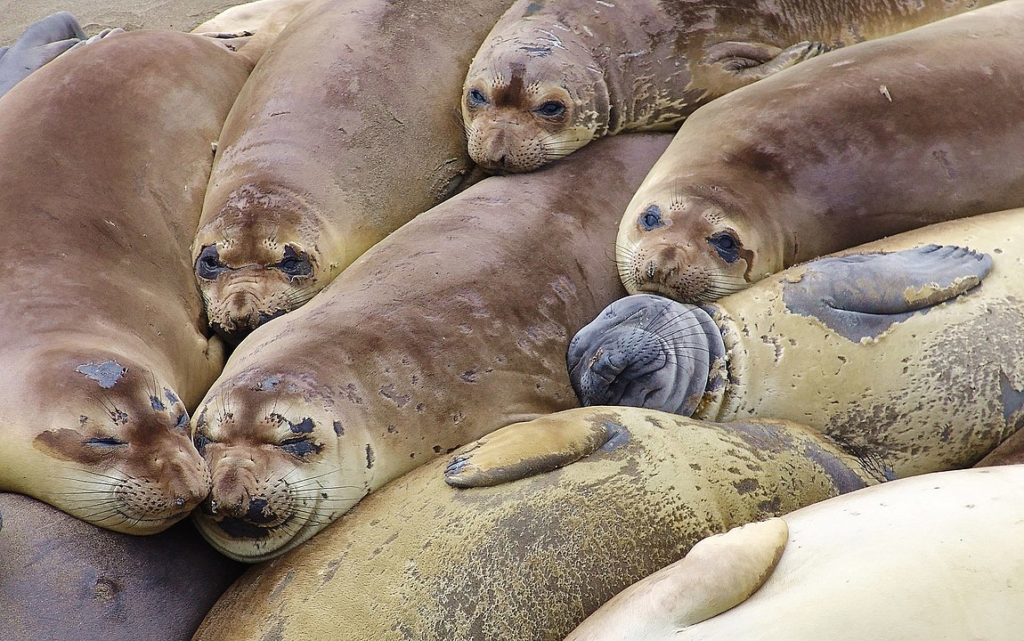 sea elephants
What creatures live at the deepest depths?
Nearly all oceanic vertebrate species canswim in depth. This is done by large vertebrate fish such as tuna and swordfish. Dive cartilaginous sharks and rays, as well as air-breathing animals - penguins, sea turtles, toothed whales and seals. All of them can reach extraordinary depths with just one breath of air.
Most of them dive so deep thatreaches the twilight zone, where light almost disappears. Some even plunge into the blackness of the midnight zone - this is the bathypelagic zone, which begins at a depth of 1,000 to 4,000 m.
Today's record holder for the deepestswimming - Cuvier's beaked whale: in 2014 it reached 2,992 m off the coast of Southern California. The record for catching fish belongs to the whale shark, which in 2010 plunged 1,928 meters into the Gulf of Mexico.
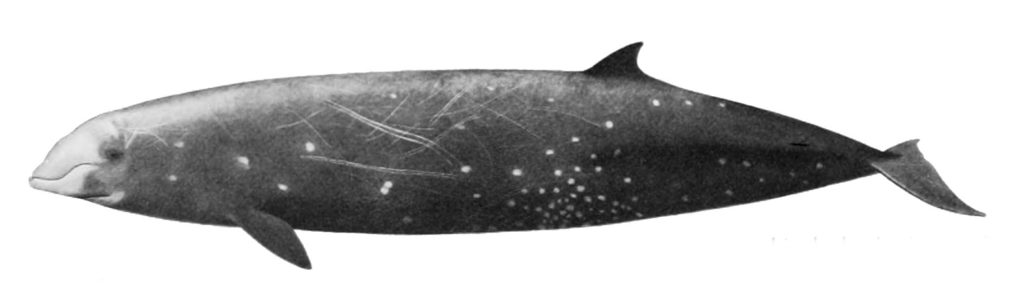 Cuvier's beaked whale
In the 19th century, naturalists believed that at depthFew live above 500 m, but in the 1940s, Navy sonar operators discovered an area in which their device detected a variety of mesopelagic organisms. This food-rich layer moved up and down: at night, organisms surfaced to feed, and during the day they went back into deep water.
In the twilight zone of the ocean was suddenlymany diverse living creatures: muscular squids, lantern fish and bristletooths. In 1980, fisheries scientists estimated the global biomass of mesopelagic fish at one billion metric tons. In 2014, a study based on acoustic research suggested that the figure should be 7 to 10 times higher.
Why else do marine animals dive so deep?
Another common theory is for navigation. Almost all large marine predators migrate at some point in their lives, and these are enormous distances.
It is known that some of them, including sharks and turtles, can pick up signals from the Earth's magnetic field, and also perceive magnetic strength and anomalies.
If the animal senses this signal, then it candive deeper to enhance perception. For example, leatherback turtles dive to extreme depths during long migrations. It is assumed that in this way they check with the route.
There is only one example of a species that dives,to cool off. Atlantic bluefin tuna spend several months each year in the frigid waters of the temperate zone and have developed a highly efficient way of keeping their body warm.
The latest theory is that at largeIt is more convenient for sea creatures to communicate in depth. In a zone that starts from hundreds to several thousand meters, sound travels further. When blue whales and fin whales are in this zone, they can hear each other from approximately 1,700 km away. But scientists still don’t know whether they swim to such depths specifically for this purpose.
Read more:
Elon Musk's Noah's Ark Will Take One Million People to Mars
Astronomers from Japan have found an unknown structure in the galaxy
Saber of unknown origin found in Greece. Scientists puzzled by a strange artifact