Scientists from the University of Chicago decided to revive smart devices to see if it would change
Slime mold (Physarum polycephalum) orslime mold is a single-celled microorganism that has electrically conductive properties. The organism is placed in a housing on the watch and the user must regularly feed it a mixture of water and oats to stimulate its growth. When the slime molds reach the other side of the body, they form an electrical circuit that activates the heart rate monitor function. These living organisms can also enter a dormant state when not being fed, allowing it to be reborn after days, months, or even years.
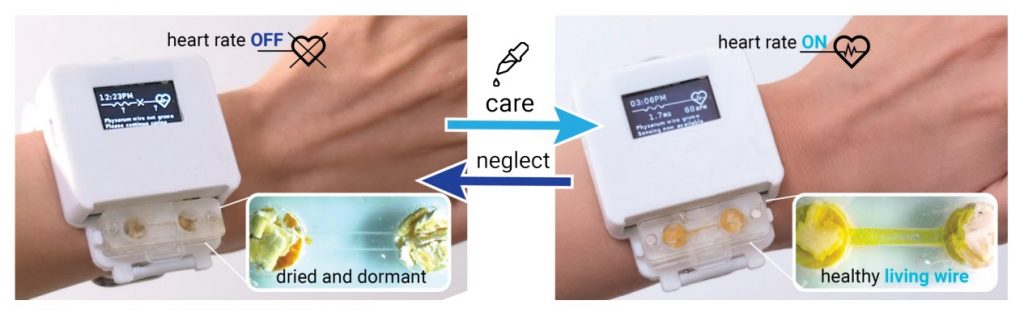 In the dormant state (left), the contact is broken andthe device does not measure the pulse, but if the mold is fed, it comes to life (right) and the heart rate monitor is activated. Image: Jasmine Lu, Pedro Lopes, University of Chicago
The researchers tested the new device withparticipation of volunteers. During the first week, they had to feed their pets until the heart rate monitor function was activated. After that, it was necessary to stop leaving and wait until the organisms hibernated. Throughout the experiment, participants described their experiences in a diary.
Researchers found high levelsattachment to watches: some participants in the experiment said that they treated devices like pets. The watches were given names, and participants gave their partners responsibility for feeding when they could not do it themselves. At the same time, it turned out that the feeling of affection was much stronger than for electronic pets such as Tamagotchi.
Cell phones, laptops and smart watches areconstant companions of most people, with whom they do not part day or night, the authors of the study note. But when those technologies fail or a new model hits the stores, many people are quick to throw away or replace their device without a second thought. The researchers in this and future experiments want to see if technology revitalization will help reduce the growing amount of e-waste.
Read more:
Does science exist in extreme conditions? We answer in numbers
Scientists have found out who benefited from the death of dinosaurs
Look at the photo of the Earth from space: it was made by the first private module