An international team of astrophysicists has combined observational data from the IXPE and Chandra space observatories to
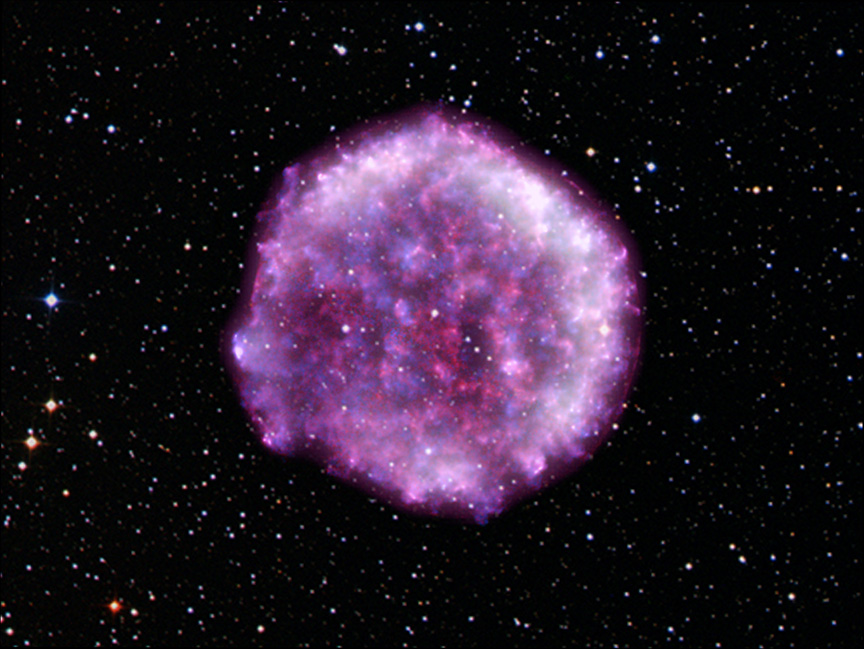 Composite image of supernova remnant SN1572, including X-ray data from Chandra and IXPE observatories and optical observations from the Digitized Sky Survey. Image: IXPE: NASA/ASI/MSFC/INAF/R. Ferrazzoli, et al., Chandra: NASA/CXC/RIKEN & GSFC/T. Sato et al. Optical: DSS, Image processing: NASA/CXC/SAO/K. Arcand, L. Frattare & N.Wolk
The researchers were able to measure the polarizationX-rays from supernova remnants to describe the geometry of the supernova's magnetic field. Polarized radiation is produced by electrons moving in a magnetic field in a process called "synchrotron radiation". An analysis of the direction of polarization helps to understand how SN 1572 and similar objects accelerate particles to superspeeds.
In the new image, the researchers combinedradiation polarization data (dark purple and white) with Chandra data (red and blue). The thin red line around the supernova remnant visible in the image shows areas where electrons were accelerated to high energies, spiraling around magnetic field lines and producing X-rays.
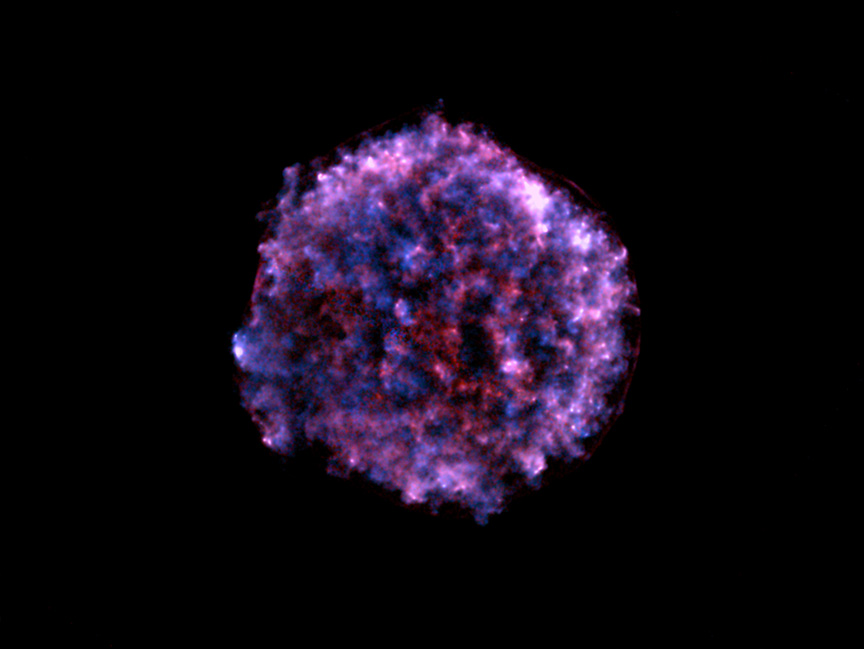
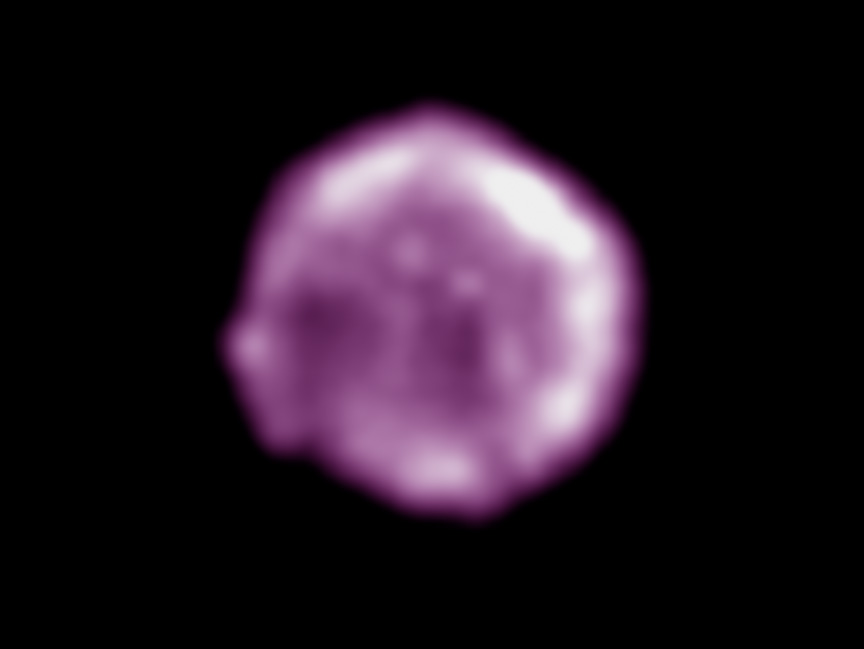
Supernova SN 1572.X-rays captured by Chandra (left) and their polarization studied by IXPE. Image: IXPE: NASA/ASI/MSFC/INAF/R. Ferrazzoli, et al., Chandra: NASA/CXC/RIKEN & GSFC/T. Sato et al.
SN 1572 is one of the most famous supernovaetype la. This is a thermonuclear explosion that occurs when a white dwarf in a binary system pulls material from its companion star until it reaches its mass limit, or when two white dwarfs merge.
The remnant after the explosion of this supernova is oftencalled "Tycho Brahe's supernova" in honor of the Danish astronomer who was one of the first to discover and describe the explosion of a star observed in 1572. It is believed that this is the event that Shakespeare describes in Hamlet: the playwright could observe a new bright star in the sky when he was 8 years old.
Read more:
The mystery of the red stripes on the satellite of Jupiter is revealed
Found "impossible" planet. She defies modern science
Archaeologists have found an ancient Roman analogue of barbed wire