One wide-angle shot reveals the planet's unique arrangement, its faint rings and two small
In addition to the huge storm calledAlso visible in the large red patch are numerous storm systems, visible as small pale ovals, as well as tiny bright plumes of cloud particles. The transition between organized zonal currents and chaotic vortex patterns at higher latitudes is also clearly visible.
JWST's Near Infrared Camera (NIRCam) also captured a wide-angle image of Jupiter, showing its rings and its two moons.
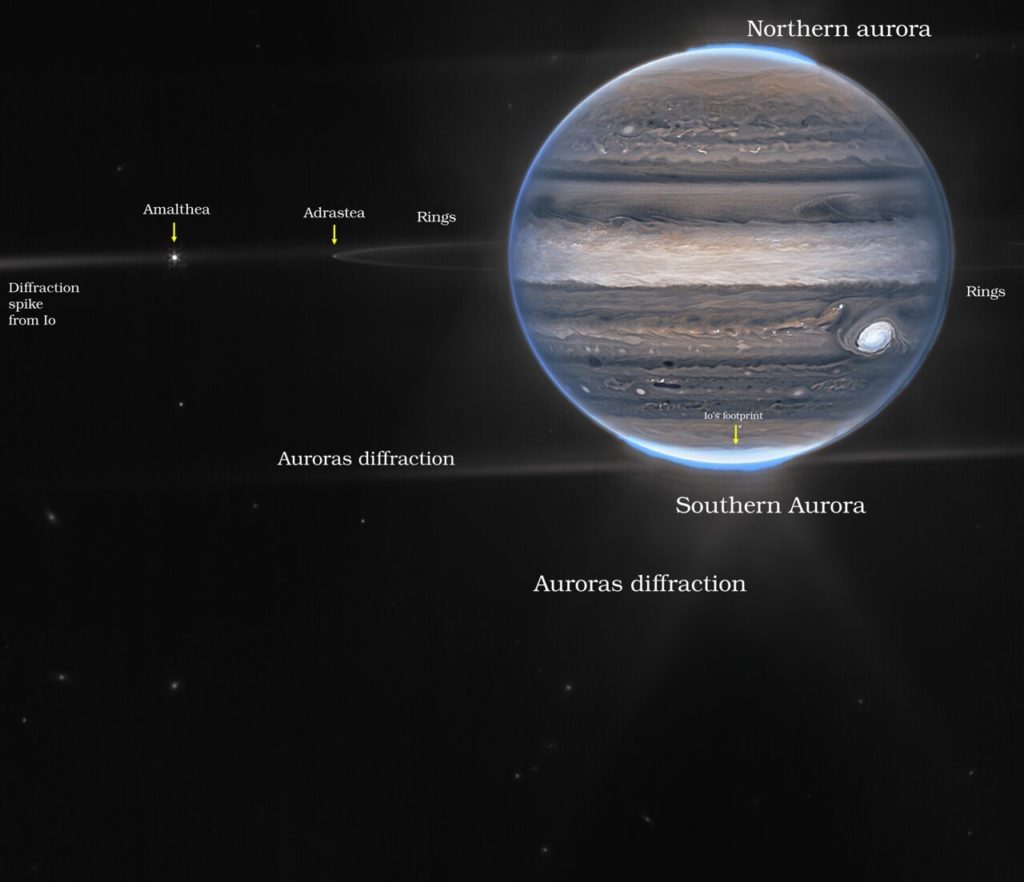 The image shows the rings of Jupiter and some of its small moons, along with background galaxies.
Credit: NASA, European Space Agency, Jupiter Early Launch Research Team.
Image Processing: Ricardo Hueso [UPV/EHU] and Judy Schmidt
JWST images were processed with the helpcitizen scientist Judy Schmidt of Modesto, California, who has been working with the Hubble Space Telescope and other telescopes for the past 10 years, and Ricardo Hueso, who studies planetary atmospheres at the University of the Basque Country in Spain. Hueso is one of several co-investigators in the Early Release Science (ERS) program and leads NIRCam observations of Jupiter's atmosphere.
Spectroscopic observations of aurorasJupiter is scheduled for later this year, and detailed spectroscopic observations of Jupiter's Great Red Spot were made on July 27 in the near infrared and on August 14-15 in the mid-infrared. Observations of the Great Red Spot is a joint project of the Early Release Science (ERS) group and the solar system observation program developed by Heidi Hummel of the Association of Universities for Research in Astronomy (AURA).
Read more:
Scientists have found a black hole that is 50 times larger than galaxies
Physicists have shown that water turns into two liquids at low temperatures
Russia has invented an alloy that can withstand the energy of a thermonuclear reactor