For centuries, ancient civilizations cooled their buildings using the natural freshness of water
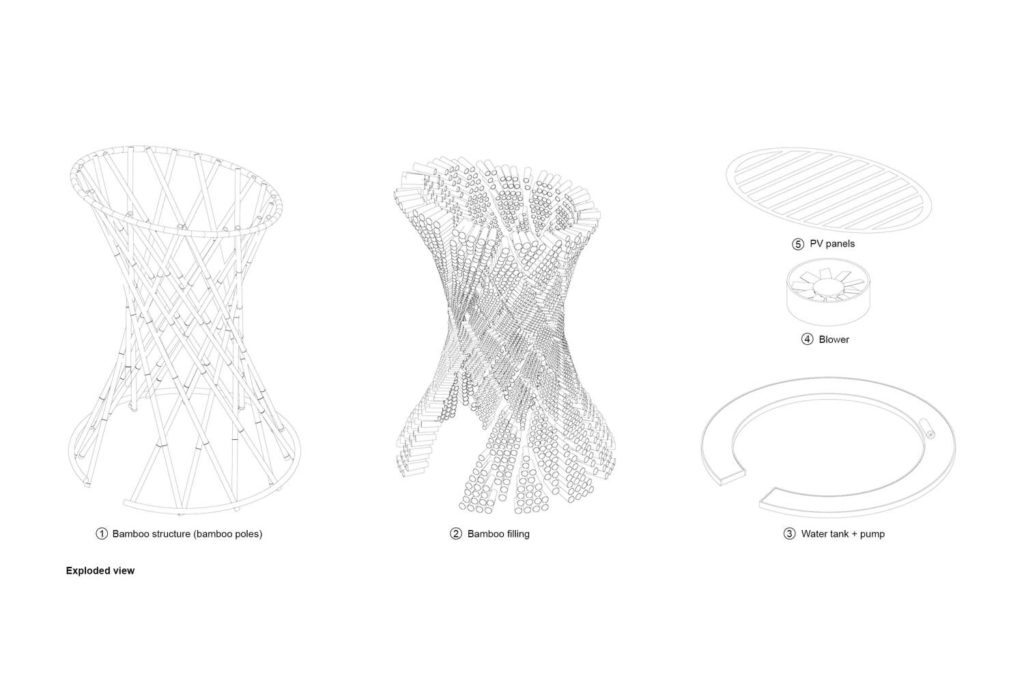 Structural diagram of the device
Laureate of the Seoul Biennale of Architecture andUrbanism 2021 (SBAU2021), the prototype for adiabatic urban cooling can be thought of as a pond in a park in the summer: the closer you get to it, the cooler the air seems. To replicate this effect, the AREP team turned to Vietnamese craftsmanship common in rural areas, where each village specializes in a particular craft involving bamboo, silk and pottery. “This helped us design a low-tech cooling device using the adiabatic principle combined with the know-how of a local craftsman,” the team elaborates.
The bamboo cooling tower has a hyperboloid shape forstructural stability. Between the main poles there is a medium through which water flows under the influence of gravity. At the center of the system is a fan that captures hot air from above and forces it to the lower levels. As it crosses the water twice, the air naturally cools due to the adiabatic principle.
To prove the effectiveness of your design,AREP decided to test and build a prototype in Hanoi. The team shares their findings: “We developed our own parametric digital BIM model to explore different potential shapes and cooling effects, and with the help of a local bamboo craftsman were able to create a full-scale working prototype. On test day we were able to lower the temperature by 6°C (from 30°C to 24°C), which confirmed the viability of the design and greatly improved the outdoor experience as you could actually feel the cooler air around the device.”
Read more:
A monster black hole was found in the "backyard" of the Earth: it is very close to our planet
NASA revealed the origin of Haumea - the most mysterious planet in the solar system
Webb photographed the Pillars of Creation. Compare how Hubble took them before GPS Starlink hacksp