Astronomers around the world observed an unusually bright and long-lasting pulse of high-energy
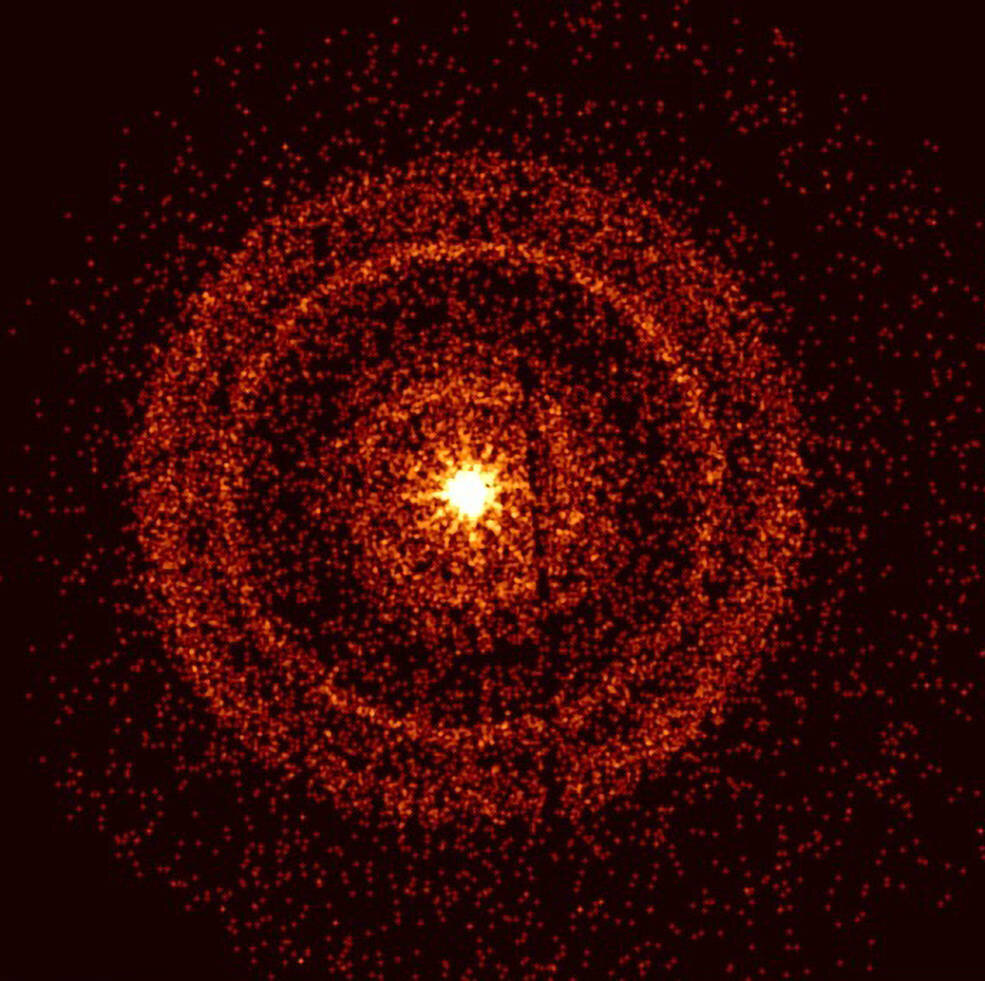 The Swift X-ray telescope recordedafterglow of GRB 221009A approximately one hour after discovery. The bright rings form as a result of the scattering of X-rays from otherwise undetectable layers of dust within our galaxy. Photo: NASA/A. Beardmore (University of Leicester)
At the beginning of October, a wave of X-rayand gamma rays passed through the solar system, triggering detectors on board NASA's Fermi Gamma-ray Space Telescope, Neil Gehrels Swift Observatory and the Wind spacecraft, among others. Scientists around the world have sent telescopes to the site to study the effects of the explosion and are continuing to make observations.
The Fermi Large Telescope sequence shows the gamma-ray sky at the location of GRB 221009A. Credit & Copyright: NASA/DOE/Fermi LAT Collaboration
The explosion was named GRB 221009A.The signal, coming from the constellation Sagittarius, took approximately 1.9 billion years to reach Earth. Astronomers have called it the "cry of birth of a new black hole" that has formed in the heart of a massive star that is collapsing under its own weight.
Images taken in visible lightThe Swift Ultraviolet/Optical Telescope shows how GRB 221009A's afterglow (circled) faded within about 10 hours. Copyright: NASA/B. Tsenko
Under these conditions, a nascent black holesets in motion powerful jets of particles moving at speeds close to the speed of light. These jets pierce the star, emitting X-rays and gamma rays as they shoot into space.
Read more:
Created a compact nuclear reactor for safe energy production
Unusual structures found on the edge of the solar system. Only the Voyagers have been there.
Black hole 'spit out' torn star three years after swallowing