Ahead of Christmas and the start of the 37th Martian year (26 December 2022) European Space Agency
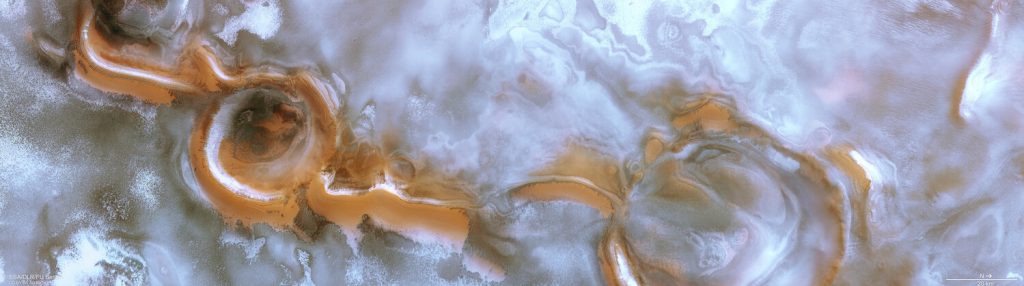 Impact craters near the south pole of Mars. Image: ESA/DLR/FU Berlin, CC BY-SA 3.0 IGO
In the picture you can see two large drumscrater, inside which alternate layers of ice and small sediments. These "polar layered deposits" are also visible in great detail in the rusty red ridge connecting the two craters. Throughout the image, dark dunes and dune fields are visible, in places covered with a thin layer of frost. The dune fields create sharp ridges that run parallel to the prevailing wind direction.
Individual dark spots in the image are associated withprocess characteristic of the polar regions. Jets of carbon dioxide produced by the sublimation of ice into gas break through the ice, throwing out a fountain of dark dust that settles in these round spots.
 Enlarged view of the crater. To the left of the “ridge” connecting the two craters, circles formed by the sublimation of carbon dioxide are visible. Image: ESA/DLR/FU Berlin, CC BY-SA 3.0 IGO
The researchers note that during the seasonalCycle in winter, carbon dioxide ice is deposited at the poles of Mars, which sublimates in spring. From 12 to 16% of the planet's atmosphere "falls out" at the poles every winter. The release of gas in the spring increases atmospheric pressure and leads to the formation of strong winds. This continuous process ensures the exchange of substances between the surface and the atmosphere during the Martian year.
The image was taken with a camerahigh-resolution stereo images installed aboard the Mars Express spacecraft. This is an automatic interplanetary station developed by ESA that explores the Red Planet from orbit.
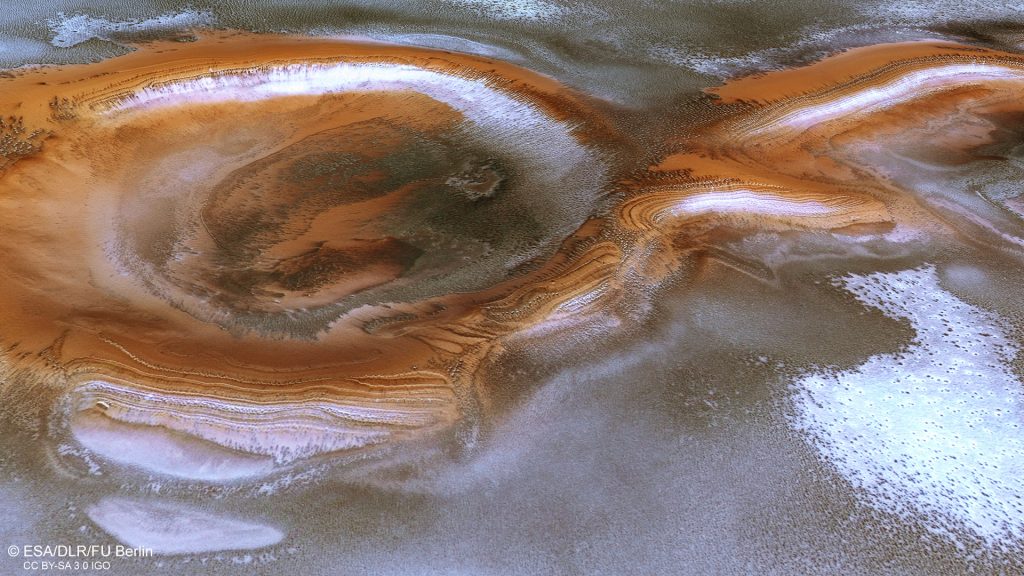 Enlarged view of the crater. Image: ESA/DLR/FU Berlin, CC BY-SA 3.0 IGO
Read more:
First-of-its-kind material withstands 'projectiles' that travel at the speed of sound
A shock wave from the Sun has opened a crack in the Earth's magnetic field
17-year-old engineer came up with a magnetless motor: it can be used in electric vehicles