Astronomers from Dartmouth College studied the Pa 30 nebula.
With the help of the 2.4-meter Hiltner telescope inDartmouth College researchers and astronomers took pictures showing a firework-like burst of thin filaments emanating from a very unusual star at the center of Pa 30. This is a dense region of illuminated gas and dust. The researchers showed that Pa 30 is virtually free of hydrogen and helium, but is instead rich in sulfur and argon.
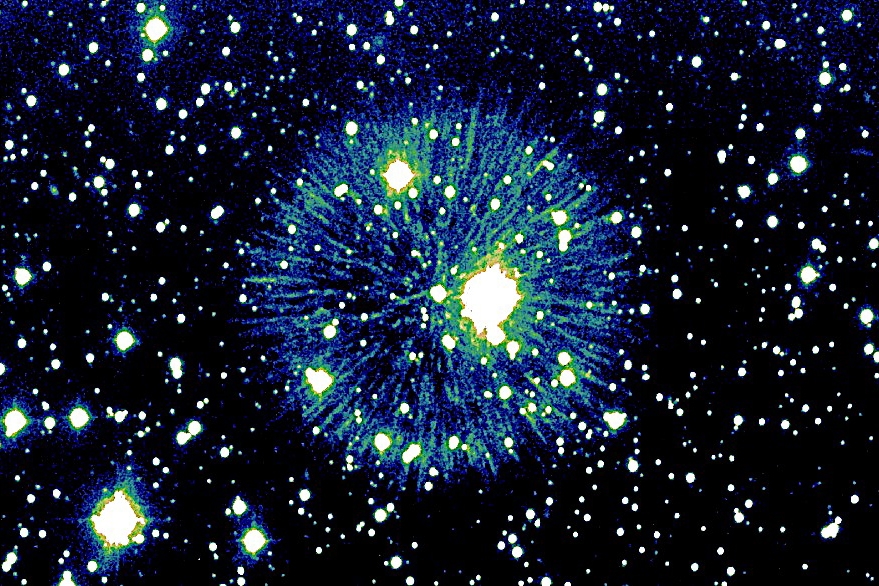 New image of the Pa 30 nebula. Image: Robert Fesen, Dartmouth
The formation of the Pa 30 nebula occurred inthe result of a lax-type supernova explosion in which the central star is preserved. One of the possible sources of this type of explosion is the collision of two white dwarfs. Recall that these are stars that are at the final stage of evolution. They are extremely dense: a mass comparable to the Sun is compactly packed into an object the size of the Earth.
The chemical composition of the nebula (low contenthydrogen and helium) confirm this hypothesis, the scientists say. The simulations, which take into account the composition of Pa 30 and the speed at which it is expanding—about 3.8 million km/h—correspond to an explosive collision between two white dwarfs that formed the nebula.
A study by astronomers from Dartmouth College confirms and develops the preliminary hypothesis of Russian scientists who first identified a star at the center of Ra 30 in 2019.
Read more:
Scientists have come up with a new treatment for hypertension. It has proven to be effective
Humans still have fur genes, but they are temporarily turned off
Look at the unusual "family portrait" of the Moon and the ISS. This photo was taken by an amateur