The image shows several spiral and irregular galaxies located in the constellation Hercules.
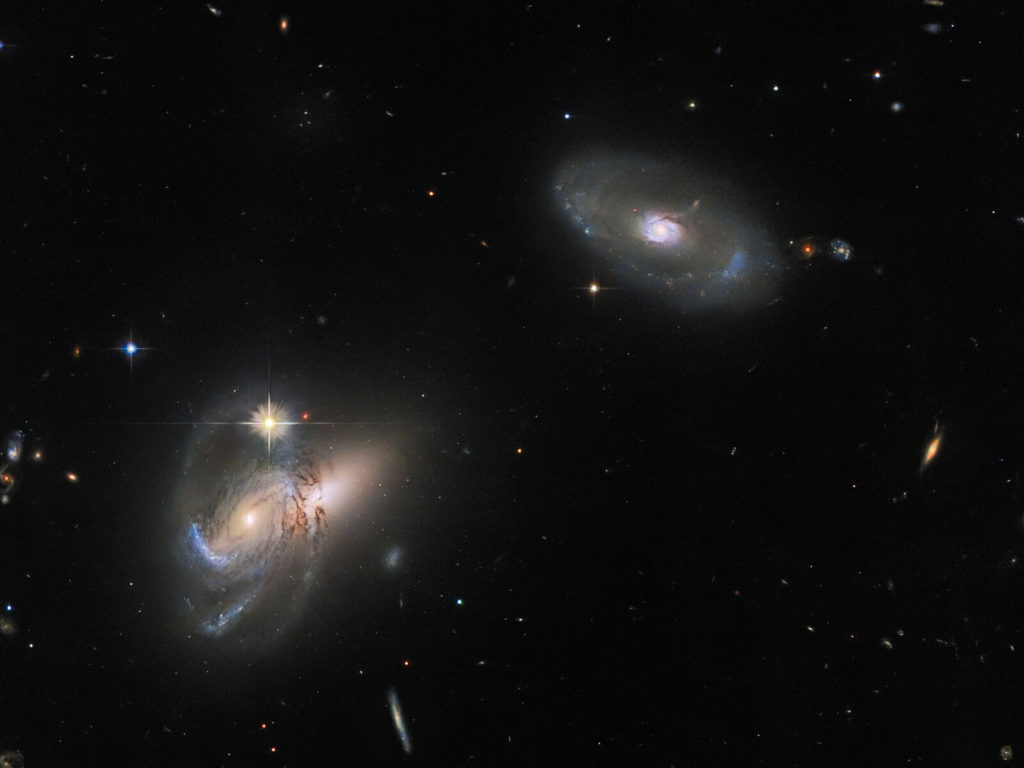 Galaxies in the constellation Hercules. Image: ESA/Hubble & NASA, W. Keel
The other two objects seem to overlap each other.friend. This active galactic nucleus is called SDSS J162558.14+435746.4 and partially obscures the galaxy SDSS J162557.25+435743.5. Both of them are located farther from the Earth than LEDA 58109. At the same time, the active nucleus of the galaxy seems brighter, because it is fueled by accretion of matter from a supermassive black hole in the center.
At the European Space Agency (ESA)note that this image is characterized by a variety of galactic forms. Although most galaxies are usually divided into two types - elliptical and spiral, in fact, their diversity is much wider. In addition to the main types, for example, lenticular galaxies are distinguished, which are in many ways similar to spiral galaxies, but do not have a pronounced pattern. And there are irregular galaxies that are different from all the others.
In addition, the sample of galaxies in the image is alsoillustrates a wide variety of names, note the ESA. For example, there is a galaxy with a simple name - LEDA 58109, and there are complex ones, consisting of many numbers and letters. This is due to the variety of cataloging systems that display celestial objects in the night sky. No catalog is exhaustive, and they cover overlapping regions of the sky, so that many galaxies belong to several different catalogs and have different names.
Cover image: Hubble Space Telescope. Photo: ESA
Read more:
Scientists filmed a strange creature with tentacles, which they mistook for a flower
An out-of-control Chinese rocket will soon fall back to Earth. What's happening
Marine archaeologists find wreckage from medieval shipwreck