The James Webb Space Telescope captured one of the first wide-angle images of mid-space
 Wide-angle image of medium depth space. Image: NASA's James Webb Space Telescope. You can view it in maximum resolution by following the link.
“Medium depth” refers to the weakestobjects that can be seen in this image, which are approximately 29th magnitude. This is about a billion times fainter than what can be seen with the naked eye. The image shows thousands of galaxies across a huge range of distances and times. Light from the most distant of them took almost 13.5 billion years to reach the Earth.
Many of the galaxies seen in the image have been discovered for the first time. In addition, the combined image shows the stars of our Milky Way galaxy in new detail.
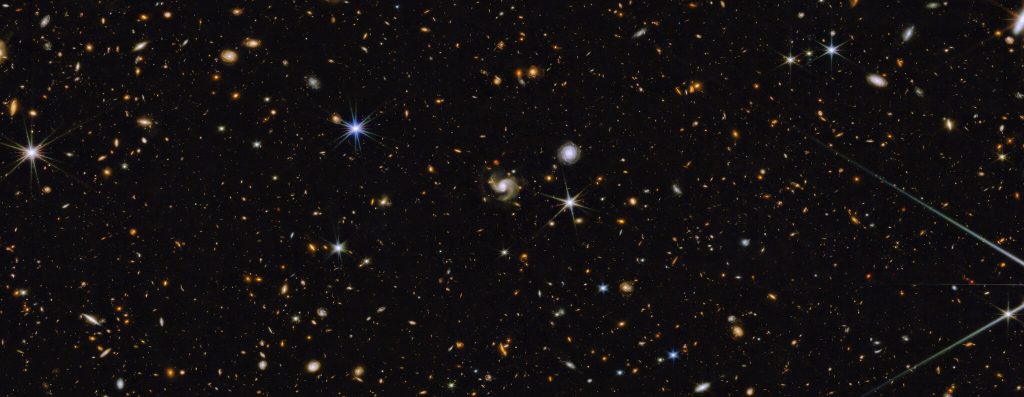 A section of a wide-angle image of space of medium depth. Image: NASA's James Webb Space Telescope. You can view it in maximum resolution by following the link.
The picture was taken with a near camera.Webb Infrared (NIRCam) and the Hubble Telescope's Wide Field Camera (WFC3). The researchers used filters that collectively cover light with wavelengths ranging from 0.25 microns to 5 microns. The image includes eight different colors of near-infrared light captured by Webb, complemented by three colors of ultraviolet and visible light from the Hubble Space Telescope.
This image is part of morea large-scale study that will cover an area about four times larger. The area of the sky is chosen so that "James Webb" can observe it 365 days a year. This will make it possible to detect time-varying objects at record distances, such as exploding distant supernovae and bright accretion gas around black holes in active galaxies, the study authors say.
Read more:
Does science exist in extreme conditions? We answer in numbers
Scientists have found out who benefited from the death of dinosaurs
Look at the photo of the Earth from space: it was made by the first private module