The development is intended for rapid remote monitoring of the underwater environment. The robot,
As engineers note, the development of airThe proven industry standard of drones was chosen for the robot. MEDUSA moves using a multicopter equipped with lifting propellers. Once it reaches the water surface, the drone lands and deploys a mobile underwater capsule with an attached camera and sensors.
MEDUSA is equipped with sensors to measuretemperature and pH level. In addition, the robot shoots video and takes water samples to determine the presence of microorganisms. It is noted that the system can descend to a depth of 10 m.
Drone operator in real timereceives information from sensors and a video image. With a remote control, he can adjust the depth and three-dimensional position of the capsule in the water, controlling the buoyancy and jets.
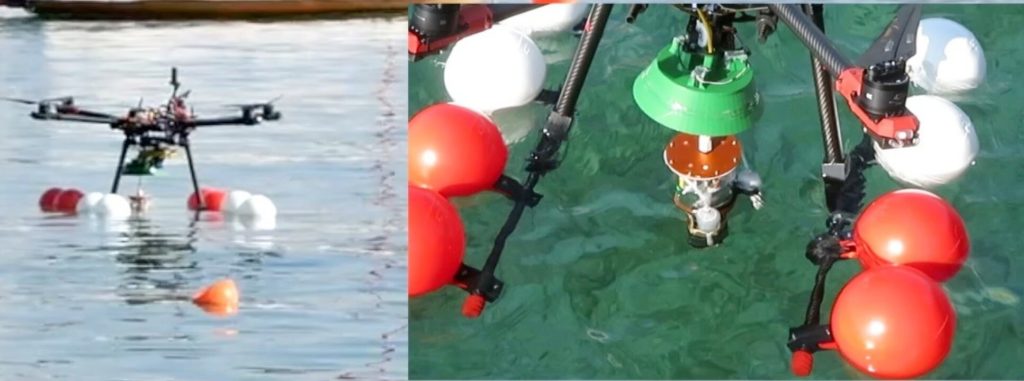 Image: Aerial Robotics Lab, Imperial College London
The researchers believe that the new developmentuseful for environmental research in hard-to-reach regions. Ecologists usually use boats to observe water areas. Replacing the traditional approach with the robotic MEDUSA will help reduce the risk to humans, especially in the harsh environment of the Arctic Ocean.
MEDUSA is unique in its dual design.Our robot has a flight component that can reach hard-to-reach places and a diving component that monitors water quality. Our drone greatly simplifies robotic underwater monitoring by performing complex tasks that would otherwise require boats.
Mirko Kovacs, Director of the Air Robotics Laboratory at Imperial College London
Cover image: Aerial Robotics Lab, Imperial College London
Read more
The Japanese dumped a giant turbine into the ocean to get endless energy from the current.
Astronomers from Japan have found an unknown structure in the galaxy
Researchers filmed a 'hidden' ecosystem in an Antarctic river