The European Space Agency has published a new image taken by the Hubble Space Telescope. On
 Galaxy JW100 as seen by the Hubble Telescope. Image: ESA/Hubble & NASA, M. Gullieuszik and the GASP team
The thin spiral galaxy JW100 is depicted inlower right corner of the photo. It is visible from the edge. The galaxy has an unusual shape: mottled blue trails extend below it, resembling tentacles, consisting of star-forming regions.
These streams are formed as a result of the process,which is called "tidal stripping". It occurs when galaxies collide with gas that permeates galaxy clusters. As galaxies pass through this rarefied gas, it blows dust and gas out of the galaxy itself like wind and creates long plumes.
 An enlarged view of the JW100 galaxy. Image: ESA/Hubble & NASA, M. Gullieuszik and the GASP team
Another one stands out in the same imagegalaxy IC 5338. It is visible in the upper left corner as a bright spot with two centers. This galaxy belongs to the type cD, giant epileptic galaxies. Such galaxies often have multiple nuclei. They are thought to grow by engulfing smaller galaxies, whose nuclei can take a long time to absorb.
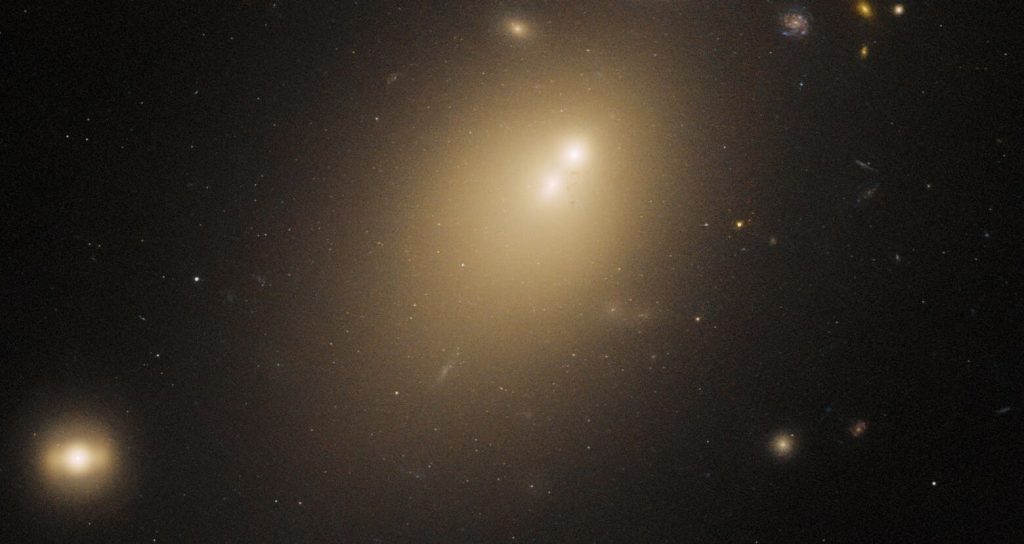 Close-up view of galaxy IC 5338. Image: ESA/Hubble & NASA, M. Gullieuszik and the GASP team
Read more:
One planet can put an end to life on Earth: how scientists have proven the fragility of the solar system
Treasure found that was hidden during the war almost 1,000 years ago
Notre Dame fire helps scientists unravel the secret of the cathedral's construction