Researchers at the University of Colorado used laser imaging to show how tiny
The study showed that aerosol particlesquickly fly out with an initial speed of 2 m / s. Gradually slowing down, they reach a height of 1.5 m above the toilet within 8 seconds. The largest droplets settle on surfaces within seconds, while small aerosol particles (less than 5 microns in size) remain in the air for several seconds or longer.
Ejection of aerosol from the toilet bowl. Video: University of Colorado Boulder
In their work, the scientists used two lasers: one continuously shining on and above the toilet, and the other sending rapid pulses of light to the same area.The constant laser showed where the particles were in the air, and the pulsed laserThe whole experiment was filmed with two cameraswith high resolution.
For the study, scientists chose a toilet without a lidwith a cylindrical flush mechanism. This model is common in public toilets in North America and several other countries around the world. In the experiment, a new, clean toilet was filled with only water. The researchers note that the addition of waste products and paper can further alter the distribution of the aerosol spray and microparticles.
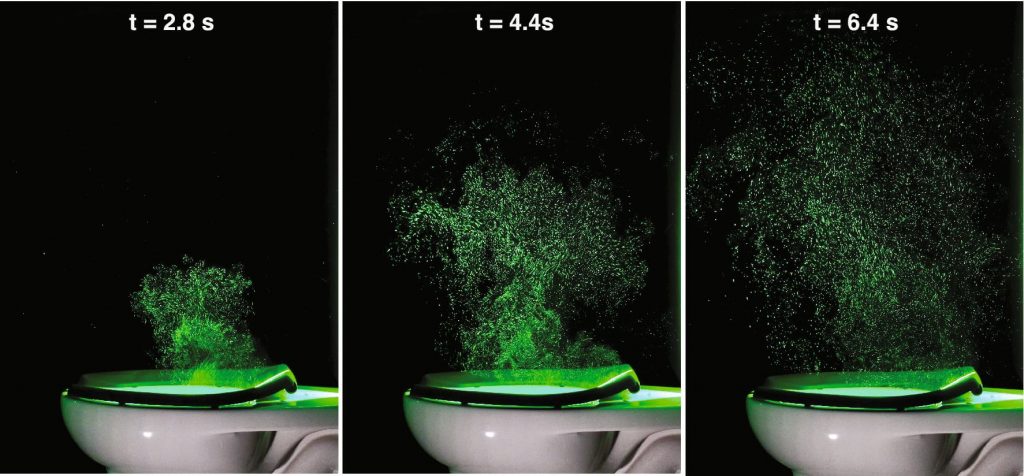 Emission of aerosol from the toilet. Image: John P. Crimaldi et al., Scientific Reports
Aerosol droplets can carry pathogens,such as Escherichia coli (E. coli), clostridia (C. difficile), noroviruses and adenoviruses. Understanding the trajectories and velocities of these particles is important to reduce the risk of infection through disinfection and ventilation strategies or improve toilet and flush design, the scientists explain. They note that when visiting public toilets, people are exposed not only to their own bacteria, but also to germs from previous visitors, which can remain in the toilet even after 10 flushes.
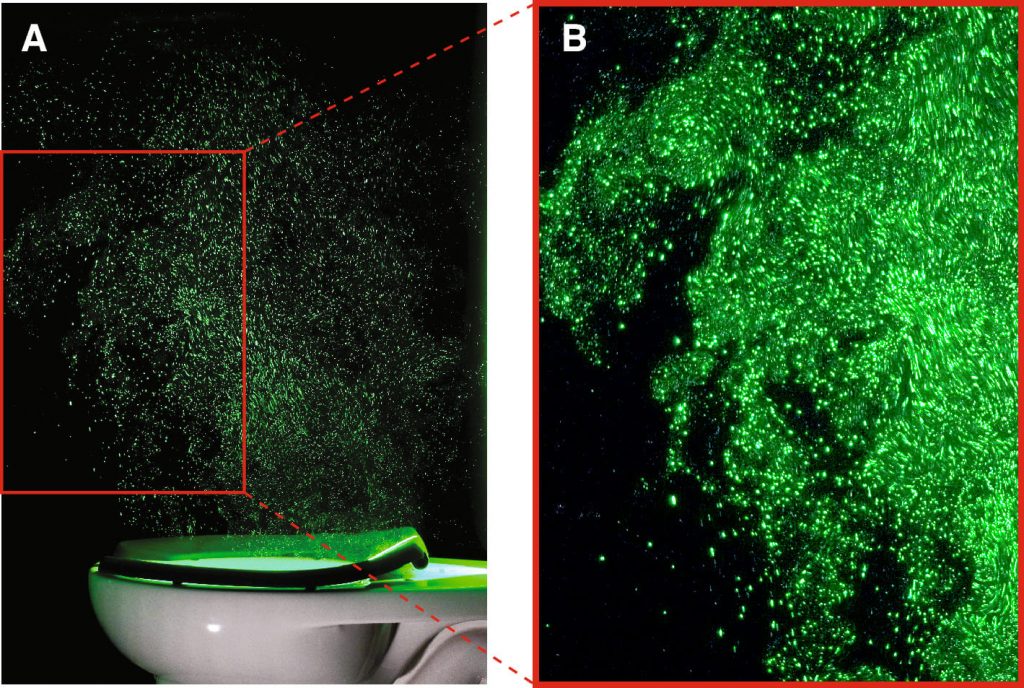 Emission of aerosol from the toilet. Image: John P. Crimaldi et al., Scientific Reports
Read more:
Scientists from the permafrost zone: how they develop smart clothes and a cancer vaccine
"The Walking Dead" existed millions of years ago: scientists told how they appeared
The egg was dropped from space: look what happened to it
On the cover: scheme of the experiment. Image: John P. Crimaldi et al., Scientific Reports