Scientists from Washington State University studied various variations of titanium alloys and
Delivery of materials into space can be veryExpensive. For example, launching one kg of payload into low-Earth orbit by a NASA shuttle costs about $54,000. Shipping cargo to Mars will cost even more. Therefore, scientists around the world are working to develop in-situ production technologies. They will use available materials for production.
In their work, the researchers produced variousparts for spaceships, adding from 5% to 100% of material imitating Martian regolith to the print mix. It is a black powdery substance similar in composition to the rocky inorganic material found on the surface of the Red Planet.
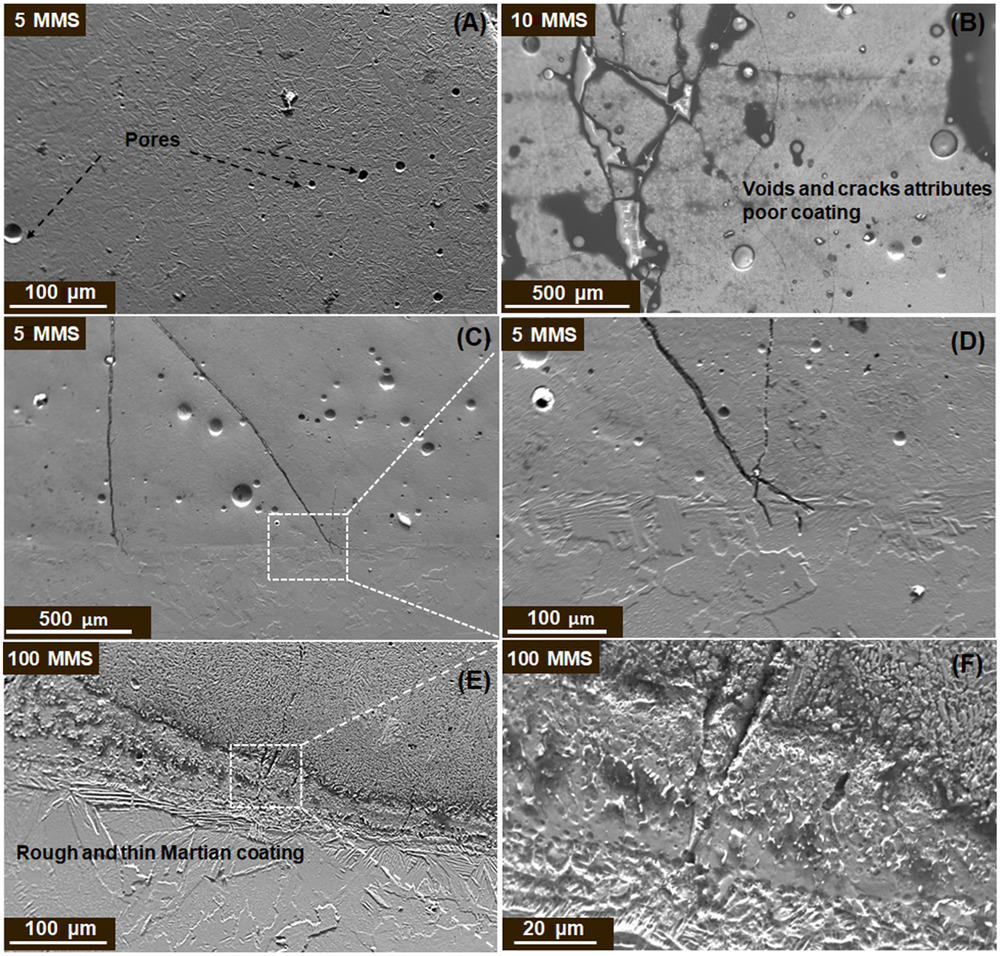 Samples printed with different amount of regolith: from 5% (5MMS) to 100% (100MMS). Image: Ali Afrouzian et al., Applied Ceramic Technology
During the printing process, a powerful laser heated the materialsto temperatures exceeding 2000°C. The molten mixture of Martian regolith, ceramics and metallic material was then poured onto the moving platform, allowing researchers to create various sizes and shapes. After the material cooled down, scientists tested it for strength and durability.
While details with 5% Martian regolithwere stronger than titanium pieces, parts made of 100% regolith turned out to be brittle and cracked easily. The researchers note that a mixture of ceramics, titanium and regolith is suitable for creating heavy-duty and lightweight rocket bodies. And brittle ceramics with pure regolith are suitable for creating a coating for protection against radiation, since cracks do not matter in this context.
Read more:
NASA reveals what the future of the solar system looks like
Physicists have cooled atoms to record temperatures. They are a billion times colder than outer space.
Researchers explain why India and Asia collided very quickly
On the cover: a selfie of the Curiosity rover with Mars in the background. Image: NASA