Every time you take a shower, you can see how small droplets of water combine to form larger drops.
To researchers from the University of Erlangen -Nuremberg (Friedrich-Alexander University of Erlangen-Nuremberg, FAU), the Max Planck Center for Physics and Medicine (Max-Planck-Zentrum für Physik und Medizin, MPZPM) and the Institute for the Physics of Complex Systems. Max Planck in Dresden (Max-Planck-Institut für Physik komplexer Systeme, MPI-PKS) was able to develop a statistical model to describe the formation, dynamics and mechanics of such cell colonies.
When bacteria conquer new territories, oneone of their first tasks is to unite and form microscopic colonies. Within these communities, microorganisms are better protected from external forces, antibiotics and other negative influences than individually. Therefore, in this form they are more dangerous for people and other organisms. This also applies to gonococci (Neisseria gonorrhoeae), which within a few hours form clusters of spherical cells on human skin (mucus), consisting of several thousand single-celled organisms.
Like many other bacteria, Neisseriagonorrhoeae have long, mobile filamentous processes - drank. They use them to attach to surfaces and move around. They help bacteria interact with each other and bond together to form colonies. Under a microscope, this process resembles the coalescence of water droplets.
Researchers from Erlangen and Dresden have now succeeded in describing this behavior of N. gonorrhoeae mathematically. Credit: Hui-Shun Kuan / FAU.
In a joint project led by a postdocHui-Shun Kuan (FAU), Wolfram Penisch (Cambridge University Postdoc), Professor Frank Yulicher (MPI-PKS) and Professor Vasily Zaburdaev, Head of the Department of Mathematics of Natural Sciences at FAU have developed a theory to describe these processes using methods of statistical physics. They use the forces acting between bacteria through pili as a starting point for their model. Thus, they were able to mathematically reconstruct the development of the colonies. The process is similar to condensation of a liquid or separation of two phases such as water and oil. When the number of bacteria per unit area exceeds a certain limit, they spontaneously combine and form a dense blob, surrounded by only a few individual cells.
These cell droplets are viscoelastic:they respond elastically to rapid deformation and move like a viscous fluid for a long period of time. The appropriate behavior they exhibit depends on whether the web of intertwined saws has time to rebuild. The researchers' model shows the central role of these filamentous projections in colony formation and how they determine their mechanical properties.
The results obtained can be generalized, as well asused to describe the mechanics and dynamics of dense clumps of cells, such as solid tumors or tissues. Thus, the theory can help physicians identify potential targets for slowing or even stopping the formation of bacterial colonies or tumors with new active substances.
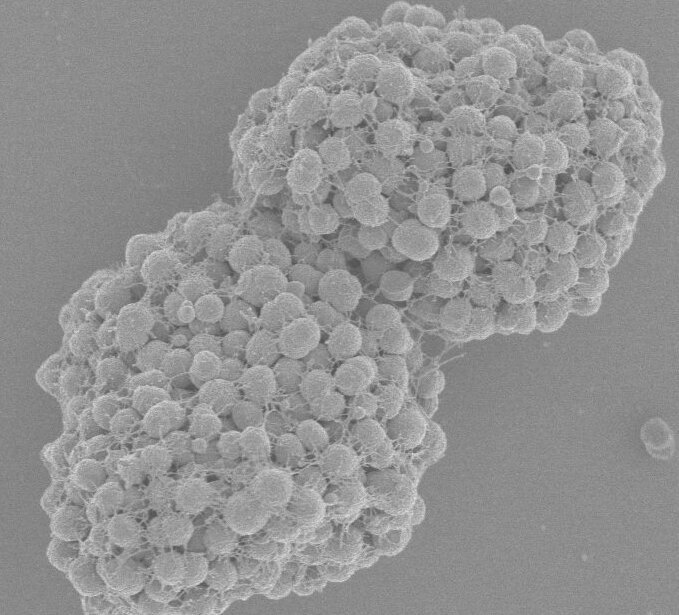 Neisseria gonorrhoeae bacterial species,the causative agent of sexually transmitted gonorrhea forms large colonies of several thousand cells within a few hours. Credit: Nicholas Bie / Brooklyn College
Read more
Abortion and science: what will happen to the children who will give birth
Scientists develop a new type of optical quantum computer
Named a plant that is not afraid of climate change. It feeds a billion people
A species of gram-negative diplococci of the genus Neisseria. They cause gonorrhea - an anthroponous venereal infection characterized by purulent inflammation of the mucous membranes, more often of the genitourinary system.
Postdoc is a researcher who has received a Candidate of Science / PhD or successfully defended a PhD and wants to pursue an academic career.
The term "solid formation" (cancer) occurs inoncology quite often. This is the name of a tumor formation that forms from its own elements or other cells and has clear forms and boundaries. Their striking feature is clear localization and division into two categories: benign and malignant.