For simple systems such as a swinging pendulum, the shape and size of the basin of attraction (Newton's basin)
In fact, they may look like tentacles.octopus, according to new work by Yuanzhao Zhang, a physicist and research fellow at the Santa Fe Institute, and Stephen Strogatz, a mathematician and writer at Cornell University. The intricate geometry of these multidimensional basins cannot be easily visualized. But in their paper, the researchers describe a simple argument showing why pools in systems with multiple attractors should look like multidimensional octopuses. As an example, scientists investigated a simple model - a ring of oscillators (systems that oscillate - "Hi-tech"), which, despite local interaction, can create many collective states, such as in-phase synchronization (with coincident phases - "Hi-tech"). A large number of coupled oscillators will have many attractors and therefore many pools.
“When you have a multidimensional system, the 'tentacles' will dominate the size of the pool,” says Zhang.
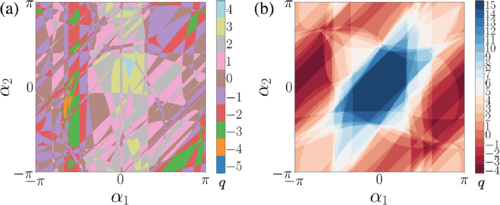
New work shows that the volume of multidimensionalbasin is not correctly approximated by a hypercube, no matter how tempting it may be. This is because the hypercube cannot cover the vast majority - more than 99% - of the points in the pool located on the "tentacles".
The document also states that the theme of swimming poolslarge size opens up a huge field for new research. “The geometry of these basins is very far from what we know,” says Strogatz. “It’s not so much about what we found, but about reminding people that there’s so much more to find. This is the early era of Newtonian basin exploration. ”
The work can also have practical applications.Zhang cites the power system as an example of multidimensional systems with many areas of attraction. If engineers understand which starting points lead to specific results, accidents and blackouts can be avoided.
“Depending on how you start up your network, it will either go into a normal operating state or an emergency, such as a power outage,” Zhang says.
Read more
A huge "black hole" was found in the middle of the Pacific Ocean. The network is wondering what it is
Large reserves of organic matter were again discovered on Mars. Scientists are looking for traces of life
Divers have found the treasures of the legendary "Island of Gold". Artifacts cost millions of dollars