-one-
What is a galactic halo?
The galactic halo is a huge “invisible” gas shell,
The most striking difference between a disk and a sphericalform halo appear in spiral galaxies. There is no such abrupt transition in elliptical galaxies, and the three-dimensional elongated disk structure smoothly transforms into a halo ball. Haloes, like galaxies, do not have well-defined boundaries: as they move away from the center, the gravitational attraction weakens, gas and other components become more and more rarefied.
-2-
What is the halo made of?
In 2020, the Hubble Space Telescope presented the most detailed study of the halo of the Andromeda galaxy. This is the “neighbor” of the Milky Way, so it is the easiest to study.
Astrophysicists have found that weak, almostan invisible halo of scattered plasma extends 1.3 million light-years from Andromeda towards the Milky Way and up to 2 million light-years in other directions. Recall that the galaxy itself is located at a distance of about 2.5 million light years from Earth. If the halo could be seen, then Andromeda would occupy an area in the night sky comparable in area to the constellation Ursa Major.
The researchers also found that the halo haslayered structure with two main nested and separate gas shells. At the same time, the outer shell is more “smooth” and hotter, while the inner shell is strongly affected by supernovae. Galactic galaxies of distant systems have not been studied to such an extent, but scientists believe that they have a similar structure.
Modern cosmological theory distinguishes three constituent elements of the galactic halo: the stellar halo (stellar halo), the galactic corona, and the dark matter halo.
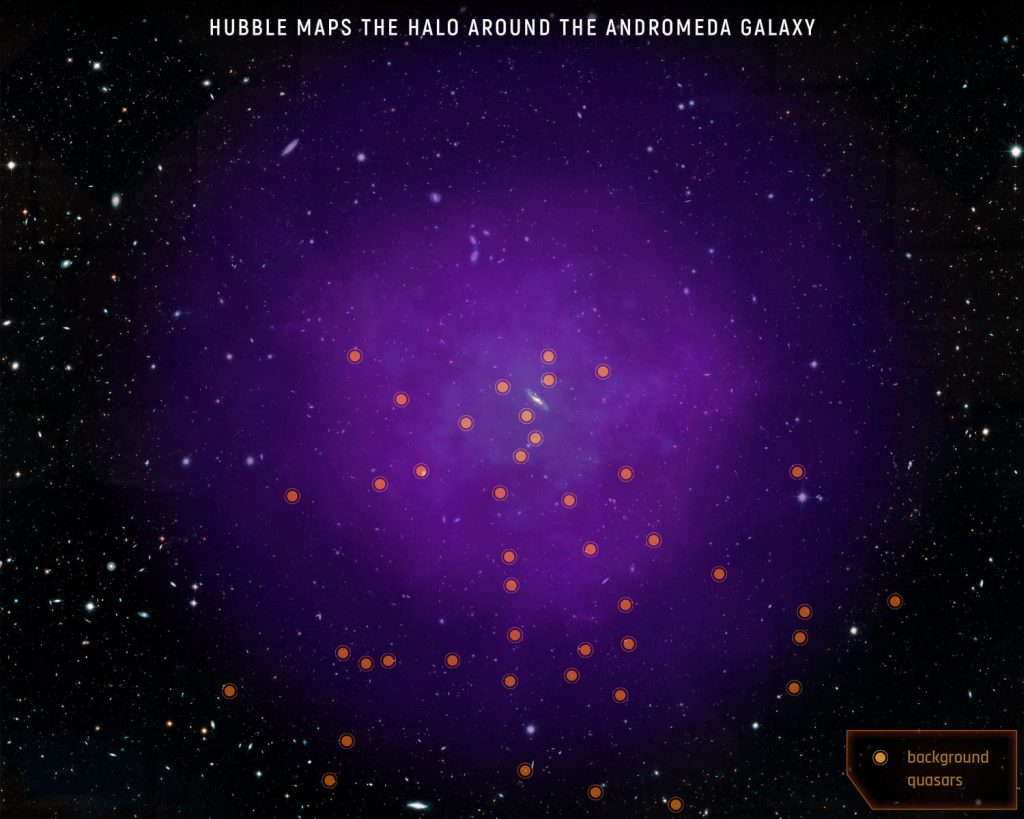 Visualization of Andromeda's halo. The data is based on a study of the passage of light from quasars (yellow dots) located behind the galaxy. Image: NASA, ESA, and E. Wheatley (STScI)
-3-
How many stars are in the halo?
A stellar halo unites a population of stars andglobular clusters surrounding the galactic disk. Similar structures are found around most known spiral galaxies and some elliptical ones. The shape of the halo resembles an ellipse surrounding the stellar disk.
Despite its huge size, it includes only about 1% of the total volume of stars, and therefore it glows much less than the galactic disk and is imperceptible during observations in the optical range.
Astrophysical modeling of galaxiespredicts that stellar halos should have two components. The inner region is dominated by stars and globular clusters formed in the galaxy itself, while the outer region is dominated by mergers with other systems. Scientists believe that the halo is formed mainly by old stars, and star formation in it is actually stopped.
-four-
Why does the galaxy need a crown?
The galactic corona is a tenuous cloudmolecular gas extending far from the galactic center. Researchers believe that coronae are remnants of the primordial cloud of gas that collapsed to form the galaxy.
Although rarefied gas is invisible, it can bedetected using microwave radiation corresponding to ionized hydrogen. The neutral hydrogen line or 21 cm line is microwave radiation with a wavelength of 21.1 cm, which corresponds to the quanta emitted when the energy state of neutral hydrogen atoms changes.
Researchers believe that the galactic corona is the galaxy's first line of "defense." It prevents the leakage of internal gas, which serves for star formation.
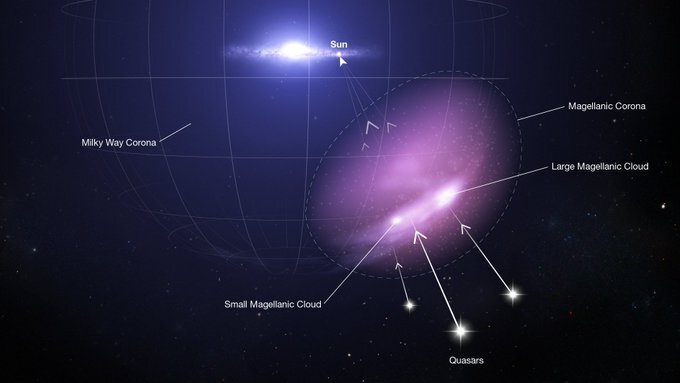 The crown of the Large and Small Magellanic Clouds, protecting them from the effects of the Milky Way. Image: STSCI, Leah Hustak
-5-
dark matter halo
The third element of the galactic halo is the halodark matter. Although the fact of the existence of dark matter has not yet been confirmed, this theory best describes the observations. Dark matter does not interact with electromagnetic radiation, nor does it emit or absorb light at any wavelength, so it cannot be seen. However, it has a gravitational effect on surrounding objects.
According to the existing theory, dark matterextends throughout the galaxy and surrounds its visible components. At the same time, its mass significantly exceeds the mass of all other objects in the galaxy combined. The dark matter halo has not been visualized and is used as a theoretical component that explains the gravitational influences that determine the movements of bodies within the galaxy.
-6-
What have scientists learned?
New study reveals true formstellar halo of the Milky Way. For a long time, researchers believed that it should be an almost regular sphere. It turned out that this is not so: the scattered stellar cloud has an oblong shape and is tilted at an angle to the galactic disk. Outwardly, it resembles an inclined American football ball.
In addition, the researchers believe that the unusual structure also indicates the presence and oblique position of the dark matter halo of the Milky Way.
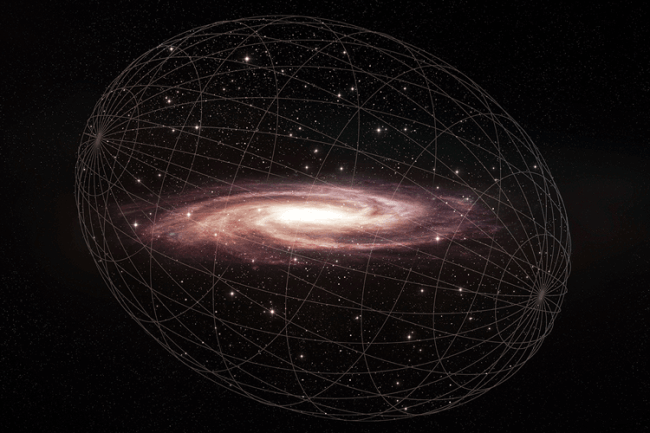 Model of the Milky Way halo. Image: Melissa Weiss/Center for Astrophysics | Harvard & Smithsonian
-7-
How was the study done?
For the analysis, scientists used two sets of data.observations of the stars that make up the halo. The first of them was obtained as a result of the work of the satellite of the European Space Academy GAIA. This is a space telescope that was launched in 2013 and takes a complete view of the night sky to make the most detailed map of objects in the Milky Way and nearby space.
The second set of data is the resultresearch H3 (Hectochelle in the Halo in high resolution). This is data from ground-based observations of halo stars that were made using telescopes at the Fred Lawrence Whipple Observatory in Arizona. H3 has collected detailed observations of tens of thousands of halo stars too far away for Gaia to appreciate.
The researchers combined data from two observations to estimate the shape of the stellar halo.
-eight-
Why is it important?
The properties of the stellar halo "store" historygalaxy formation. In particular, the oblique elliptical shape of the Milky Way halo, obtained as a result of observations, confirms one of the theories of its formation.
Researchers believe that the halo of the Milky Way -the result of a collision with a dwarf galaxy 7 to 10 billion years ago. As a result of this galactic collision, the dwarf galaxy was torn apart, and its constituent stars scattered into a halo. Such an origin story explains the difference between the "population" of the halo and the stars of the disk of the Milky Way.
In this case, the triaxial ellipsoid reflects observationstwo groups of stars in a stellar halo. The clusters formed when the dwarf galaxy passed two orbits of the Milky Way. As it moves, it would slow down twice at so-called apocenters, the furthest points in a dwarf galaxy's orbit, scientists say. These pauses led to additional ejection of stars and the formation of concentrated regions. The tilt of the stellar halo indicates that the dwarf galaxy collided with the Milky Way at an angle.
-9-
What's next?
The fact that the slanted shape was preserved afterSuch a large amount of time serves as an additional sign of the existence of dark matter, scientists believe. It is the halo of dark matter that keeps stars from shifting towards the classical shape, resembling a spheroid.
The researchers believe that further analysisstellar halo will help to understand in which areas of the galactic halo of the Milky Way the concentration of dark matter is highest and to concentrate research using dark matter particle detectors in these directions.
Read more:
Cows were fed hemp and checked what happened to their milk
Named the main danger of the lunar mission "Artemis"
Created a navigation system that is more accurate than GPS