Researchers from the Massachusetts Institute of Technology have proven that a new type of computer can be
The screens of most modern computersmanufactured using liquid crystal displays (LCDs). Such displays are made by growing crystals in a flat plane. They consist of rod-shaped molecules that line up in parallel (the rest are removed). The orientation of the molecules in LCDs is of course not always perfectly aligned, but they are close enough to provide a clear image.
Now scientists have suggested thattake advantage of these small inconsistencies to create a new way of storing and processing computer data. Such a computer can encode a unique value for each offset type to store a bit of data. As a result, a computer using this approach will not be limited to ordinary binary bits. It will have many options, which will probably make it much faster than the machines used today. This will depend on how quickly the orientation of the molecules can be changed.
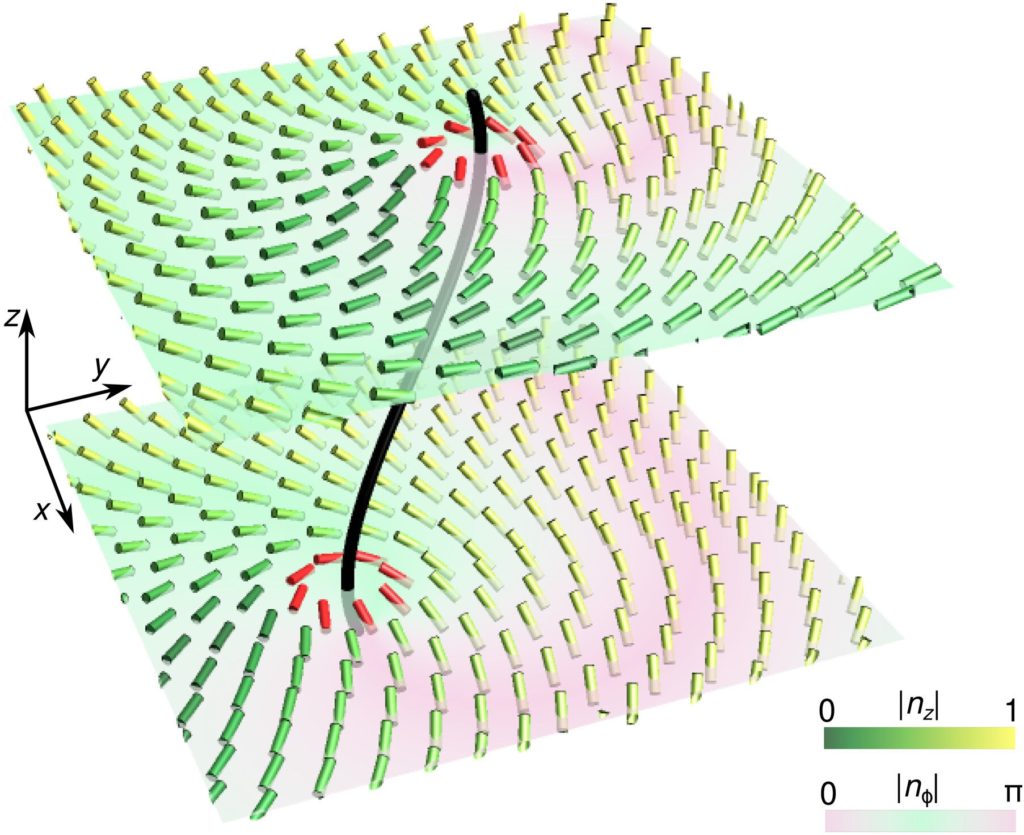 N-bits attached to the LCD defect line.The local field, indicated by cylindrical stripes, rotates along closed curves that envelop the defect line. Credit: Science Advances (2022). DOI: 10.1126/sciadv.abp83711
Scientists noted that the orientations of molecules cancontrol with an electric field. In this case, it will be possible to perform calculations as with standard logic gates. The calculations will look like ripples moving through the crystal.
To see if their approach would work,researchers first developed theories describing how such calculations would occur. They then created simulations based on their theories and found that their ideas turned out to be correct. The scientists believe their approach is ready for testing if the engineering team is interested in the project.
Read more:
Scientists have found a black hole that is 50 times larger than galaxies
Physicists have shown that water turns into two liquids at low temperatures
Russia has invented an alloy that can withstand the energy of a thermonuclear reactor