Engineers at the Massachusetts Institute of Technology have developed a method for creating "ideal" two-dimensional
To create semiconductors, researchersusing the vapor deposition method. During this process, the atoms settle on the silicon wafer and turn into 2D structures. This is a common way to grow crystals and produce thin semiconductors. Its drawback is that under normal conditions, each "core" of the crystal grows in random directions.
Engineers have found a way to overcome this limitation.To do this, the silicon wafer was covered with a special “mask”: the researchers formed tiny pockets of silicon dioxide, each of which is designed to capture the embryo of the future crystal. They then passed gas from the atoms, which settled in each pocket, forming a single-crystal two-dimensional material. The authors call such a crystal ideal, since its monolithic structure does not contain obstacles that restrict the movement of electrons.
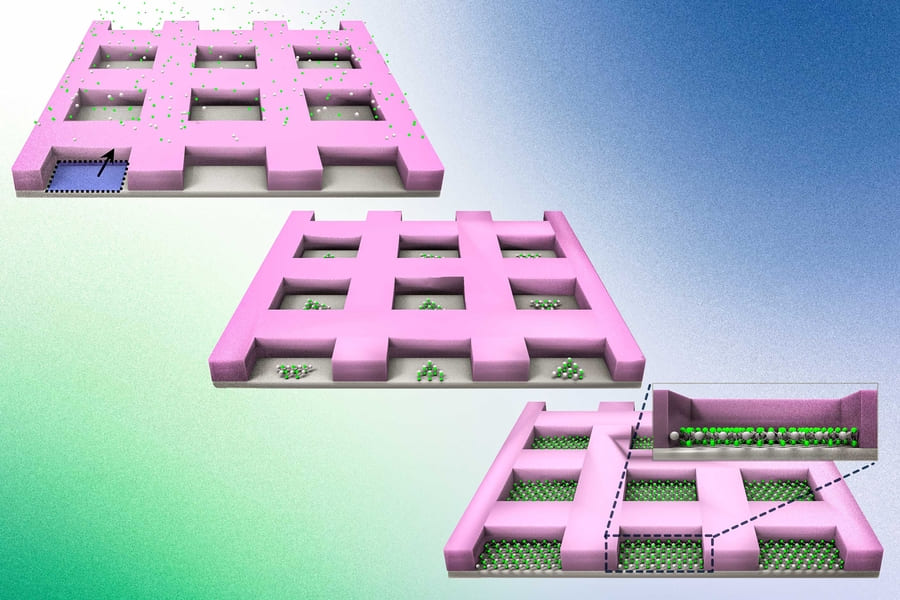 A two-dimensional silica mask creates "pockets" for the growth of individual monolithic crystals. Image: MIT News
With this method, engineers have developedmultilayer semiconductor device. After covering the silicon wafer with a patterned mask, they first grew one type of 2D material to fill half of each square, and then grew a second type on top to fill the rest of the square. As a result, a two-layer ultrathin film was formed on each section of the silicon wafer.
Transistors are the main element of moderncomputers are currently being formed on silicon crystals. According to Moore's Law, since the 1960s, the number of transistors on a microchip has doubled every year. The limitation is that this growth cannot be infinite, since silicon loses its semiconductor properties at the nanoscale.
Researchers believe that the use2D single-crystal structures from various materials will help overcome this limitation and develop next-generation high-performance electronic devices based on 2D semiconductors.
Read more:
A giant sunspot is turning towards the Earth. It is visible to the naked eye
Scientists have figured out how to restore the heart after an attack
TESS discovered a "new Earth": a stone planet with water is in the habitable zone