The FX-322 drug candidate, developed by Frequency Therapeutics, is designed to treat the underlying cause of hearing loss —
Progenitor cells are intermediatestep between stem and differentiated cells. Such cells can produce only one type of cell, but are capable of multiple self-reproduction.
</ p>Already in the first clinical study, the companyconfirmed a statistically significant improvement in speech perception in a number of participants after a single injection. The effect of the drug in some of them was observed for almost two years. To date, the company has dosed more than 200 patients. Three independent clinical trials have shown a significant improvement in speech perception, according to MIT representatives.
“Some of the participants could not hear infor 30 years. They said that for the first time they could go to a crowded restaurant and still hear their children, says Robert Langer, an MIT professor and co-founder of the company. “It's very important to them. Obviously more needs to be done, but even the fact that you can help a small group of people really impresses me.”
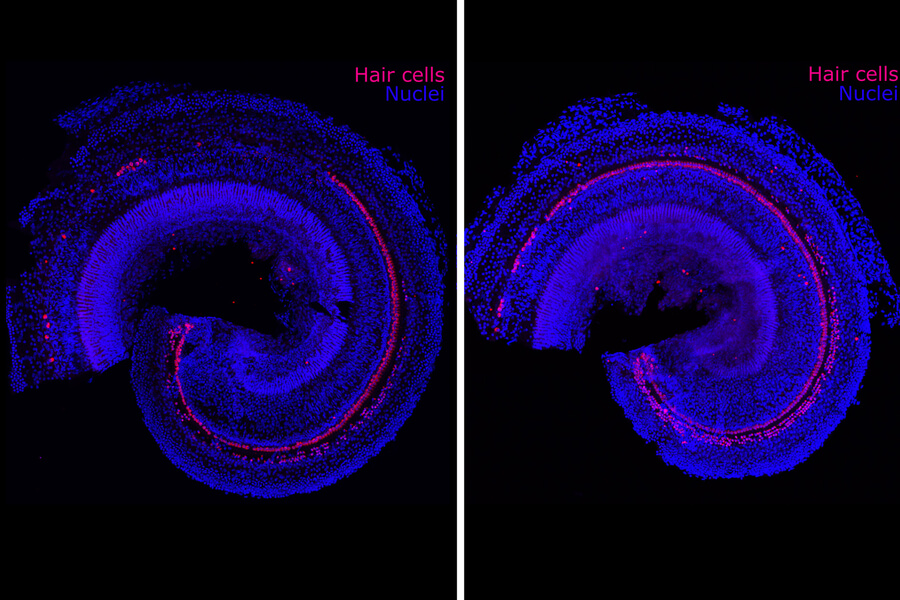 Hair cell regeneration (highlighted in pink). Pictures before and after drug administration. Image: Hinton AS, Yang-Hood A, Schrader AD, Loose C, Ohlemiller KK, McLean WJ, MIT
Human inner ear (cochlea) filledliquid. Sound waves cause vibrations that are picked up by the hair cells. At one end of these cells are microvilli (stereocilia) that float in fluid and are sensitive to movement. Vibrations of stereocilia lead to the formation of electrical signals by the cells, which pass along the nerve to the brain.
Hair cells die off when exposed to loud noisessounds, as a result of aging, or under the influence of medications, such as certain types of chemotherapy and antibiotics. Cell loss leads to the development of sensorineural hearing loss, the most common cause of hearing loss. Since the human ear does not regenerate hair cells, hearing loss in this case is irreversible.
According to the UN, more than 5% of the world's population, or about430 million people are in need of rehabilitation to solve the problem of "disabling" hearing loss. The organization's projections show that by 2050, 2.5 billion people will have hearing problems, including at least 700 million of them who will need treatment.
</ p>The founders of Frequency Therapeutics believe that their proposed approach to treatment, chemical attack on progenitor cells, can be applied to regenerative therapies in other areas.
Tissues throughout the body contain progenitor cells, so we see a huge range of applications. We believe this is the future of regenerative medicine
Chris Luz, Chief Scientist and Co-Founder of Frequency Therapeutics
Read more:
Scientists have named the first sign by which to look for extraterrestrial life
Potentially dangerous asteroid will approach Earth on April Fools' Day
Genetics Beat Cat Allergies With CRISPR