Researchers at MIT have developed a tiny device that
Key problem with wireless transmittersis that they must be comparable in size to the length of the electromagnetic wave they transmit and receive. These wavelengths are very large - they are the speed of light divided by the frequency of the wave. Therefore, most devices require large antennas.
In this case, if you increase the transmission frequency to reduce the wavelength, you get a very invasive transmitter. This is due to the fact that high frequencies emit heat that damages living tissues.
The researchers found a way out of this impasse:they created a device that converts electromagnetic waves into acoustic waves. These waves with the same frequency have five orders of magnitude less length than electromagnetic waves. This is due to the difference in the speeds of light and sound. Therefore, a small device can transmit waves with the desired wavelength.
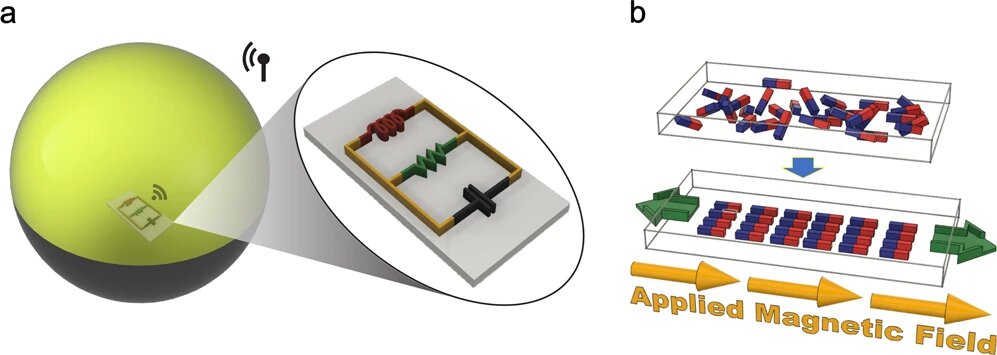 Schematic diagram showinga cell rover working wirelessly from a cage (left), and a diagram (right) illustrating the principle of magnetostriction. Randomly oriented magnetic domains align in the direction of the applied magnetic field, which in turn causes deformation of the material. Image: Baju Joy et al., Nature Communications
Engineers have developed miniature antennas frommagnetostrictive materials. When a magnetic field is applied to them, the particles in such a material align with its direction, creating a stress in the material. This can be compared to how a cloth woven into metal pieces deforms under the influence of a magnet.
When a variable is applied to the antennathe magnetic field, strain and stress (pressure) generated in the material create acoustic waves in the antenna, the scientists explain. Such a device, embedded inside the cell, can be used to study microbiology and organize a "live broadcast" of the processes that occur there.
Read more:
It became known which tea destroys protein in the brain
Planetologists have found signs of life on Saturn's moon
Look at the first photos of Mars that Webb took: they are literally dazzling