Based on previous research, MIT researchers
The panel can be placed above the item (or nearit) which needs to be cooled. For example, boxes containing perishable goods such as food or medicine. According to MIT, the technology will allow food to be safely stored for about 40% longer in very humid conditions or triple the safe storage time in drier conditions. It can also be used to cool water used in air conditioners. This way they consume less energy while remaining just as efficient.
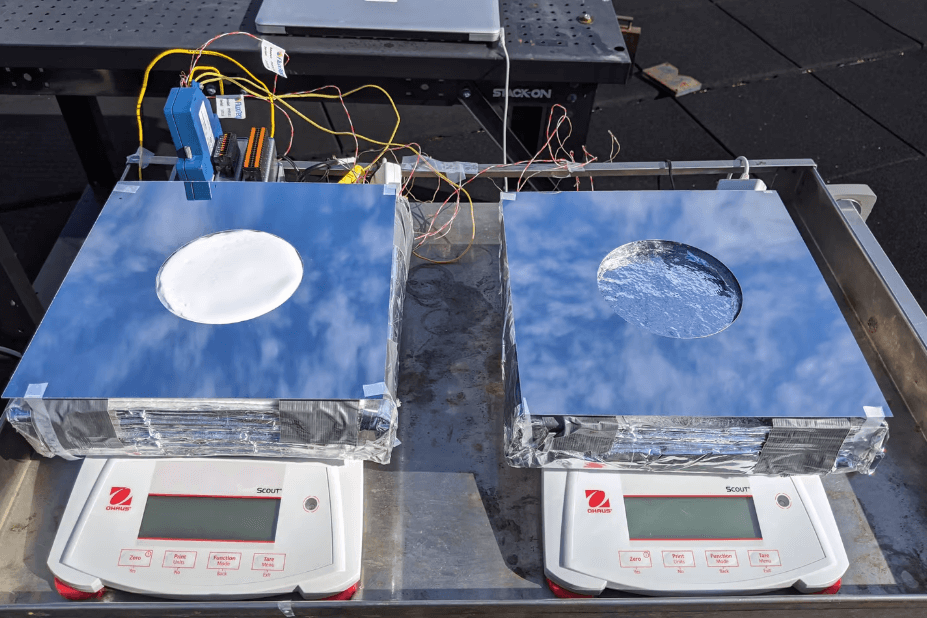 102mm square version of the device (left)being tested on the roof of the Massachusetts Institute of Technology. On the right is a device using only evaporative cooling for comparative testing.
Photo: Zhengmao Lu
The bottom layer of the system is a mirror material,reflecting falling sunlight. This prevents the infrared radiation from the sun's rays from heating the coated item. In the middle there is a porous hydrogel, it consists mainly of water. When liquid water is heated, it evaporates into steam, which rises to the top layer.
The top layer is a special type of airgel thatconsists of air pockets in polyethylene cavities. Both water vapor and reflected infrared rays pass through the airgel, providing evaporative and radiative cooling, respectively.
However, the airgel acts as an insulating layer, preventing ambient heat from reaching, for example, a grocery box. Like the bottom layer, it reflects the sun's rays well.
In some of the hottest countries in the world, whereWhile cooling systems are most needed, the infrastructure required to power such installations is often lacking. The new system will help them as it provides some cooling effects but no electricity.
The problem is that while its production costsexpensive. In the future, engineers will focus on methods to reduce the cost of airgel production. Other materials that are used in the system are readily available and relatively inexpensive, the authors of the development conclude.
Read more:
Mysterious 'blue goo' at the bottom of the sea baffles scientists
Developed generator for wind farms without expensive magnets
Look at a phenomenon that is simply impossible on Mars