Traditionally, to predict the behavior of a breaking wave, scientists use one of two methods: either
In his new work, published in the journalNature Communications, scientists at MIT used both methods and machine learning to effectively predict the behavior of breaking waves. The researchers found that the new model is better at predicting how and when the waves break. For example, AI estimated the steepness of a wave immediately before breaking, as well as its energy and frequency after breaking, more accurately than conventional wave equations.
The researchers collected data on the movement of waves duringtime of experiments in a 40-meter tank. At one end of the tank, the authors of the work installed an oar, the movement of which led to the appearance of a wave in the middle of the tank. Sensors along the entire length of the pool measured the height of the water as the wave propagated.
Conducting such experiments takes a lot of time.time. Between each experiment, you must wait until the water is completely calm before starting the next experiment, otherwise they will affect each other.
Debbie Iltink, study co-author
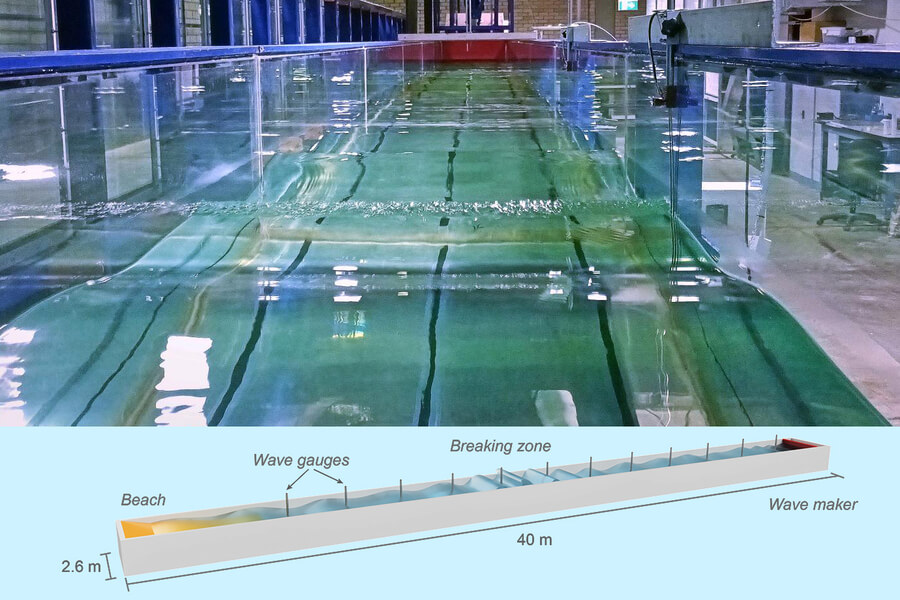 Image: MIT
Scientists conducted about 250 experiments andused the measurement data to train the neural network. For example, the algorithm has learned to compare real waves in experiments with waves predicted in a simple model, and based on the differences between them, tune the model so that it matches reality.
After training the algorithm on experimentalThese researchers tested the performance of the neural network on the data of two independent experiments, each of which is carried out in separate wave tanks with different sizes. Tests have shown that the neural network gives more accurate predictions than the results obtained using wave equations.
As the authors of the work note, AI also caughtan important property of breaking waves, known as "downshift", in which the frequency of the wave is shifted to a lower value. According to the researchers, this is a very important factor, because as the frequency decreases, the wave accelerates. The neural network predicts the frequency change before and after each breaking wave, which can be especially important when preparing for coastal storms.
“If you want to predict when highthe waves will reach the harbor and leave it before these waves arrive, then if you get the wave frequency wrong, then the calculated wave approach speed will be wrong,” Yltink adds.
The researchers presented their model in the formopen source software that is available to all users. The authors believe that it can be useful, for example, in climate modeling of the ocean's ability to absorb carbon dioxide and other atmospheric gases, as well as for modeling the testing of offshore platforms and coastal facilities.
Read more:
It has been hunted for centuries: what do we know about the planet Vulcan next to the Sun
Physicists have experimentally confirmed a new fundamental law for liquids
Astronomers have found a planet near the Earth: it has a very strange orbit