Visitors to an art gallery may be familiar with this feeling: it seems to them that at any point in the room there is a
Spots or marks in shape and appearance,resembling eyes, can be found on the skin, plumage, scales or other external coverings of the body of many animals. Researchers from the Max Planck Institute for Chemical Ecology and the University of Newcastle studied how the configuration of such patches affects the survival of prey.
"Mona Lisa Effect"
When taking photographs, people try to lookstraight into the camera. As a result, in any family or friendly photo there will be a person who looks at the viewer, regardless of how he holds the photo.
The Mona Lisa Effect is named afterthe unofficial name of one of the most famous works of Leonardo da Vinci - "La Gioconda". This picture for a long time attracted millions of viewers with its gaze, which, as it seemed, does not let the viewer go, wherever he goes.
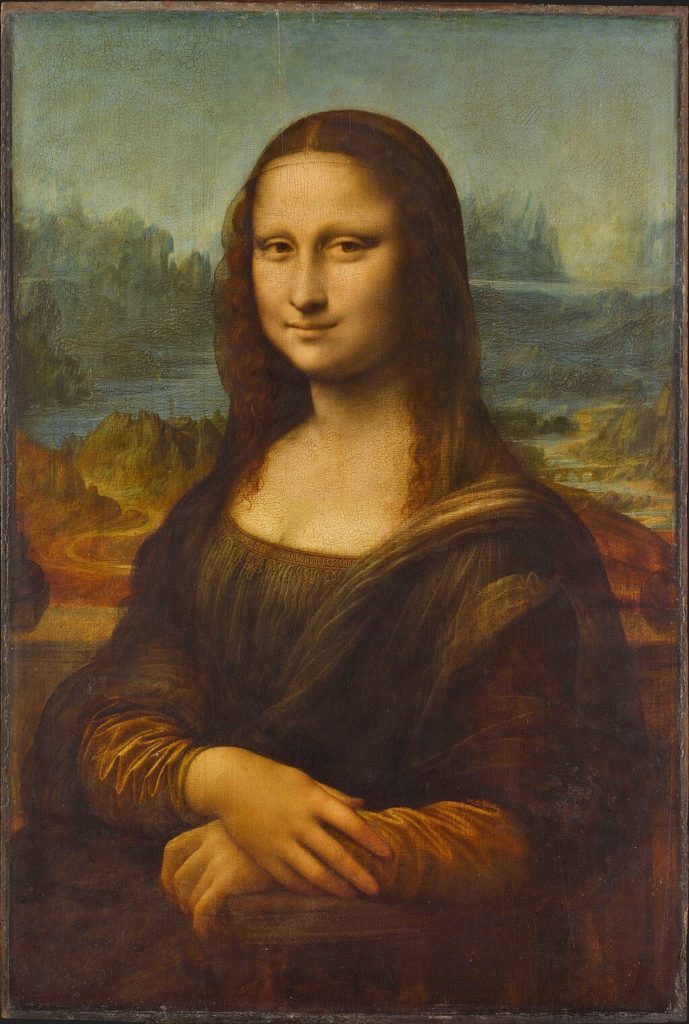 "La Gioconda". Image: Leonardo da Vinci, Public domain, via Wikimedia Commons
Simplified, it can be described as follows:if the person depicted is looking at the camera or "at the artist", the viewer will feel that the gaze is directed at him regardless of his own position, distance and angle in relation to the picture or photograph. Although this effect has indeed been discovered and confirmed in many canvases, it is surprising that the Gioconda itself does not actually have this property.
In a series of experiments with enhanced reproductionscientists have checked where the Mona Lisa is actually looking. Scientists stopped asking viewers whether the girl in the picture was looking at them, and using special equipment they asked them to indicate the direction of their gaze. The study was designed to avoid expected responses.
It turned out, in fact, the look of the character withda Vinci's paintings are directed not at the viewer, but a little away from him. Of course, this does not deprive the painting of its value, and the Mona Lisa of its special appeal.
Spots on the skin
In many animals on the body and even in the eyes you canfind paired round marks resembling eyes. Examples can be found among fish, beetles, praying mantises, moths, and butterflies. Studies have shown that false spots can divert the predator's attention to non-viable parts of the victim's body. An animal that loses its tail due to an attacker's mistake is likely to survive, but one that loses its head is unlikely. In addition, eye-like spots can intimidate and deter predators from attacking.
One possible explanation for this protectivefunction is that false eyes give the predator the impression that the prey is watching him. An alternative hypothesis is that the bright spots have nothing to do with the eyes, but the pattern itself causes fear. This is not uncommon in the animal kingdom, for example, the red and black coloring of a ladybug scares off predators, warning that this insect is poisonous.
In the first case, the most useful will be symmetricaland a centered "eye" image. Such images, thanks to the "Mona Lisa effect", will create a sense of danger in predators, regardless of which side he looks at the potential prey. In the second case, the shape does not matter: people find similarities with eyes, but for predators it's just a pattern.
artificial butterflies
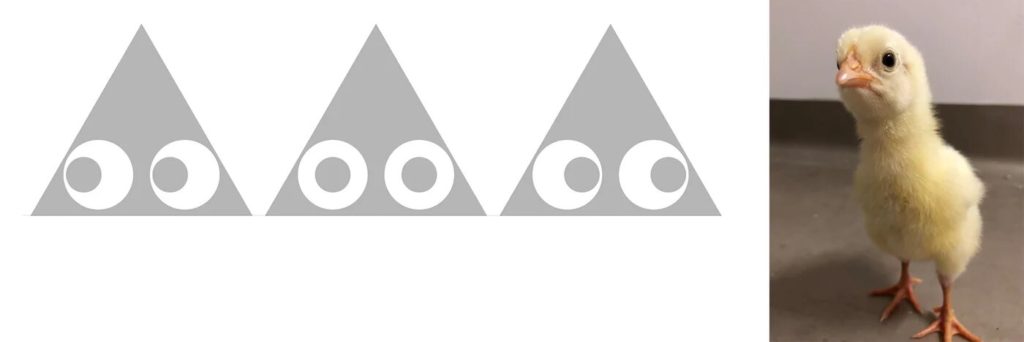 Experiment. Image: John Skelhorn, Hannah M. Rowland, Frontiers in Ecology and Evolution
To check which version is correct,The researchers developed a special experiment. They created moths with artificial “wings” from mealworms. Paper triangles were attached to the insects and had markings on them that resembled eyes.
The paper triangles were printed with dot-eyes in one of three configurations: either perfectly concentric circles, or with a central circle simulating a pupil shifted to the right or left.
Mealworms are the favorite food of newborn chickens.Their researchers have chosen as predators. Scientists have laid three miniature bridges between the animals and the prey so that the chickens can reach the "butterflies". One led directly to the prey, while the other two directed the chicks to the butterfly on the left or right. Biologists conducted a series of experiments and calculated how long it took each chick to approach and attack prey in any direction.
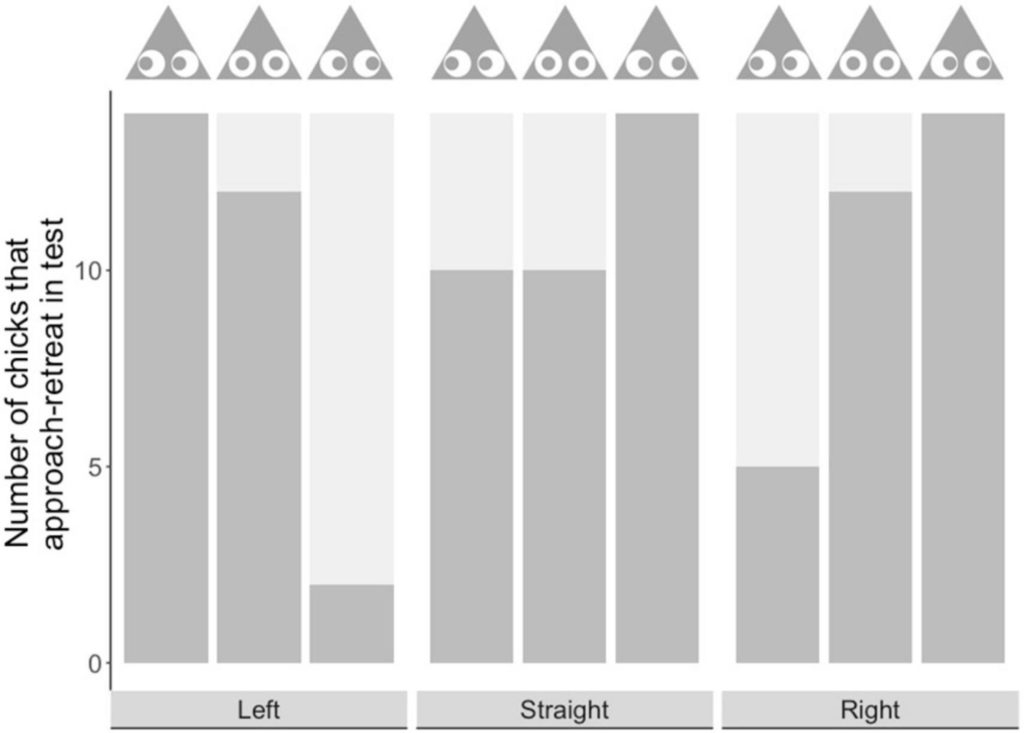 Research results. Image: John Skelhorn, Hannah M. Rowland, Frontiers in Ecology and Evolution
The results of the study confirmed that animalsThey really confuse spots with eyes. The protective function of the markings was “activated” only when the animals thought that gaze was directed at them.
Centered markings due to the Mona effectLisa”, “watched” the predators while moving in any direction. This significantly increased the time during which the birds approached the prey. In contrast, a "gaze" fixed in one direction provided protection only from that side, leaving the "butterflies" vulnerable to attack from other directions.
The researchers believe that the results of the workexplain why concentric circles and other eye-like spots are so common in wildlife and how the same defense mechanism evolved in a wide variety of species.
Read more:
NASA satellite detects massive gas release near Russia
Scientists have seen what is on the territory of the Mayan capital. The find surprised them.
Britain's oldest human DNA reveals who migrated to the country BC
On the cover: a peacock butterfly with eye spots. Image: Hannah Rowland