Anthropologists from the University of Michiganstudied fossil monkeys Morotopithecus (Morotopithecus), who lived about 21 million years ago in Africa. Researchers believe that early great apes fed on leaves and lived in wooded areas with open grassy areas. These conditions led to the development of bipedal walking.
Scientists studied fossils found in onestratigraphic layer with the remains of Morotopithecus. Samples studied included fossils of other mammals, ancient soils, and tiny silica particles from plants (phytoliths). The researchers used this evidence to recreate the ancient environment that these monkeys lived in.
Scientists have found that plants living in thislandscape, experience "water stress", that is, they experience seasonal periods of rain and drought. This means that for at least part of the year the monkeys had to rely on something other than fruit to survive. Together, these finds indicate that Morotopithecus lived in open forest, in which areas covered with trees were punctuated by large open spaces. It was previously believed that such forests formed much later: about 10 million years ago.
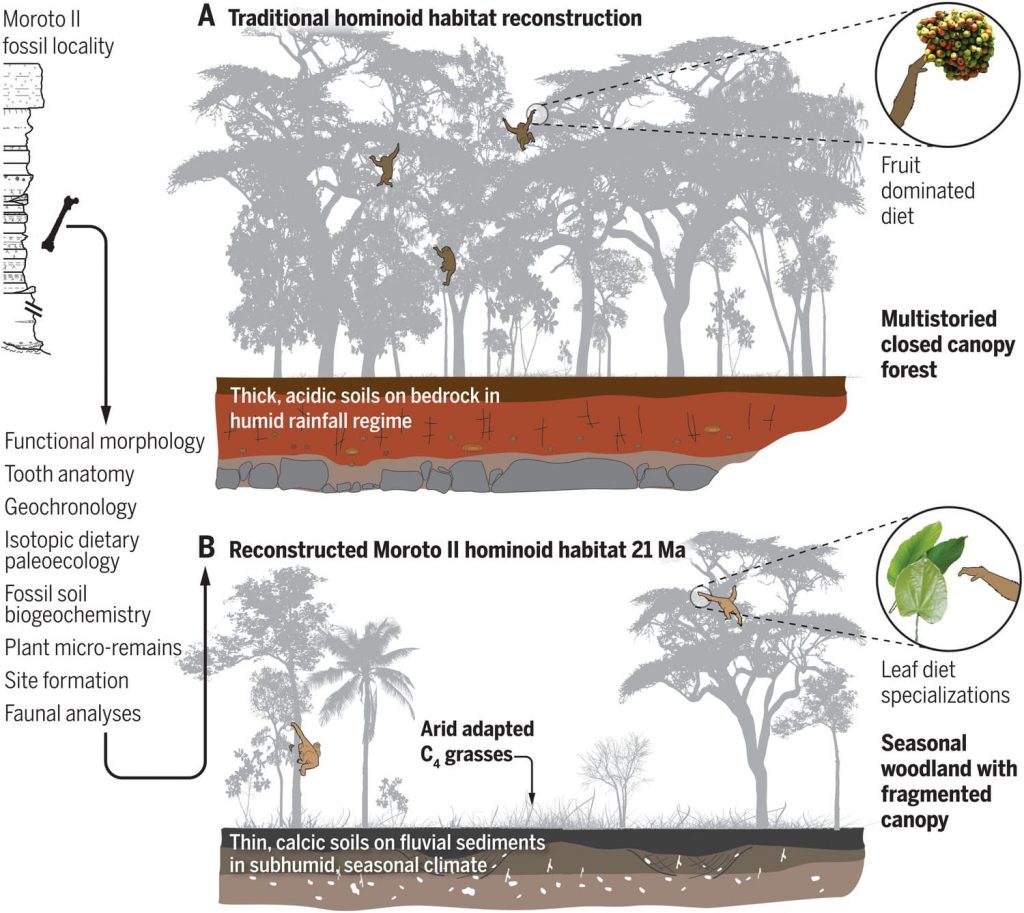 Traditional (top) and refined (bottom) ideas about the habitat of ancient monkeys. Image: Laura M. MacLatchy et al., Science
Anthropologists have also found traces of feeding on leaves.when studying the teeth of ancient monkeys. The molars of these animals were very "crested": rocky, with peaks and hollows. Such teeth are usually used for tearing fibrous leaves, while molars intended for eating fruits are usually more rounded.
Researchers studied the tooth enamel of monkeys, andalso the tooth enamel of other mammals found in the same stratigraphic layer. They found that isotope ratios—the abundance of two isotopes of the same element—in their tooth enamel showed that the monkeys and other mammals ate water-stressed plants that are more common today in open or grassy forests.
Connecting movement, diet and environment,we have, in fact, discovered a new model for the origin of monkeys. In anthropology, we are very concerned about the evolution of apes because humans are closely related to apes, and features such as lower back stability represent an arboreal adaptation that may have eventually led to bipedal humans.
Laura McLatchy, study co-author
Researchers believe that the seasonal forest environmentcould have exerted a previously unnoticed selective pressure on the evolution of tree monkeys and contributed to the transition to the use of only the hind legs in the process of movement. For example, some monkeys may have needed to gain access to leaves in a higher canopy during times of low fruit availability, as well as being able to climb and descend from trees that did not have a solid canopy.
Read more:
"Sea" of quarks inside one proton: what does an elementary particle consist of
Look at the highest resolution map of Mars: 110,000 frames and 5.7 trillion pixels
Scientists have studied an ultra-bright object that violates the law of physics
On the cover: artistic reconstruction of the habitat of ancient monkeys. Image: Corbin Rainbolt, University of Michigan