Researchers at Purdue University and Tennessee University in Knoxville have developed a metamaterial that uses
Unlike humans and other living beings,Autonomous vehicles have no way to filter out information they don't need, the scientists explain. Because of this, the sensors are forced to process a large amount of data, which slows down the reaction rate in times of danger.
Domed surfaces that "feel"their surroundings, help the drone's wings respond to only the most essential sensory information. Since a certain minimum force is required to push the "dome" inward, forces below this threshold will automatically be filtered out.
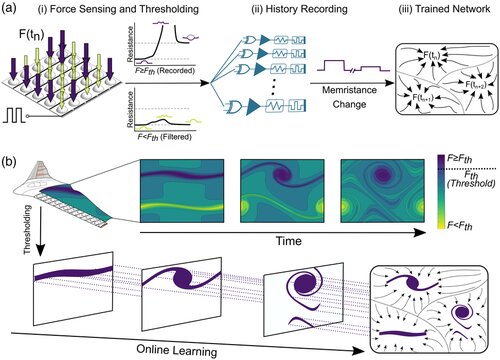 The principle of the technology. Image: Katherine S. Riley et al., Advanced Intelligent Systems
For example, a certain combination of domes,rising and falling in certain parts of the wing can indicate to the aircraft control system that the wing is under dangerous pressure. Other forms of sensors can diagnose dangerous temperatures or the approach of a foreign object.
When a certain level of power overturnsdome, sensors embedded in the flat portion of the surrounding metamaterial detect the change. The electrical signal then triggers a memory device called a memristor to record the force and where the impact was made.
The emerging patterns allow the metamaterial to “remember” the impacts and develop a behavior pattern in case a similar situation repeats. Such a strategy resembles the principles of animal and human learning.
Read more:
NASA satellite detects massive gas release near Russia
Scientists have seen what is on the territory of the Mayan capital. The find surprised them.
It turned out what happens to the cells of the body when the heart dies
Cover image: Purdue University, Jared Pike